


When the sick rule the world, mortality will be sexy. When the sick rule the world, all writing will be short and succinct, no paragraphs will be longer than two sentences so we can comprehend them through the brain fog the well bring to us daily.
Dodie Bellamy, When the Sick Rule the World, 36.
In Sofi’s last day at the spa-clinic, in really what are Sofi’s last few minutes at the spa-clinic before she needs to call her Uber so that she can get to the airport at least one hour and thirty minutes early, she laments how pain is “not like anything.” And, if it is not like anything, she says, then it is “so fucking boring.”
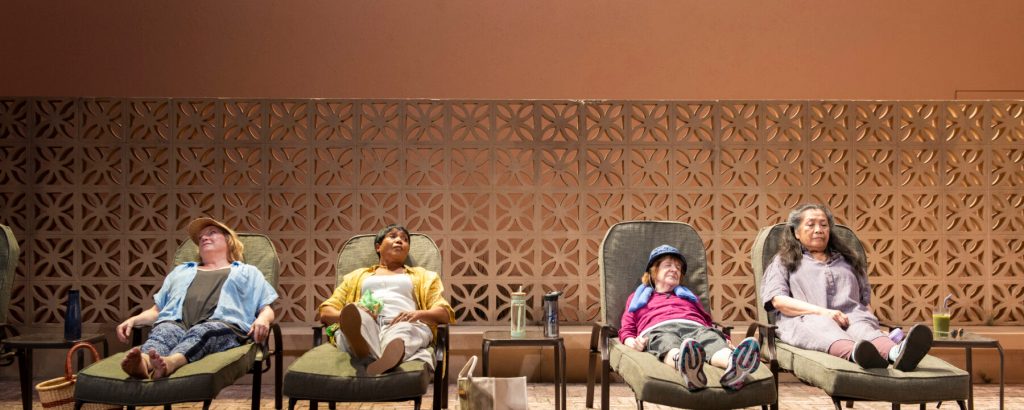
For the audience of Annie Baker’s “Infinite Life” (now playing in New York), this line would seem maybe like what we’ve been watching. For most of the hour and forty-five-minute run, we watch people we know are in pain while watching them not do much. Sofi (Christina Kirk) is one of five women (Eileen, Elaine, Ginnie, and Yvette) at various stages of fasting as prescribed by an unseen doctor. The fasting causes pain, hunger pangs, nausea, and woozy sleepiness, but so do the illnesses, sometimes narrated with terrible specificity and other times alluded to vaguely in conversation, that they are fasting to treat. Both are indistinguishable in terms of what we watch them do—sit on lawn chairs, sip water or green juice, and read (or mostly don’t read) their books. As critics who have reviewed the play have noted, we are kept in a limbo space, part purgatory, part Eden. To be patient and to be a patient is a thin line between to wait and to suffer. But how to show or speak of the patient’s boredom? How to show and speak of a boredom defined, as Sofi defines it, as the absence of language for something?
When they talk about their pain, they have two available vocabularies: of precise medicine and of vague likeness. It is like razorblades. Or it’s like a blowtorch. Or it’s like burning. Or it’s like hell. Or it’s like “tick tock tock.” Or, as one character says, “a minute of this is an infinity.” These statements come out more often at night, when the lights turn down and characters are lightly illuminated or illuminated only by a cellphone light. Sofi screams into her husband’s voicemail that she’s trying to tell him what her pain is like. But both the characters and the play are reluctant to dwell here more than for a flash in the night—expression is a shameful voicemail rather than the bulk of interactions.
Early on, the play pauses entirely so that one of the women, Eileen (Marylouise Burke), addresses Sofi to narrate when she most clearly and dramatically expressed her pain: she says, “This is the night you heard me screaming.” In control, Eileen narrates what she yelled at the other women: that they could not understand what her pain was like and that she could tell by how they held themselves and held their bodies. It is Eileen who says that her pain makes a minute an infinity—we learn that from her condensed, sparse summary of what is implied to be a much longer breakdown. As Eileen says, her pain and her screaming should not be replicated. There should be no effort to simulate the pain in metaphor or in dramatizing Eileen’s breakdown. In these scenes, the play feels directly responsive to Susan Sontag’s 1978 plea to resist metaphoric thinking as “the healthiest way of being ill” (3). But is resisting metaphoric thinking, as Sofi suggests, just rendering their pain boring?
In resisting metaphors, the characters use the equally unsatisfying, obtuse language of their doctors. The language of medicine—of chemicals, of precise body parts—is where even the characters acknowledge their boredom. Mia Katigbak’s Yvette has “a whole story”—as the sardonic Ginnie (Kristen Nielsen) says—that comes as a litany of diagnoses and attempted medical cures of which having her bladder removed and replaced by a bag is only the rising action that culminates in a tumor that she had managed to shrink by fasting. She is the savviest with medical terminology, listing as a litany and playing with the ready-made couplets of different “-zols” she has been on. Perhaps because of her savviness, she is proud of her story, imagining it as a worthy inspiration for the other women and a testament to the facility they all share. They should put me on the website; why am I not on the website, she complains.
But we also don’t really get Yvette’s story, in all its medical detail, in full. The play is also resistant to the boring language as much as to the screaming metaphoric one. After Yvette begins, Sofi interrupts to address the audience with “twenty minutes later,” moving us forward in Yvette’s monologue, skipping by some of the “and thens” and skipping over the Latin names to the juicer cancer bits. Like the spa itself and its mysterious doctor, the playwright also refuses to put Yvette and her story on the website. This move structures and moves along the play so that we can cover the “maybe nine, ten days,” that Sofi spends at the spa. For each, Sofi addresses to the audience that time has passed—ten minutes, an hour, seven hours, twenty-five hours, and so on—and we skip over the dead time, the quiet time, the not-reading. Sofi becomes part father-time and part stage-manager.
So loudly skipping over the dead time reveals a hesitancy, a self-consciousness about adopting a literary form that could be as boring as what these women are going through. We never watch them for that long. The play seems equally hesitant to mimic structurally what the boredom of their pain is “like” just as it was hesitant to make us listen to Eileen’s screams. Baker’s 2014 “The Flick” has the distinction of winning a Pulitzer Prize and being a show that audience members walked out on during intermission. The scandal was merely that it ran for three hours and that those three hours were made up of long periods of silence and long periods of watching actors perform tedious work. Of “The Flick,” the New York Times asserted that it “requires your patience, but it rewards that patience.” For the story of actual patients in “Infinite Life,” the time skips, which always garnered a laugh from the packed audience I was in, seem a joke on Baker’s own signature form: minimalism, silence, an appreciation for time passing, or as one scholar puts it, slow aesthetic experience. Here was a short minimal line that could tell a story for that appreciation without making us have to actually sit there.
The device effectively acknowledges yet ultimately evades the experience of boredom for us despite, or because, the play gives us boredom as an alternative to metaphors for pain. I raise this point only partially as criticism—I did find the time skips too neat, too actually in control of an experience that we are constantly told these women are only pretending to control—but I also raise it because it suggests that boredom is just as hard, if not more so, to represent than illness. A master of tedium doesn’t want to do it. Since Virginia Woolf’s “On Being Ill” in the 1920s, there has been a rich conversation about how illness and chronic pain distort time and how artists of all kinds have formally innovated to capture those experiences. What strikes me here is that the well-covered problems for representing pain and illness collide with a more perplexing problem of representing and talking about women’s boredom. In her comprehensive 1995 historicizing study of boredom, Patricia Meyer Spacks finds at its origins that women “identify boredom as a problem troublesome only to men” and they instead find “systematic verbal constructions of alternatives to boredom” (30). There is a history of writing around women’s boredom. It is not lost on me that this play has a nearly all-women cast and is set in a space of feminized leisure. But it is only nearly so: Sofi leaves sexual voice mails for one man while pleading for her husband to take her back, Elaine recreates conversations with her husband who is a “screamer,” and, at about halfway through, a man (Pete Simpson) shows up. These men serve an important contrast: they are untroubled when representing their illness and they never seem bored.
The women’s pain is gendered; in Sofi’s case, it is bound up in her sexuality and sexed organs. Spacks also notes, boredom “almost always suggests disruptions of desire: the inability to desire or to have desires fulfilled” (x). In a sense, the sexual nature of her pain only seems to cast it as more troublingly boring (one of the only extended sequences without any actions or talking is when the audience watches Sofi masturbate). There is one metaphor that Sofi also holds on to: that her particular pain, which is located in her bladder and in her clitoris, constantly throbbing and then flaring when she urinates or when she orgasms, is a punishment. It is a punishment, sometimes for an “emotional affair” that she conducted over voicemail (desire acted upon). Other times, it is a punishment for not taking the affair far enough, for “not touching” (desire not acted upon). The actual metaphor she sticks with is then something like women’s double-bind; damned if you do, damned if you don’t. At other moments in the play, Sofi’s illness neatly resembles menopause, asking her to confront a difficult “second puberty” as her reproductive organs change, she discovers new sexual desires, and she confronts painful aging and inevitable death. In contrast, gray-haired Nelson walks shirtless in “silk pants” and calls his wife to “give her a heads up” before he acts on their open relationship. He holds his body with confidence: he displays it and lays chest first on the lawn chair, arms dangling on the side like he is in a permanent push-up. We look at him and feel that there is no way that he experiences the same pain as the women we have seen shuffle and ease their tense bodies on and off stage, on and off the lawn chairs. His body language certainty parallels his other certainty: that his illness is a metaphor. In the dark of night, Nelson vapes. He reveals his “unsexy” diagnosis: he had colon cancer and has it again; this fourteen-day fast is merely a waylay point to chemotherapy. Sofi confesses the particular overlap of pain and sexuality in her illness—how she has to weigh the pain of each orgasm—and he insists he has felt pain like she can’t imagine. Before his diagnosis, when his colon was inflamed, he vomited his own waste. The whole time he “was tasting my own shit,” he says, “I kept thinking this is a metaphor.” A metaphor for what, Sofi asks. “For shit in my mouth,” he replies. He insists on the idea of metaphor even if it is not “for” anything but the explicit experience.
They return to this conversation at the end of the play. She propositions him but then hesitates when she realizes her time is, in fact, limited. She would need, as she tells him, “seven hours of your cock in my mouth” and she has a plane to catch. He replies after a long pause, a subtle movement in his face, “that’s too long.” We get another laugh here at a line that evokes the pain of doing one thing for too long without anyone actually doing it. Indeed, that’s the other thesis statement: non-action, non-performance, not showing is the testament to the extent of women’s pain. Nelson also accuses Sofi of not wanting sex (and for her, its twin, pain) badly enough. His logic is that people act on what they want, if they don’t act, they don’t want it; his logic is that feelings are transparent with action. Paralleling his comments earlier, she denies this logic; he can’t imagine how badly she wants. In fact, the more she wants, the less actionable and the less transparent to others it becomes. It is a gendered logic that the more one feels—desire and pain twinned here—the less it can be shown, to the object of desire or to the audience. When boredom and pain are equated, the more boredom women feel, the less it can be shown.
Watching “Infinite Life” now, enjoying it in the theater, I have to think that boredom’s difficulties can be a good thing; it can be good to laugh at boredom rather than fall into its dread. For Sofi to admit that neither language nor boredom are good methods for representing her pain is the beginning of her catharsis.
Additional Works Cited:
Bellamy, Dodie. When the Sick Rule the World. Semiotext(e), 2015.
Sontag, Susan. Illness and Metaphor and AIDS and its Metaphors. Picador, 1989.
Spacks, Patricia Meyer. Boredom: The Literary History of a State of Mind. University of Chicago Press, 1995.
Image source: Production photo of “Infinite Life” from The Atlantic Theater Company. The image shows four women on lawn chairs in front of a perforated wall.