

Distances do not appear the same to those up and those in bed.
––Julia Stephen, Notes from Sick Rooms (1884)
And then these doctors tell you that you will die, or recover! But you don’t recover!
––Alice James, Diary, September 27, 1890
…for I’m amphibious still, in bed & out of it.
––Virginia Woolf, Diary, 14 September, 1925
I
On September 14, 1925, Virginia Woolf notes in her diary that she has received a letter from T.S. Eliot asking her to contribute an essay to his new journal Criterion–– a “letter that fawns & flatters, implores me to write.”[1] Woolf had in fact already accepted the invitation: “Of course I should think it an honour,” she had replied two weeks earlier, “to figure in your first number…but you’ll have to let me know when you want it, and how long, and what is your publication date.”[2] Woolf writes that she was glad to see her friend’s “pencil again,” and that she’d love for him to visit, adding that she had spent the previous “two weeks in bed, though—a chill, a headache, and so on, but am practically recovered now, and looking at the evening sky sitting upright.”[3] In a letter to Roger Fry two days later, Woolf admits to still feeling ill: “I’ve been spending practically all my time here comatose with headaches.”[4] In November, Woolf sends Eliot “On Being Ill,” which he published the following January. In a note announcing her posting of the essay, and apologizing for the delay, she explains blandly that she had been “working under difficulties.”[5]
Woolf opens the September 14 entry confessing the “disgraceful fact” that on a beautiful sunny day she’s been up “writing…at 10 in the morning in bed,” in part to test the “poor nerves” at the back of her head: “—for I’m amphibious still, in bed & out of it; partly to glut my itch (‘glut’ and ‘itch’!) for writing. It is the great solace, & scourge.”[6]
“Practically recovered,” she assures Vanessa in the same language, on the same day she writes to Fry.[7] Vagaries of a chronically ill writer’s self-portrait:
I feel as if a vulture sat on a bough above my head, threatening to descend and peck at my spine, but by blandishments I turn him into a kind red cock.[8]


In h day, Renée French charts the linear unfolding of her h, a recurrent migraine in six numbered stages, through a series of black and white drawings, shaded at times in grayscale.[9] Throughout the memoir, there is neither language nor pagination. No marking of time: time is the day. Joan Didion describes the pains of the day in her essay, “In Bed.” “Three, four, sometimes five times a month, I spend the day with a migraine headache, insensible to the world around me.”[10] French’s drawings track the movements of a small standing female figure—just the outline of a body, abstract and featureless—as she takes to her bed, as if overcome by the imminent onset of the migraine. The figure then remains flat and still, while strange extrusions appear to emerge from her head and attach themselves to the bars of the bedstead, the two sometimes tangled together.[11] This is the position that Woolf in the essay calls “recumbent,” the privileged origin of horizontal aesthetics. In h day’s stage 6, the figure finally sits up, moves to one side of the bed and stands, as if ready to leave the room, as if the headache is over—for now.
Across the fold, on the facing right page, French offers a kind of mute, surrealist slideshow, representations of places and strange creatures that invite but also resist interpretation. While the slender body lies immobile, without language, isolated, somewhere (but where?), across the fold, she is not entirely out of the world’s ecology.
In conversation with comics critic Douglas Wolk, the artist explains that her memoir is “an attempt to show what it’s like to have a migraine, from the outside to the inside. There’s an ongoing series of drawings on the left hand pages that take you through the pain part of it…. And then on the right hand pages, there’s a story I had visualized for years, in order to distract me from the headaches….”[12]


Here, for example, midway through stage 3, opposite the figure stretched out on the bed, a tiny animal, possibly a small dog with a remarkably elongated tail, emerges from within ripples of water, as if to climb to safety on what may be a concrete barrier. Like this pair of facing pages, subsequent pairings feature a human figure on the left and on the right an image that randomly combines little dogs (often wrapped in twine), undefinable objects that frequently appear woven, fragments of a room, bits of wall, and also, at intervals, what seem to be seascapes, mysterious bodies of water. Readers are lured into conjuring a relationship between the figure on the bed and on the facing page, a little dog contemplating a ball of twine to play with (the dog also appears on the cover). Given the surreal nature of the right-facing images, however, it would be unwise to interpret too literally the story French tells herself during her pain and suffering, though the drawings are typically located in an outside world, spaces with the possibility of movement, far from the confines of the bed.
The pages follow the rhythm of a diary—uneven installments of a body under siege—pain mapped from page to page, wordless emanations that chart a brain disordered by migraine. As with Woolf’s portrayals of her vulnerable, amphibious self, migrating “in and out” of bed, French’s lines configure the “daily drama of the body” evoked in On Being Ill––the chronic, bed-bound, episodic, let’s say for now, lyric moments of intense feeling. In The Two Kinds of Decay, her memoir of a prolonged and perplexing illness, Sarah Manguso insists on the rules of genre: “the lyric speaker must occupy the lyric moment as it’s happening.”[13]
In Theory of the Lyric Jonathan Culler offers this: “The fundamental characteristic of lyric, I am arguing, is not the description and interpretation of a past event but the iterative and iterable performance of an event in the lyric present.” Culler is defining poetry (in contrast to fiction’s narrative propulsion), but what could be more iterable than the chronic? The chronic has a genre problem.[14]
II
A contemporary of Woolf’s mother Julia Stephen, Alice James created a powerful version of the invalid’s story Woolf had found missing from the literary landscape.[15] In her diaries, James, like Woolf, recorded the daily dramas of her body. The diary is well suited to catching the moment of pain. It is also the ideal form for tracking the repetitive installments of the manifestations of chronic illness, notably, though not exclusively, for both writers, the persistence of headache.[16] Whatever the pain, James and Woolf track the minutiae of their suffering, writing from bed, alternately, from the horizontal perch of the sofa. French too: “Even when I started drawing comics in the 1990s,” she recalls,“it was all on my bed, with a drawing board on my lap.”[17]
The diaries ferry those unglamorous moments and punctuate the plotless story of the chronic; they testify in the present to the intensities of each occurrence, to the bludgeon of the moment. This is the lyric of chronic illness writing.
Eliot had not been “enthusiastic” about On Being Ill. Woolf reminds herself, that like Leonard, she had thought the essay “one of my best.” But as she returns to the piece for proofreading, Woolf shares Eliot’s judgment: “I saw wordiness, feebleness, & all the vices in it. This increases my distaste for my own writing, & dejection at the thought of beginning another novel. What theme have I? Shan’t I be held up for personal reasons?” (December 7, 1926).[18]
Perhaps what Eliot objected to in the essay was precisely the project itself: to write an essay that embodied, without naming it, the lyric fluency of the chronic.
Not everyone in Woolf’s circle shared Eliot’s disparaging view of the essay. In a letter to Vita Sackville-West, Woolf mentions that she had run into Lytton Strachey at a lecture by Tolstoy’s daughter, and reports that he “praised my article in the Criterion tremendously, which, as we never praise each other’s writing now, did for the moment illumine me….”[19] On February 6, 1926, Woolf thanks Edward Sackville-West (Vita’s young cousin) for his praise: “I am very glad you liked my article—I was afraid that writing in bed, and forced to write quickly by the inexorable Tom Eliot I had used too many words.”[20] Two days later, Woolf mentions finding a letter from her friend Ottoline Morell, who waxes enthusiastic about “that wonderful essay On Being Ill.”[21] Despite the spate of almost uninterrupted, debilitating headaches, when Woolf meets Ottoline at a party in March that year, her suffering does not seem to show: “Well, said Ott. how are you? You look wonderfully well; as if you never had an illness in your life.” Woolf brushes off the compliment: “(Now what does she say that for? To get pity for herself, sure enough.) I can’t say I’m any better” (March 3, 1926).[22]
It’s against the backdrop of raging headaches, syncopated time in bed or stretched out on a sofa, an emotional roller coaster of joy and despair about her merits as a writer, that Woolf, ill herself, composes On Being Ill. “Considering how common illness is, how tremendous the spiritual change that it brings,” the essay famously begins, “how astonishing” that “illness has not taken its place with love and battle and jealousy among the prime themes of literature.” “Novels, one would have thought,” Woolf continues, slyly, thinking no doubt of Mrs. Dalloway, published several years earlier, “would have been devoted to influenza; epic poems to typhoid; odes to pneumonia; lyrics to toothache.”[23] On Being Ill is neither a novel nor an ode, of course, but an essay that gives illness its literary hue and legacy.
In the opening salvo of The Body in Pain Elaine Scarry enlists Woolf’s On Being Ill to launch her primary theme, pain’s “unsharability”: “English, which can express the thoughts of Hamlet and the tragedy of Lear,” she writes quoting Woolf, “has no words for the shiver and the headache…. Let a sufferer try to explain the pain in his head to a doctor and language at once runs dry.”[24] Scarry amps Woolf’s gloss on headache and ordinary suffering to stake her own broader claim: “Physical pain,” she famously declares, “does not simply resist language but actively destroys it, bringing about an immediate reversion to a state interior to language, to the sounds and cries a human being makes before language is learned.” Scarry notes in passing Woolf’s “complaint about the absence…of literary representations of pain,” and corrects her claim, citing Philoctetes, the play of Sophocles whose plot famously turns on the traumatic consequences of an excruciatingly painful and smelly wound.
But pain as represented in literature is not really Scarry’s remit. She quickly moves to situations more generally in which a “phenomenon can be verbally represented”; and for Scarry, this is the central problem: how—and if—pain may come to be “physically represented (politically represented)” (her emphasis), since the pain of another, she argues, emerges from “an invisible geography.”[25] Woolf serves Scarry primarily as a point of entry to the question of pain itself, which soon leads to a discussion of torture, rather than the manifestations of pain in literature, on the one hand, or everyday life, on the other. This is not to say that Scarry gets Woolf entirely wrong.[26] But when Woolf evokes the predicament of the patient faced with the paucity of language to describe the pain of a pounding headache, she reaches for a provocative metaphor to convey the possibility of verbal invention: “He is forced to coin words himself, and, taking his pain in one hand, and a lump of pure sound in the other…, so to crush them together that a brand new word in the end drops out.”[27] In that vision, pain can produce new language, even at the cost of unspeakable suffering.
On Being Ill ends abruptly with a literary fragment borrowed from Augustus Hare, a prolific Victorian writer, and restaged by Woolf. An instance of emotional pain’s excruciating power suddenly comes to close the essay in the cameo of a Lady Waterford, who, in a final scene, “crushed” the folds of a heavy curtain as she mourned the unexpected death of her husband on the day of his burial.”[28] In Woolf’s version, the “lump of pure sound,” of suffering in need of language, emerges as a new language capable of carrying grief, in the moment of great need. “Agony,” a word that melds the bodily and the spiritual, the mode and moment of the lyric speaker, is the essay’s last word.
III
Le moi est haïssable.
The self is hateful.
––Blaise Pascal, Pensées
Bed-borne for most of her short life, Alice James produced a diary whose pages brilliantly embody the aesthetic and ethical values of the horizontal view Woolf invokes in her essay. James began her journal on May 31, 1889, at age forty, after four and a half years of strange bodily symptoms of illness that left her feeling “misinterpreted… and misread”:
I think that if I get into the habit of writing a bit about what happens, or rather doesn’t happen, I may lose a little of the sense of loneliness and desolation which abides with me. My circumstances allowing of nothing but the ejaculation of one-syllabled reflections, a written monologue by that most interesting being, myself, may have its yet to be discovered consolations. I shall at least have it all my own way and it may bring relief as an outlet to that geyser of emotions, sensations, speculations and reflections which ferments perpetually within my poor old carcass for its sins; so here goes, my first Journal![29]
In the elaboration of her diary’s poetics of the narrow and uneventful, but also the intensely felt, James proposes the aesthetics of a relentlessly first-person writing. That writing performs the lyric of illness representation Woolf was calling for but also already producing rhetorically herself in On Being Ill, as well as already practicing across the intermittent outpourings in her diaries.
“Recumbent,” we’ve seen, is the term Woolf deploys to describe the position—and its advantages—of those, who while confined to bed like Alice James, possess a source of knowledge superior to that belonging to the “army of the upright.” “Now, lying recumbent,” she writes, sketching an example of the horizontal sublime: “staring straight up, the sky is discovered to be something so different from this that really it is a little shocking.”[30] James shares Woolf’s sense of wonder, the surprise caused paradoxically by the boundaries of confined vision:
March 30th, 1890
I have an exquisite 30 seconds every day: after luncheon I come in from my rest and before the window is closed I put my head out and drink in a long draft of the spring….What hours of roaming could give me a more intense absorption of the ever- recurring Miracle than those few moments which sink into my substance![31]
In Phenomenology of Illness, philosopher Havi Carel describes the experience of being and becoming ill in part as a confrontation with “the social architecture of illness.” She describes this experience as an “encounter between a body limited by illness and an environment oblivious to such bodies.”[32] Such is the chronic condition of the invalid Alice James and her resistance to that exclusion, her refusal to accept oblivion: chronic is when you don’t recover.
James believed in the power of diary writing, not only as an intimate gesture of self-care, an antidote to loneliness, but also a passionate attachment to the natural world. Almost one year after beginning the diary, James creates what’s become a famous self-portrait of a writer hard at work, not least because of its central metaphor:
April 7th, 1890
I remind myself all the time of a coral insect building up my various reefs of theory by microscopic additions drawn from observation, or my inner consciousness, mostly.[33]
James might well have borrowed her coral image from Darwin’s popular Journals and Remarks (1839), in which Darwin, whose work (and extended relations) James knew, reports in detail on how reefs are constructed—layer by layer below the surface through the steadfast work of “little architects.”[34] More paratactic than propulsive, James’s slow work of accretion patiently assembles a structure of minutiae that pulls us in by its metaphors: lyric doing the work of the chronic.
A few weeks later, irritated by Anatole France, an author she otherwise admired, James defends the aesthetics of a singular subjectivity against France’s charge of solipsism: “‘Tout vaut mieux que de s’écouter vivre.’” Anything’s better than listening to oneself live. James resents the Frenchman’s assumption (extracted, oddly, from his complaint about an entirely different literary exercise and sounding a lot like Pascal) that sustained attention to the one’s own emotions is tedious for the reader. Alice defends her project of self-recording: if only he knew how to listen, she objects, the critic would have to acknowledge that one may “strike, even from that small shrill key-board, all the notes of melody, comedy and tragedy” (August 17, 1890).[35] The metaphor of the keyboard distills James’s writerly ambition: to fashion an instrument capable of making art from the details of one’s life, even, indeed especially, from the circumscribed realm of an invalid.
In her second year of the journal, James details the genre’s remarkable mimetic affinity to her circumstances, with a new metaphor from the repertoire of the small.
March 22, 1891
How amusing it is to see the fixed mosaic of one’s little destiny being filled out by the tiny blocks of events, the enchantment of minute consequences with the illusion of choice weathering it all! Through complete physical bankruptcy, I have attained my“ideel,”as Nurse calls it….[36]
Here, the little architects’ accumulation of moments of vivid, embodied experience is figured not as a sequential, plot driven narrative, but as a visualized ensemble of small pieces. Thirty years later, Woolf will use the same metaphor to describe her diary writing: “Running through this,” she writes in May 1920, “I see I’ve left out one or two important pieces in the mosaic.”[37] Here, in lovely symmetry, both James and Woolf liken their diary entries to the patterning of a mosaic. From this perspective, unlike the additions to the coral reef that continues to grow by accretion, for James the metaphor of the mosaic emphasizes the shape of the finite; for Woolf, by contrast, a diary page belongs to an expansive, open-ended story that she spools over her lifetime across genres.
*
On or about October 4, 1934, Woolf notes her reading schedule:
Books read or in reading.
….
Library books: Powys
Wells
Lady Brooke
Prose. Dobrée
Alice James
Many M.S.S. none worth keeping.[38]
If we know that in 1934 Woolf borrowed Alice James’s journal from the library, we don’t know what she made of the pages written by a woman almost the same age as her mother and by the sister of her father’s great friend Henry James. In Alice’s pages she would certainly have had to recognize experiences of pain and chronic illness, themes and metaphors described in On Being Ill. She would also have had to recall entries from her own diaries about the unexpected intensity, almost magical perspicuity of reading and writing––horizontally.
May 5, 1890.
If I can get on to my sofa and occupy myself for four hours, at intervals, thro’ the day, scribbling my notes and able to read the books that belong to me, in that they clarify the density and shape the formless mass within, Life seems inconceivably rich…. [39]
And in On Being Ill, like James, Woolf waxes euphoric over the joys of reading while a patient:
In illness words seem to possess a mystic quality. We grasp what is beyond their surface meaning, gather instinctively this, that, and the other…. [I]n illness, with the police off duty, we creep beneath some obscure poem…and the words give out their scent and distill their flavour.[40]
But in 1930, four years after the composition of the essay, when Hogarth Press publishes On Being Ill in book form, Woolf’s celebration of horizontal aesthetics and the magic of transparent reading, her diary pages record a more somber, ambivalent account of sofa time, lying down or, like James, seated propped up: “To lie on the sofa for a week. I am sitting up today, in the usual state of unequal animation. Below normal, with spasmodic desire to write, then to doze.” (Sunday, February 16, 1930).[41] At the end of that year, Woolf bluntly names the cost of the chronic, the downside of its intermittence, whatever the past accomplishments: “& Lord, how difficult to write in bed…. How difficult though to get back into the right mental state: what a queer balance is needed” (December 29, 1930).[42]
In the diary entry from 1925 we saw earlier in which she recalls Eliot’s invitation to write for his new journal, Woolf, “amphibious still,” complains of headache and rants about her pal’s bad behavior. But she also describes plans for an outing to meet Vanessa, shop, and see friends: “I go to Lewes this afternoon….” The entry ends with the acknowledgment of her need to get out: “For I’m naturally sociable; it cannot be denied.”[43]
While from the purview of her diary, James tracks the social calendar of a mobile world she inhabits only from afar, Woolf lives with the freedom to enjoy the very “hours of roaming” that James translates into the intense pleasure of “30 seconds” of breathing the air outside her window. So that whatever Woolf may have recognized of her own headaches in James’ Diary, parallels in affect and expression that today at times feel uncanny, an essential difference between these two writers remains, and it lies beyond the difference the gap of generations makes: when she wanted to leave sofa and bed, Woolf did not require a bath chair and a nurse. James, one could say, embraced her immobility, just as she refused to concede the power of headache’s pain.[44]
IV
Alice in Bed: Recumbent: An Intermission
Idea for a fiction-meditation….“On Women Dying,” or “Deaths of Women,” or “How Women Die.”
––Susan Sontag, As Consciousness Is Harnessed to Flesh
In 1972, a few years before her breast cancer diagnosis, Susan Sontag made notes in her diary for a literary work that would almost twenty years later become the play Alice in Bed. A list of eleven exemplary women, “Material,” Sontag called it, for this project, followed. The list begins with Virginia Woolf and ends with Woolf’s friend Dora Carrington.
Alice James is third on the list.
“Women don’t die for each other,” Sontag concluded, oddly, compared to “fraternal death.”[45]
In 1991, Sontag’s play was produced in Bonn and in 1993 performed in New York. In “A Note on the Play” that follows the script, Sontag casts Alice James as an avatar of “Shakespeare’s Sister” in Woolf’s imagined portrait of a vulnerable young woman in A Room of One’s Own. This brilliant sister of Henry James and William James, she writes, like Judith Shakespeare, suffered from a truncated destiny: “The waters of depression closed over her head when she was nineteen, she tried to summon the courage to commit suicide, she suffered from a variety of vague and debilitating ailments, she went abroad, she stayed in bed, she started a diary, she died…at forty-three.”[46]
Of breast cancer, Sontag fails to add, though her cancer was diagnosed at almost the same age as James was.
Alice James to Margaret Fuller: “I do love lying down don’t you?”[47]
Margaret Fuller (who is not on Sontag’s list of celebrated dead women but famously died on an ocean voyage): “You crossed the Atlantic and never left your cabin?”
Alice James: “Recumbent.”[48]
Lest we miss the point, in the New York staging of Alice in Bed, Alice appears “in a large brass bed, under a stack (ten?) of thin mattresses.”[49]
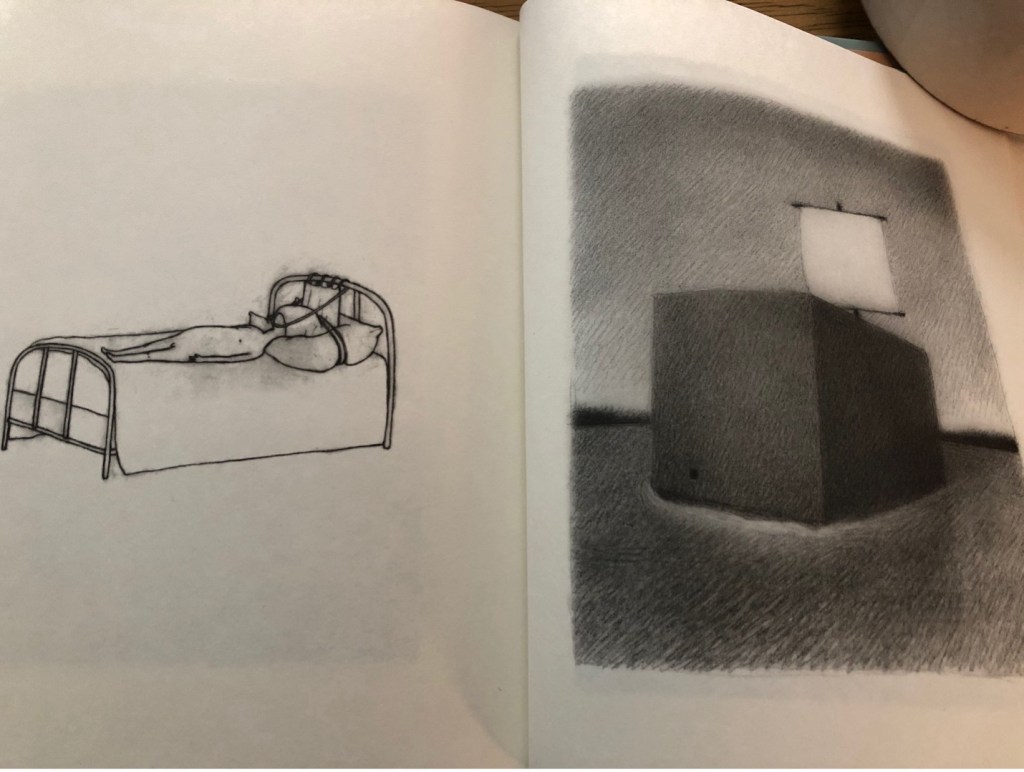

In h day, midway through stage 6, French’s solitary figure, her featureless avatar, remains tethered to the bed, immobilized by headache, but I’m tempted to read the facing page as a dream that she soon may be setting sail in slow motion, toward a faraway horizon, like Alice’s final transatlantic journey when the story of what awaited her was still a blank screen, like the empty pages of a journal to be filled.
Sontag, I think, sold Alice James short. After all, though her Alice remained recumbent in her cabin during the transatlantic voyage, she went on, once in England, to write her brilliant diary pages, leaning against beautiful pillows, almost upright on an elegant horsehair sofa.
V
“But you don’t recover!” Alice James complained, and she didn’t, recover, that is, until she was diagnosed with breast cancer, of which she died not long after the diagnosis, happy, despite the pain, at last to have an illness that would end: “To him who waits, all things come” (May 31, 1891).[50] Now, not many of us who live unhappily with chronic illness would, of course, like James, wish for cancer to end the waiting, to mark an end to the endlessness of an illness that only repeats. But however hyperbolic her expression, it conveys the experience of many suffering today from chronic illness, its debilitating persistence over a lifetime, a time that lacks the finitude and closure of recovery and its narrative.[51]
How to give the chronic its due?
Virginia Woolf solved the problem of the relentless return of her chronic illness by suicide less than two decades after writing On Being Ill. But her language and insights have continued to illuminate the nature of being ill. In 2012, a new edition of On Being Ill was published with an afterword by Rita Charon.[52] In 2021 a second edition was published in Amsterdam.[53] This one also includes several essays, notably by Audre Lorde, but several by less well-known writers, almost all dealing with chronic illness. The preface suggests that these meditations arose within the context of Covid, during which attention to chronic illness took on new meaning and Covid itself has engendered more illnesses that are emerging in chronic form and from which one does not appear to recover, including those subject to the syndrome called Long Covid.
VII


Above, the penultimate image from h day. The solitary figure stands for the first time, emerging from bed after a long siege of tethered immobility. At right, the mystery cube seems to be in motion in this final iteration, after its earlier dreamlike appearance, at that point poised closer to the viewer and closer to the bed across the fold. Here, the cube now appears to be moving away from the scene of migraine pain, literally making tracks, leaving memory traces. “The migraine,” Didion writes in her essay “In Bed,” “has acted as a circuit breaker, and the fuses have emerged intact. There is a pleasant convalescent euphoria. I open the windows and feel the air, eat gratefully, sleep well.”[54]
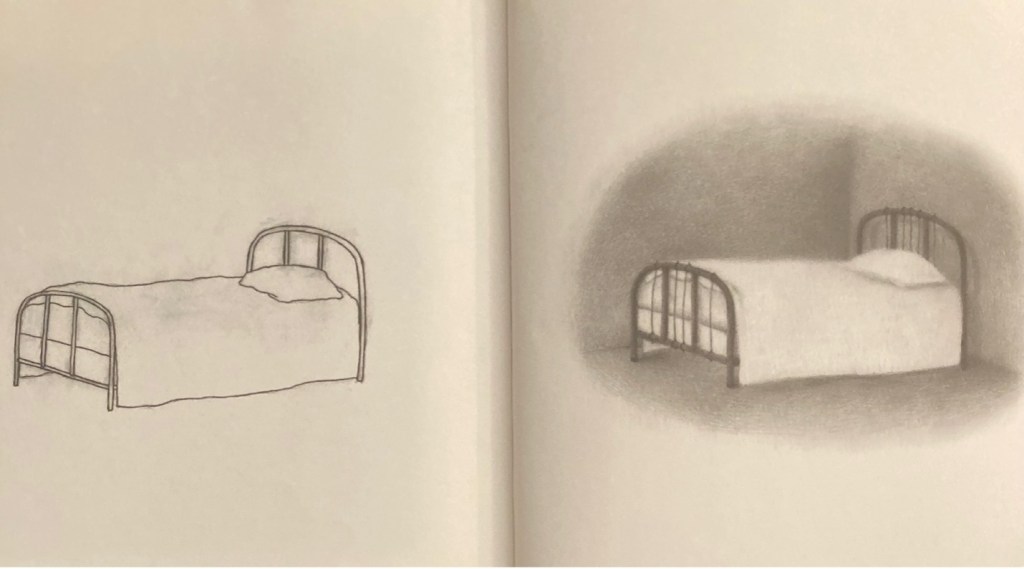

Two empty beds, the second shadowed in a penumbra, occupy h day’s final two pages. In the regime of the chronic, migraines recur and the beds await our return.
Coda: Colette
In “The Captain,” a sympathetic portrait of her father, Colette acknowledges the legacy of his “lyricism.” In recalling his encouragement when she was starting out, she also recalls, almost in passing but with an edge, her husband’s delight that he might have “married the last of the lyric poets,” the writer, who on leaving him, became Colette.[55]
Colette, who suffered from crippling rheumatism, spent many years in late life recumbent, writing from her “divan-bed,” on an adjustable desk that was attached to it. In The Blue Lantern, her last published work, this arrangement “gladdened” both her leisure and her working hours.[56] Neither journal nor memoir, Colette insists, the book represents simply “two hundred pages,” pages she had not expected to write after The Evening Star, three years earlier, lines she explains, dedicated to reporting the “ordinary” under the light of her blue lantern. Despite the “twisting pain, as if under the heavy screw of a winepress,” or rather alongside it, she also has come to know that she is destined never to stop.[57]
Acknowledgments: I’m grateful as always to Jacob Aplaca for his astute critical insight and meticulous editing. I’m no less indebted to the friends and readers who have patiently accompanied me through the essay’s peregrinations: Rachel Adams, Vesna Goldsworthy, Susan Gubar, Tahneer Oksman, and Victoria Rosner.
Image credit: All images appear with permission from the artist, Renée French.
[1] Virginia Woolf, The Diary of Virginia Woolf: 1925-30, ed. Anne Olivier Bell (New York: Harcourt Brace & Co., 1980), 41.
[2] Woolf to T.S. Eliot, September 3, 1925, in The Letters of Virginia Woolf: 1923-1928, ed. Nigel Nicolson & Joanne Trautmann (New York & London: Harvest/HBJ, 1977), 203.
[3] Ibid.
[4] Woolf to Roger Fry, September 16, 1925, in Letters: 1923-1928, 208.
[5] Woolf to Eliot, November 13, 1925, in Letters: 1923-1928, 220.
[6] Woolf, Diary, 40.
[7] Woolf to Vanessa Bell, September 3, 1925, in Letters: 1923-1928, 203. Before the November 27, 1925 entry, an editor’s note included in Woolf’s diary states that in this period, during which she wrote On Being Ill, Woolf “was more or less ill, in and out of bed, with occasional walks or drives with LW and seeing a very limited number of visitors.” See Woolf, Diary, 46. It would be difficult to overstate the importance of the editors of the volumes of diaries and letters, as well as Hermione Lee’s scholarship on Virginia Woolf, in particular her work on the Paris 2012 edition of On Being Ill. Also of importance is the Fall 2016 issue of the Virginia Woolf Miscellany devoted to Woolf and illness, edited by Cheryl Hindrichs, and in particular Hindrichs’s incisive reading of On Being Ill. See Cheryl Hindrichs, “Introduction to Virginia Woolf and Illness,” Virginia Woolf Miscellany, no. 90 (Fall 2016): 44–48. Barbara Lounsberry’s multi-volumed work on Woolf’s diaries is also a valuable source of information and analysis. See Barbara Lounsberry, Becoming Virginia Woolf: Her Early Diaries & the Diaries She Read (Gainesville: University Press of Florida, 2016); Virginia Woolf’s Modernist Path: Her Middle Diaries & the Diaries She Read, First paperback printing (Gainesville: University Press of Florida, 2019); and Virginia Woolf, the War without, the War within: Her Final Diaries & the Diaries She Read (Gainesville, FL: University Press of Florida, 2020).
[8] Woolf to Vita Sackville-West, November, 16, 1925, in Letters: 1923-1928, 221.
[9] Stage 1 opens with a line drawing of a solitary, featureless human head, marked only by a small, internal shape, possibly representing an ear; Stage 2 includes a line drawing of what appears to be a dog’s head in profile, with an internal squiggle (for lack of a more precise term), and a tiny, obscure animal profile below; Stage 3 shows a dog’s head in profile with balled up twine in the place of a brain. It also includes a separate little micro animal head below, similar to that displayed in 2; Stage 4 shows the human head again in profile with the bird-like claws beginning to pierce; Stage 5 shows the head attacked by piercing arrows, the ball of twine, and chains of twine feeding through the skull; and Stage 6 opens with a return to the original featureless head in profile, with two ambiguous inserted squiggles. See Renée French, H Day (Brooklyn: PictureBox, 2010).
[10] Joan Didion, “In Bed,” in The White Album, by Joan Didion (New York: Simon and Schuster, 1979), 168.
[11] In an interview with WOWxWOW, French describes her view of what the images represent: “Most of the portraits with things exploding out of the face or the skin warping around the head, are based on the migraines.” See “Renee French – A River Runs Through It – Artist Interview,” July 27, 2015, https://wowxwow.com/artist-interview/renee-french-ai.
[12] Douglas Wolk, “Stuff Nightmares Are Made Of,” The New York Times, October 29, 2010, https://www.nytimes.com/2010/10/31/books/review/Wolk-t.html.
[13] Sarah Manguso, The Two Kinds of Decay: A Memoir (New York: Farrar, Straus and Giroux, 2009), 166.
[14] Jonathan D. Culler, Theory of the Lyric, (Cambridge: Harvard University Press, 2017), 226. I owe the phrase to Jacob Aplaca.
[15] James’s biographer Jean Strouse describes the rhythm of Alice’s day, as mornings in the bedroom and, after a brief excursion, most afternoons on the sofa in the sitting room, writing. See Jean Strouse, Alice James: A Biography, (New York: New York Review Books, 2011), 274-5.
[16] In Dear World, Kylie Cardell describes the diary comic’s ability to intensify “a propensity of the form to prioritize the lyric moment, the heightented emotion, and the fleeting experience.” See Kylie Cardell, Dear World: Contemporary Uses of the Diary (Madison: The University of Wisconsin Press, 2014), 128. This seems true of French’s diary-like installments. Of course, one would hesitate to read James’s and Woolf’s diaries as belonging to a comic mode, though a productive analogy could be made to the single page drawings of Bobby Baker’s illness in Diary Drawings.
[17] “Renee French – A River Runs Through It.”
[18] Woolf, Diary, 59. The disappointment did not stop Woolf from moving ahead with To the Lighthouse with joy: “I am blown like an old flag by my novel,” she exclaimed two months later. “I am now writing as fast & freely as I have written in the whole of my life,” speed writing, so to speak, while ill. (February 23, 1926, Diary, 59)
[19] Woolf to Vita Sackville-West, January 1926, in Letters: 1923-1928, 236.
[20] Woolf to Edward Sackville-West, February 6, 1926, in Letters: 1923-1928, 239-40.
[21] Woolf, Diary, 58. Editorial summary of the essay’s publishing history. D. 58
[22] Ibid., 65-6.
[23] Virginia Woolf, On Being Ill: With Notes from Sick Rooms by Julia Stephen (Ashfield: Paris Press, 2012), 3-4. This Paris Press edition also included Julia Stephen’s Notes from Sick Rooms, as well as an introduction by Hermione Lee. In the New York Public Library’s 2023 exhibit, “Virginia Woolf: A Modern Mind,” On Being Ill is described by Francesca Wade as a pioneering text that argues that “illness is actually a generative position to think from.” This is just as Alice James’s diaries have been taken up by disability activists. In the legend at the exhibit, situating On Being Ill, the curators suggest that Eliot found the essay “too personal.” There is, of course, no “I” in the argument, but rather, a plural, a collective: “outlaws that we are” (22). That probably wouldn’t have changed Eliot’s mind. Perhaps he found the essay too lyric? See https://www.nypl.org/events/tours/audio-guides/virginia-woolf-modern-mind/item/13274.
[24] Elaine Scarry, The Body in Pain: The Making and Unmaking of the World (New York, NY: Oxford Univ. Press, 1987), 6-7. If, then, The Body in Pain’s subject is most often political pain—being subjected to pain, for example, through state torture—Woolf’s in On Being Ill is the kind of pain more widely, expansively, and typically endured in the course of being ill in everyday life. She’s after what it means to live with illness. To that effect, Woolf ventriloquizes the invalid’s refrain—”‘I am in bed with influenza’—but what,” she asks, “does that convey of the great experience” (8)? What’s lacking, notably, is the invalid’s story: the days and nights of illness during which one’s view of the world is radically transformed. Oddly, on the very first page of The Body in Pain, almost arguing with herself, Scarry imagines the possibility of precisely that kind of story: “Physical pain has no voice, but when it at last finds a voice, it begins to tell a story…”(3). Susannah B. Mintz takes issue with Scarry’s basic claim that’s become a “truism that pain cannot be described, that it defies representation in language.” See Hurt and Pain: Literature and the Suffering Body, (London: Bloomsbury, 2013), 3-4. Ann Jurecic also wonders why critics “have been so convinced” that “pain is beyond language” (qtd. in Mintz, 5).
[25] Scarry, 12 & 3.
[26] Possibly this unexpected turn, a dramatic ending to a story we have barely entered, engendered the review in the TLS in December 1930, which Woolf noted as a “slight snub” in her diary (Diary, 336): “The subject has shown a new, precipitous face for an instant, and once more vanished into the mist.”
[27] Woolf, Ill, 7.
[28] Ibid., 28.
[29] Alice James, The Diary of Alice James, ed. Leon Edel, Northeastern University Press ed (Boston: Northeastern University Press, 1999), 25.
[30] Woolf, Diary, 12-13
[31] Ibid., 105-6.
[32] Havi Carel, Phenomenology of Illness, First edition (Oxford: Oxford University Press, 2016), 76 & 77.
[33] James, 109.
[34] Today, Darwin’s Journals and Remarks is referred to as The Voyage of the Beagle. See Charles Darwin, The Voyage of the Beagle (1839) (Bristol: Read & Co. Books, 2020), 527.
[35] James, 131.
[36] Ibid., 181.
[37] Woolf, Diary, 42.
[38] Woolf, Diary, 248.
[39] James, 113.
[40] Woolf, Ill, 21
[41] James, 286.
[42] Woolf, Diary, 343,
[43] Ibid., 42.
[44] James recounts a scene that takes place with the nurse dressing her in which Alice refuses sympathy for the five-days of “sick head-ache” and resents the implications of weakness: “The headache had gone off in the night and I had clean forgotten about it,” rejecting the implicit view that she was defined by her suffering or unhappiness (July 12, 1889, 48). In counterpoint to the author’s diary protest, we find this: Early in The Master, his novel about Henry James (and the James family), Colm Toíbín imagines Henry coming to terms with his sister’s recurrent illness through cliché: “They tried to name her malady, and the nearest her mother could come to describing it was to say that Alice was suffering from genuine hysteria. Her illness was incurable, Henry realized, because she looked after it and clung to it as though it were a visitor with whom she had fallen helplessly in love” (56). This view, alas, continues to describe how many women suffering from chronic illness, whether ME or Lyme, are viewed by the medical profession––a view slowly changing only now and belatedly with the recognition of Long Covid.
[45] Susan Sontag, As Consciousness Is Harnessed to Flesh: Journals and Notebooks, 1964-1980, ed. David Rieff (New York: Farrar, Straus and Giroux, 2012), 326.
[46] Susan Sontag, Alice in Bed: A Play in Eight Scenes (New York: Farrar Straus Giroux, 1993), 113-4.
[47] Ibid., 52.
[48] Ibid., 56.
[49] Ibid., 7.
[50] James, 206.
[51] According to CDC statistics, six in 10 adults in the U.S. have a chronic disease and four in ten have two or more. They are the leading cause of death and disability and the leading drivers of the national trillion-dollar annual health care costs. Those numbers alone should give pause, and not only for their statistical heft. What does this tell us about what it means to live with one or more of these life-limiting diseases? See “Chronic Diseases in America,” Centers for Disease Control and Prevention (Centers for Disease Control and Prevention, December 13, 2022), https://www.cdc.gov/chronicdisease/resources/infographic/chronic-diseases.htm#print. What are the implications for what it costs financially and humanly to be sick with chronic illness? The well-documented article “The Medicine Is a Miracle, but Only If You Can Afford It” describes the prohibitive costs of drugs available on the market to ease or slow painful and life-threatening illnesses. In one case as reported, a man suffering from “rare chronic leukemia,” learned after the trial for a new drug was successful that the drug would cost $6000 a month, and was not covered by his insurance. See Gina Kolata and Francesca Paris, “The Medicine Is a Miracle, but Only If You Can Afford It,” The New York Times, February 7, 2023, https://www.nytimes.com/2023/02/07/health/medicine-insurance-payments.html?searchResultPosition=1.
[52] The Paris Edition, cited above.
[53] See Virginia Woolf, On Being Ill, trans. Sophie Collins (Amsterdam: Uitgeverij HetMoet, 2021).
[54] Didion, 172.
[55] Colette, My Mother’s House and Sido, trans. Una Vincenzo Troubridge and Enid McLeod (New York: Farrar, Straus and Giroux, 1953), 176.
[56] Colette, The Blue Lantern, trans. Roger Senhouse (Westport: Greenwood Press, 1972), 7.
[57] Ibid., 161.