


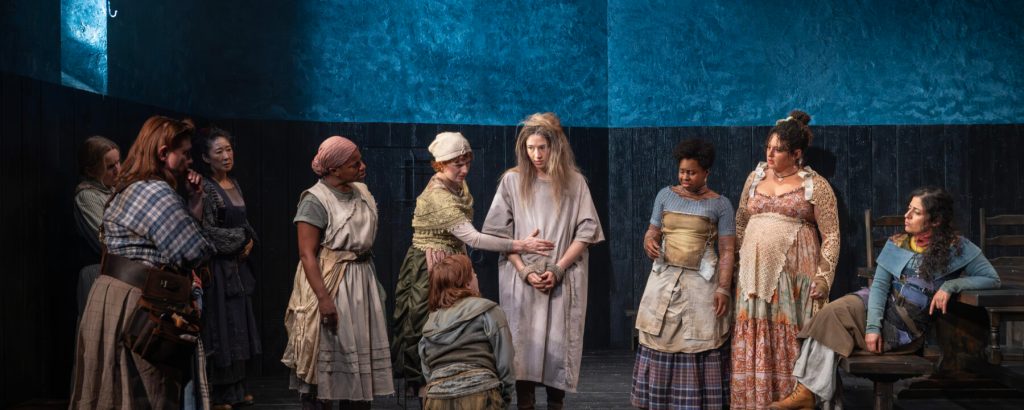
Lucy Kirkwood’s 2020 play The Welkin, which just finished its American premiere run at the Atlantic Theater, uses deliberate echoes of courtroom dramas from Arthur Miller’s The Crucible onward to make a counterintuitive point about medical and postmortem investigation specifically, and about reproductive justice more broadly – sometimes, the point of an investigation is to obscure the truth from view.
As critic Maya Phillips points out, it reflects but, importantly, does not replicate a longstanding trend in popular representations of women’s historical testimony: the idea that that women’s testimony is a smokescreen for entrenched cultural beliefs (as opposed to, say, reportage). Kirkwood does uncommon justice to both the power and deliberate impotence of the matron’s jury – a jury of women, convened by male authorities, as experts on maternal and fetal health, and on death in cases of suspected infant murder. As such, her work reveals a fundamental truth about both early modern and contemporary medicine: that when it comes to women’s rights and bodies, public inquiries and bodily examinations can often act as smokescreens for deliberate obfuscation.
As an early Americanist scholar who researches the jury of inquest as a tool of communal determination and social control, I was intrigued and deeply impressed by Kirkwood’s depiction of the jury of women. Throughout the play’s two acts, the matron’s jury, an all-female variant of the early modern jury of inquest (sometimes, in cases of murder, called the coroner’s jury), try to both prove and disprove that Sally is pregnant, attempting to visually anatomize her living body for signs of pregnancy. These scenes capture the inquest or inquisition, a process that could apply to the bodies of both the dead and the living. When inspected by early modern juries, bodies were viewed, and, if they were the bodies of the deceased, sometimes partially or fully dissected for signs of injury.
As Sara M. Butler has written about pleas of the belly in medieval England, though medieval and early modern judicial systems heavily favored male authorities and jurors, “women were zealous participants in those elements of law enforcement from which they were not blocked because of their sex.” (Butler, 354) Accordingly, Kirkwood constructs a matron’s jury of 12 women of varying stages of life and experience bringing children into the world to evaluate whether Sally is, in fact, expecting. The play thoroughly illustrates their engagement, while also showing the restrictions that AFAB authorities encounter, both from within the matron’s jury and without, in their efforts to prove a young woman’s guilt or innocence.
This conflict is illustrated, in part, by the contested nature of medical expertise that the jurors demonstrate about the female medical practitioners who have treated them throughout their lives. Midway through The Welkin, Judith Brewer (Ann Harada in the Atlantic production) tells 11 other women (and one silent, troubling, observing man) how Lally Fletcher, a deceased village elder known for diagnosing pregnancy, would also treat those who came to her for help when they wanted to get rid of warts. Describing Lally’s method, Judith explains that she’d ask the person in question to point out where they had a wart, and then ask them, again and again, if that was really the spot they meant. After a while, when Brewer looked at where her warts had been, they’d be gone.
The other women listen attentively, some incredulous, some convinced. “What, so she enquired it away?” scoffs Kitty Givens (Tilly Botsford). (Kirkwood, The Welkin, 1.5, 47) Whether Kitty’s exclamation reflects either a desire for empirical proof or the ageless skepticism of women’s healing powers, even among women (or both), is left to the audience to decide. After all, the premise of the play is the task assigned to 12 women in one English village in 1759: to determine, as matrons themselves, whether or not Sally Poppy (Haley Wong), a young woman sentenced to death for murdering a young child, is pregnant—a diagnosis which could save her from hanging.
In records of the matron’s jury, we often only have lists of names: here, we have 12 voices, some of which are in assent, many of whom are driven by their own motivations. They are led in spirit by Sandra Oh’s midwife Lizzy Luke (as Helen Shaw writes for The New Yorker, inhabiting the “Henry Fonda position in the jury room”), who is both professionally and personally motivated to prove Sally’s pregnancy, thereby saving the young woman she brought into the world. Others, including a forewoman appearing under a false identity and on behalf of another wealthy and interested party, want to disprove Sally’s pregnancy at any cost. Their methods vary from the verbal (arguing) to the physical. Turning fully away from Lizzy after she’s finally, successfully helped Sally produce some milk, the jurors don’t get a chance to see it before the fireplace and its unexpected contents explode, replacing the white liquid with blackened soot and feathers–a potent monstrous birth metaphor for those expecting to reveal only the unseen interiors and secrets of women (Park, 2006).
Such an inability to see, whether through misadventure or refusal, illuminates the political discounting of women’s testimony, both in the eighteenth century and in ours. It’s a move foreshadowed by foreman Billy Coombs’s (Glenn Fitzgerald) question to Lizzy’s daughter Katy (Mackenzie Mercer) before then jury convenes. Asking her to recall the gaps between predicted appearances of Halley’s Comet, Katy’s response suggests leaps in time that erase the distance between 1759 and 1986—and, as critic Sara Holdren notes, that such leaps denote not so much progress, but collapse.
Significantly, the jury keeps getting sidetracked by questions about Sally’s guilt–was she persuaded by her lover to murder the child against her will, and unable to resist him? But Sally Poppy’s guilt is not in doubt, whether she’s detailing her adultery to her estranged husband or how she could have stopped the murder in question (but “didn’t want it to stop”). (Kirkwood, The Welkin, 2.6, 99) The only crime she denies is theft. (“I never took them stomachers!” she screams at the child’s distressed and silently imperious mother, Mrs. Wax, toward the close of the play.) (Kirkwood, The Welkin, 2.6, 114)
While Sally is economically motivated to revenge herself bodily on those who have denied her payment and stability, her act of infanticide is also indicative of a desire to see the body torn apart, an act that, to her, seems to represent the dissolution not of the body, but of class hierarchy and economic injustice. She wants to reverse the way that the courts see her–as poor, and therefore subject to capital punishment and punitive anatomy–a fact underscored by some dismissive commentary on Sally’s intended fate: “I hear they take out your heart and hold it up,” one juror says. “I doubt they’ll find one,” another replies. (Kirkwood, “The Welkin,” performance, 22 June 2024)
That Sally cannot bear the thought of being anatomized herself–and that she and the women of the jury are acutely aware this is her intended fate–is a stark reminder of the costs of female disobedience. She does not need to be dead to be subjected to the slab, as the set created by dots suggests, the long jury table standing in for the bier. While placed upon that platform, and subjected to the speculum by Mr. Willis (Danny Wolohan), Sally finds that she has become an interrogated body, regardless of whether she is alive to speak for it or not.
As evidence keeps getting discounted or destroyed–Sally’s belly seems full to some and not to others; the milk glass fills with soot–it is unclear whether this destruction is intentional or not. Even the male doctor Mr. Willis, after pronouncing that Sally is both “quick” (pregnant) and “with quick child” (has a fetus that has been ensouled, and thus cannot be destroyed), seems undecided on how much he wants to be responsible for finding physical evidence or discounting it entirely. Perhaps, he suggests on his way out the door, Sally’s crime was caused by a “tyranny of the ovaries”–a diagnosis which, far from confirming her status as a protected mother, suggests her transformation into a monster, masquerading in maternal form. (Kirkwood, The Welkin, 2.6, 104)
“What, so she enquired it away?” Kitty Givens asks Judith Brewer, derisively, of Lally’s rumored wart treatment. But such an observation could stand in for the request that Sally, like other people with wombs, reveal her feelings and her body over and over, with no guarantee of medical relief or political recourse after having done so. The matron’s jury looks and looks at her; when they doubt Lizzy Luke’s midwifery expertise, they call in a male doctor, who asks if they understand different terms for stages of pregnancy; and when that doctor agrees with Lizzy that Sally is pregnant, another pair of interested parties makes sure she will not continue to be so. The doubting refrain of Judith Brewer’s friend, meant to help, could easily be twisted into that of anti-choice activists putting more and more restrictions on the rights and procedures AFAB people and their doctors say they need, whether to start, end, or preserve a pregnancy. Unsatisfied by expertise, they demand more and more access. And they do so under the guise of looking: But are you sure?
Works Cited:
Butler, Sara M. “More than Mothers: Juries of Matrons and Pleas of the Belly in Medieval England.” Law and History Review, 2019; 37(2), 353-396.
Holdren, Sara. “Time Out of Mind: The Welkin and Hilma.” Vulture.com, 12 June 2024.
Kirkwood, Lucy. The Welkin. London: Nick Hern Books, 2020.
–. “The Welkin,” The Atlantic Theater, 22 June 2024 (performance).
Park, Katherine. Secrets of Women: Gender, Generation, and the Origins of Human Dissection. Zone Books, 2006.
Phillips, Maya. “‘The Welkin’ Review: Is She Guilty, Pregnant or Both?” The New York Times, 14 June 2024.
Shaw, Helen. “Sandra Oh and a Cast of Downtown All-Stars Illuminate a Period Thriller: The British playwright Lucy Kirkwood’s ‘The Welkin’ exorcises the jury-room drama.” The New Yorker, 13 June 2024.
Image: from The Atlantic Theater Company production photos.