


A few months ago, I offered a Graphic Medicine workshop at an event geared towards those who provide care to their loved ones impacted by cancer. The premise: for caregivers to use art, color, and words to reflect on their support systems and consider ways of broadening and deepening the connections which those systems comprise. The etiology of this workshop began with community-mapping activities writ large – often artistic or graphic renderings of a space or community, sometimes done realistically and sometimes intended to convey emotional truths rather than physical ones[1].
With this in mind, a colleague and I created a community-mapping activity that we have facilitated with those living with cancer and then modified to share with frontline providers during the beginnings of the COVID-19 pandemic (West, et al.). It was from this grounding that I developed the workshop given to those caregiving for loved ones who have a cancer diagnosis. While the workshop I provided at this caregiver-focused event was quite different in terms of prompts and end goals from prior iterations, it has good company theoretically and pragmatically in the world of Graphic Medicine and community-mapping.
The activity itself is designed to be done either individually, but can be done in the company of others. Participants write and draw in response to a series of prompts, with time at the end for discussion and sharing for those who want to do so. While my personal preference is for live facilitation of these activities, I also designed it adaptably to allow for asynchronous participation. Thus, I offer this activity to you, as a way to think about and engage reflectively with your own care network and support system, whether you are caregiving or not.
A few notes:
- Supplies generally include paper[2] and something to write with[3]. You can also do this digitally if you prefer.[4]
- Start with the supplies in front of you and work your way down the prompts below. I suggest giving yourself between 3 and 5 minutes for each prompt[5]. At the end, you will have time to go back in and finish any unfinished parts.
- Anyone can draw (Czerweic, 2021). The goal here is not realism or perfection, but engagement. If your version of this activity has more words than drawings, that is okay. If it involves stick figures or abstract shapes, that is okay. It is all okay.
- This is for you. If, at the end, this is a piece you want to share with others, that is wonderful. If you want to keep it somewhere no one else can find it, that is just as wonderful. Take away the pressure of having an audience for this work.
The prompts:
- Draw yourself. Because this activity is about you, place yourself at the center of the paper.
- Draw your home space. This can include as little or as much of your home as you would like.
- Draw the person/people for whom you are caregiving.[6]
- Draw the person/people who care for you “up close.” These are people who are part of your daily or almost daily life.[7]
- Draw the person/people who care for you from afar.[8]
- Draw a person/people who are always a positive part of your life but who are not part of your close care system. This may be an old friend who you see only very rarely, a friendly barista who you see at your favorite coffee shop, a colleague in another department who you only interact with on occasion, etc. The key is that when you do interact, you are always better for it.
- Draw a place where you feel most at peace.
- Draw a place where you wish you spent more time.
- Draw any important community spaces you have not yet added.[9]
- If there is anything else you want to add, or any drawings you want to complete, now is the time.
As you look over your work, note if there are things that surprised you. Are there people you expected you might draw but who you did not? Are there people you did draw who you hadn’t thought of initially? Consider if there are ways to engage with this network more deeply: are there places you can spend more time that feel supportive or peaceful? People with whom you can deepen your ties?
It is likely that this care system will change over time, so please feel free to revisit this activity again in the future, either by adding to the map you have already made or by making a new one.
Footnotes:
[1] There are many examples of community- and body-mapping. One article that nicely sums up the practice (though did not influence our design directly) is by Sweet, E.L. & Ortiz Escalante, S. & is in the “works cited.”
[2] 11”x7” is ideal to give yourself more space, but you can use what you have available.
[3] A pen or pencil is a good place to start, and colorful is good too. Be thoughtful about the colors you choose. A red pen might remind you of getting a graded test back in school, or red might make you feel more powerful. The color doesn’t matter, but how you feel about it does.
[4] If music helps you focus, that may be a helpful part of your supply list too.
[5] This is not an exact science, but it does give you enough time to think a bit and put something on the paper, without feeling too wide-open. Also, I suggest you set a timer so that you don’t keep checking the clock.
[6] If you are not caregiving in the traditional sense of the word, consider who you feel responsible for taking care of emotionally.
[7] I have, on occasion had someone note that they are not sure anyone does care for them in this way. If this is you, I encourage you to think more broadly. Are there people in your life who are consistently and frequently a positive piece of your day? This might mean you think of a kind coworker who has a knack for checking in at the right time, a healthcare professional who you see regularly and who provides good care, or a friend who you converse with online or via text message. A person doesn’t have to physically live near us or hold a traditionally “close” role in our life in order to be part of our close support network.
[8] Again, this can be someone who is physically far away or who is a more distant part of your support system even if they may be geographically near.
[9] Think about where you spend your time or the spaces around you that offer support even if you do not often interact with them.
Works cited:
- Czerwiec, MK. “How to Get Started Making Comics – MK Czerwiec.” MK Czerwiec, 11 July 2021, comicnurse.com/how-to-get-started-making-comics/.
- Sweet, Elizabeth L., and Sara Ortiz Escalante. “Engaging territorio cuerpo-tierra through body and community mapping: A methodology for making communities safer.” Gender, Place & Culture, vol. 24, no. 4, 16 Aug. 2016, pp. 594–606, https://doi.org/10.1080/0966369x.2016.1219325.
- “What Is “Graphic Medicine”?” Graphic Medicine, www.graphicmedicine.org/why-graphic-medicine/.
- West, Kathryn et al. “Creating Comics to Address Well-Being and Resilience During the COVID-19 Pandemic.” Health promotion practice vol. 24,1 (2023): 26-30. doi:10.1177/15248399211065407
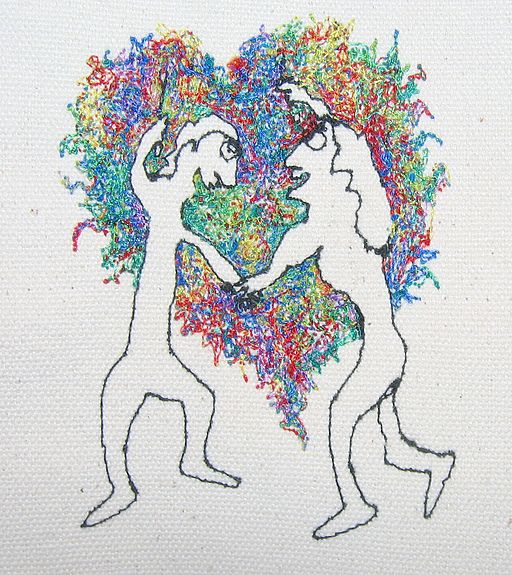
Image credit: P.Nosa, CC BY-SA 4.0 <https://creativecommons.org/licenses/by-sa/4.0>, via Wikimedia Commons