


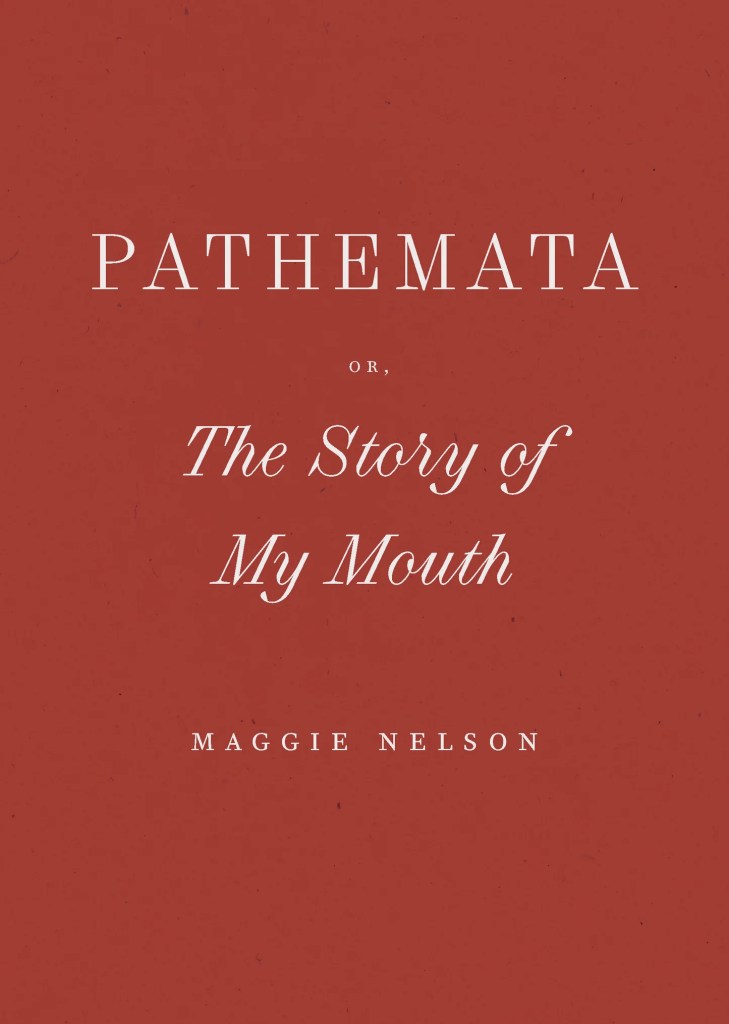
After years of living with jaw pain, Maggie Nelson began to write about it. In her new lyric memoir, she describes her practice of cataloging the ebbs and flows of her pain as well as the process of accumulating information from various specialists. “I allow the / tapestry to widen,” Nelson writes as she adds to this ever-growing document a host of corporeal experiences. She incorporates, too, “the literal / and symbolic role of the mouth in the life of a writer” (5). None of the healthcare providers with whom she shares this expansive record take much interest in its contents. Contrary to Elaine Scarry’s claim that the body in pain “actively destroys” language, Nelson fears that her suffering makes her seem pathologically verbose – “a logorrheic in need of / management” (Scarry 4, Pathemata 4).
This lengthy pain journal, which Nelson calls a pathemata (Greek for “suffering” or “affliction”), is decidedly not her slim new book, also titled Pathemata, though it, too, weaves her quest for care together with other vignettes: from Nelson’s loquacious childhood to the early days of the COVID pandemic and, finally, to the loss of a beloved friend. A precise yet wide-ranging account that blurs the boundaries between dream and reality, this new work marks Nelson’s return to the fragmented form of 2009’s Bluets. In Pathemata, Nelson offers readers a far sparer version of the pain journal she describes, building empty spaces between fragments that leave room for the relational dimensions of pain to emerge.
As she seeks relief for the pain in her mouth, Nelson also wrestles with others’ attempts to quell her verbosity. The lengthy pathemata that she totes from one appointment to the next echoes a childhood family friend’s biting joke decades prior: “Does her mouth come with an off switch?” (6). Nelson recalls being such a propulsive talker in her youth that she was taken both to speech therapy and to an orthodontist who inserted a metal spike behind her front teeth to correct her “tongue thrust” (6). Later, a dentist recommends that she tape her mouth closed as she sleeps; and in dreams, too, she finds that speech eludes her. These encounters with providers remind us that the mouth is not only an organ of expression but also a permeable threshold. Nelson’s boundaries are crossed in more ways than one in her quest for relief. One provider makes jokes about oral sex while his dental instruments rest between her teeth. Another is chatty at the start of their appointment before revealing the conversation as a ruse, an opportunity to observe Nelson’s mouth. Curious, Nelson begins paying similarly close attention to the mouths of others but finds that applying such scrutiny “feels intrusive and mean” (30).
New boundaries emerge with the onset of the COVID-19 pandemic. Virtual attempts to traverse the firm physical boundaries of social distancing only turn Nelson inward towards her own internal narration: “Every day, before logging onto my son’s Zoom school— / We can’t go on like this. / That’s what you think. / I am talking to myself, a fractal interiority” (43). The splintering effects of isolation are compounded when Nelson learns that a dear friend and former teacher, C, has been diagnosed with a rapidly progressing cancer. Like many who lost loved ones at the height of the pandemic, Nelson is “boxed in” by public health protocols and unable to reach her dying friend (51).
Throughout Pathemata, Nelson refers to others by initial only, but I recognized “C” as the writer and feminist theory professor Christina Crosby, whose pedagogy Nelson writes about admiringly in 2015’s The Argonauts. Crosby, who became disabled after a bicycle accident seventeen years prior, wrote about her own pain in A Body Undone: Living on After Great Pain (2016), a memoir in which Nelson appears. Nelson cared for her then, and she wrote about the accident in both 2007’s Something Bright, Then Holes and Bluets. In their work on the reciprocal relationships that can emerge out of feminist mentorships, Nancy K. Miller and Tahneer Oksman observe that “the history of feminism has taught us the importance of mutually reimagining our self-definitions” (4). Across nearly two decades of writing, Nelson’s and Crosby’s collective record of pain puts the body at the center of such a project.
In 2019 Crosby reflected that both Nelson’s friendship and her writing “helped to sustain [her]” in the wake of her accident and the grief that ensued (68). She explains that Nelson “understands the interminable, recursive work of grieving loss” and that “attention to bodies-in-relation to be one of the striking features of Maggie’s writing, from first to last” (68, 71). These features of Nelson’s work are on full display in Pathemata. As she grieves C’s decline, the individual nature of Nelson’s medical quest gives way to a more relational model of pain. When Nelson writes of “the pain, this friendship, / this love, which has meant everything to me and somehow lies at the / core of who I am,” she reveals both C’s care and her suffering as constitutive of Nelson’s own interiority (51-2).
It is unsurprising, then, that the story of Nelson’s mouth is also a story of C’s mouth. During her brief foray into scrutinizing others’ speech, Nelson thinks of C, whose jaw was “ravaged” by her accident (29). Later, although she is unable to see her friend at the end of her life, Nelson observes C’s mouth in other ways. During their final phone call, her “breathing is loud and labored; all of her personhood is audible in / the rattle” (54). Her voice also lingers with Nelson after her death: “I can’t stop hearing C’s voice saying, ‘Maggie, my dear Maggie.’ / No one will ever say my name like that again” (58). The distinct “personhood” expressed in C’s end-of-life “rattle” is paralleled after death by the particularities of her echoing utterance. Although she highlights C’s particular manner of speaking, this characteristic quality is also fundamentally relational, as C holds Nelson’s name in her mouth.
Near the two-year anniversary of C’s death, C’s partner, J, describes her own desire “to offer the world at / least some of what C offered us—the presence, the rigor, the holding” (67). This description of C recalls an earlier memory that Nelson revisits before we learn that C is dying. While presenting on a panel alongside C, Nelson is in the throes of severe jaw pain that she insists must be “visible, necrotic,” but a trip to the bathroom mirror reveals it is not (40). And yet, C clearly sees something. When she “takes [Nelson’s] hand under the table” at which they are seated, the two form “a silent tableau… / …as the auditorium fills with bodies and chatter” (40). C discretely supplies the presence and the holding for which she is later remembered as she joins Nelson in her pain. Her private gesture of care – a hand “cradled” beneath the table – goes as undetected by their audience as Nelson’s suffering itself. This offering, it seems, remains with and continues to expand within Nelson after C’s death. A “feeling has been growing inside / me,” she reflects as J shares her own insight, “… no words, just a little bulge of light nudging out” (67). No longer tied to the suppression of subjectivity, this wordlessness has come to signal possibility.
Such wordlessness sits alongside verbosity throughout Pathemata, and this tension comes into focus most clearly towards the book’s conclusion. Nelson offers an apt counterpoint to C’s death by extending her study of her pain to memories of giving birth, an experience she also narrates alongside a death (that of her partner’s mother) in The Argonauts. When she was in labor, she recalls in Pathemata, her birth coach, “kept encouraging me / to notice the space between contractions—she said I needed to notice / the space so that I could use it as a reprieve, to gear up for the next / contraction” (67). Such reprieves might offer a key to Pathemata’s form, which draws attention to the spaces between fragments – and between pains – where transformation becomes possible.
Indeed, in the space that emerges after C’s death, Nelson is reconstituted in something like her likeness: “For the first time in over two decades of being a teacher,” she writes, “I recognize / that I am one” (67). This self-recognition departs from her discussion of her teaching ten years earlier in The Argonauts. There, Nelson confesses that in her classroom, “I feel high on the knowledge that I can talk as much as I want to, as quickly as I want to, without anyone overtly rolling her eyes at me or suggesting I go to speech therapy,” before clarifying: “I’m not saying this is good pedagogy” (48). If Pathemata offers any resolution, it is not the alleviation of Nelson’s pain or grief, but the reconciling of her own pathologized verbosity with “the core” forged within her by her former teacher.
In The Argonauts, Nelson writes, “I do not yet understand the relationship between…writing and holding,” imbuing, Jonathan Farmer notes, her confession with an optimistic “yet” (47, Farmer). A decade later, in Pathemata, it seems Nelson has begun to make sense of this relationship. Unbounded and unpathologized language, the book suggests, might offer some of the “the presence, the rigor, the holding” that Nelson has learned from C. As her grief transforms into her self-recognition as a teacher, her personal pathemata, too, finds a new form as a memoir that gives voice to her pain while also holding others within its pages.
Works Cited:
Crosby, Christina. A Body, Undone: Living on After Great Pain. New York University Press, 2016.
—. “Words Matter: Friendship, Grief, and Maggie Nelson’s Reckoning with Loss.” FRAME, vol. 32, no. 2, 2019, pp. 67–83.
Farmer, Jonathan. “‘Writing and Holding.’” Los Angeles Review of Books, 12 Sept. 2015, https://lareviewofbooks.org/article/writing-and-holding.
Miller, Nancy K., and Tahneer Oksman. “Introduction: Mutual Engagements.” Feminists Reclaim Mentorship: An Anthology, edited by Tahneer Oksman and Nancy K. Miller, State University of New York Press, 2023, pp. 1–20.
Nelson, Maggie. Bluets. Wave Books, 2009.
—. Pathemata, Or, The Story of My Mouth. Wave Books, 2025.
—. Something Bright, Then Holes: Poems. Soft Skull Press, 2007.
—. The Argonauts. Graywolf Press, 2015.
Scarry, Elaine. The Body in Pain: The Making and Unmaking of the World. Oxford University Press, 1985.
Image credit: Pathemata book cover, Wave Books.