


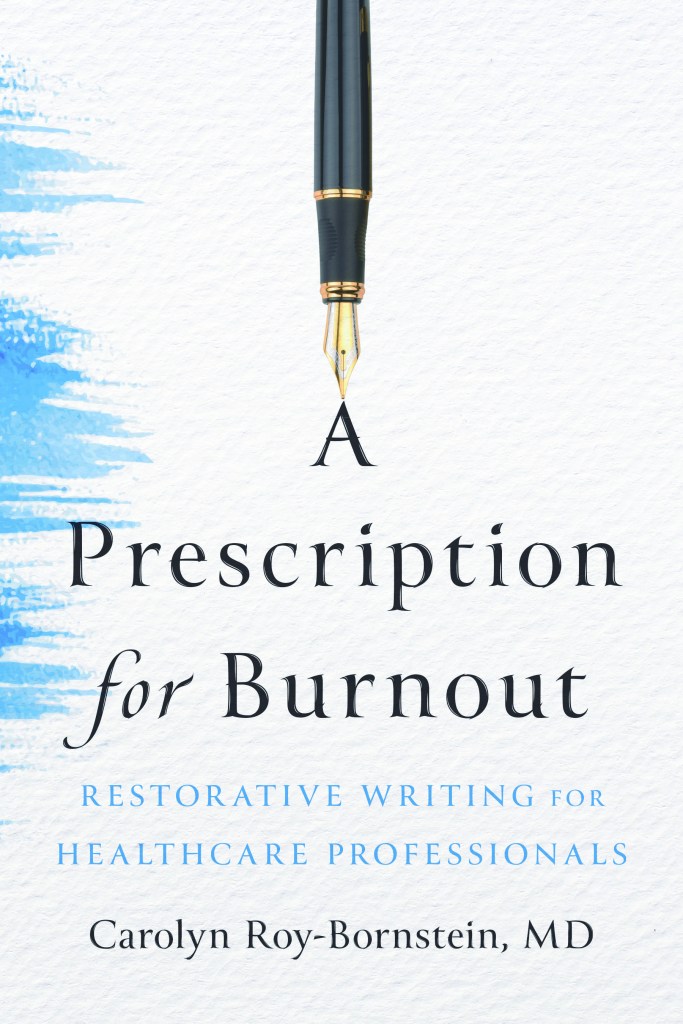
For only a moment I was concerned that Carolyn Roy-Bornstein’s new book, A Prescription for Burnout: Restorative Writing for Healthcare Professionals, was going to ask too much of me and my colleagues. A retired pediatrician and writer-in-residence for a family medicine residency program, Roy-Bornstein has created a reflective writing workbook built around the definition of burnout shaped by research pioneer Christina Maslach (Maslach and Leiter 103). Part I contains writing prompts that target emotional exhaustion. Part II invites readers to counter their cynicism. And Part III challenges colleagues to restore self-efficacy.
If I’m honest I was probably feeling a bit emotionally exhausted, cynical, and a bit defeated when I thought, I can’t just lifestyle my way through the challenging landscape of healthcare. Performing downward dogs, journaling, and meditating does not readily dispel my unease that my career has its meat hooks in a baseline amoral industry that profits off the sick and suffering (Piemonte and Abreu 125).
And yet Roy-Bornstein is not suggesting that personal struggle in healthcare occurs in a vacuum. She is not asking that we give a pass to healthcare leaders and administrators or ignore the structural challenges that pervade the work we do (12, 31, 35, 124). Her premise is that even if the difficult times during a healthcare career are rare, “banking our personal resources and building our individual resilience is a practice that will only add arrows to our quiver” (36). She has found through personal struggle and evidence-based interventions that reflective writing, among its many benefits, is good for the body, heart, and soul. Reflective writing sops up excess cortisol (Part I—14), nurtures empathy (Part II–83), and fosters openness (Part III–140).
Throughout the book, Roy-Bornstein models self-reflective practices personally and professionally. She recounts her anguish after her son suffered a traumatic brain injury from a motor vehicle accident as she was bombarded by platitudes and later when her foster daughter struggled with a severe eating disorder (she has published two memoirs on these events). In discussing her daughter’s trajectory with her illness in Chapter 14, “Writing to Gain Perspective,” she recalls: “It is not hyperbole to say that writing saved me during this time. It was on the page where I was able to gain some much-needed perspective” (79). When she could quiet the external noise and her own harmful inner monologue, Roy-Bornstein found that “my writing was my release and my refuge” (79).
As a pediatrician, Roy-Bornstein embodies vulnerability and humility when she shares in Chapter 7, “Writing to Increase Self-Awareness,” that her colleague once called her out on an inattentive phone exchange she had with a worried parent. The parent perceived Roy-Bornstein as dismissive, which soured the therapeutic relationship (41–42). Even if we’ve missed the mark sometimes, Roy-Bornstein reminds us that the path toward remediation may be just a ballpoint pen and a notebook away: “Sometimes we locate our best selves when we write…” (145).
A Prescription for Burnout is not a book intended to be read cover to cover in one sitting. Like some medications, the exercises in this book can be utilized as needed. To that end, I decided that a review would be incomplete without sampling an exercise myself. Each chapter has three prompts that escalate in effort. The first asks the reader to observe and lay down the facts. The second prompt nudges the writer to explore thoughts and feelings. The final one asks for synthesis. What did you glean? What lessons have you learned? (6–7).
For my exercise, I self-prescribed Chapter 11, “Writing to Listen.” The first prompt asked me to describe a revelatory patient encounter that occurred because a patient had time to tell their story. The second prompt asked about a time when I listened poorly. The final prompt challenged me to think about the encounter when I didn’t listen well from the patient’s perspective. These three reflective tasks reminded me of an inpatient palliative care consultation I conducted a few months ago when I disappointingly failed to pause and connect with a patient during the most agonizing of revelations.
My team is frequently asked to see elderly patients who have sustained a fall. Sometimes a fall is not serious, but sometimes a fall can be life-threatening or lead to a steady decline and a hospice enrollment. My patient’s fall was not serious. Her pain was mild and she was eating well, so in my mind, I did not approach the visit with any kind of urgency or grave concern. I just needed to lay eyes on her and move on to the next patient.
One of the core skills of a palliative care clinician is to walk into a room and immediately create a safe space to reveal difficult things where sentiments such as “Why has God abandoned me?” Or “I’m scared I’m burdening my family” might bubble up quickly. I did create that space at first. And even though I am used to hearing hard things all the time, I was not expecting the patient to tell me about her daughter who had been murdered by her partner a few years ago.
What I should have done was maintain eye contact, nod, be quiet, and then acknowledge how hard that must be. I could have asked if the day held significance—was this the anniversary of the event or her daughter’s birthday? It was obviously top of mind for her. Instead, I went down the rabbit hole of cynicism. Yep, I thought, angrily, women are way too often victims of intimate partner violence and we do not have enough resources in place. While that is true, my inner monologue was not helping my patient. Stunned, I moved on with my checklist of things to discuss. I could see I lost her in the next moment and my patient wanted nothing to do with me. How could I blame her?
Months later, my ego is still bruised. I am not supposed to lose that sacred space. I pulled the rug out from under my patient and I know better. As painful as this process was, it’s the work that Roy-Bornstein is asking of us: “Our reflective writing practice gives us that playground on which to explore our deepest thoughts, that canvas on which to paint our repressed feelings, that white space into which we can pour our truth” (128). My truth is that I cannot become inured to the most tender and devastating of patient revelations.
A Prescription for Burnout can be a solo project—just like I sampled for myself. Roy-Bornstein’s intention was that the exercises can be “private, portable, easy to use, and accessible for professionals at any level” (56). She utilizes these practices when working as a narrative medicine instructor for a family medicine residency (58). The book has thirty chapters and many resident training programs last three years. Such programs could pick one topic each month to incorporate reflective writing into their regular didactic time. The introduction of the topic and the writing itself should take about 40 to 45 minutes, longer if the writers share their thoughts.
In the end, Roy-Bornstein is asking a lot from those of us who work in healthcare—not that we ignore the greed in the industry, but that we embrace self-reflection. While that work can be messy and difficult, the payout can be immense: “Writing can be the filter, the emotional colander through which we sift the stories we have been given, holding on to what will serve us and letting go of what will not” (28–29). Ultimately, Roy-Bornstein has provided us tools to navigate the marathon that is a career in healthcare when so much is at stake—the caretaking of ourselves and our patients in a spirit of creativity, self-expression, and dare we aspire—even flourishing.
Works Cited
Carolyn Roy-Bornstein, A Prescription for Burnout: Restorative Writing for Healthcare Professionals (Baltimore: Johns Hopkins University Press, 2026).
Christina Maslach and Michael P. Leiter, “Understanding the Burnout Experience: Recent Research and Its Implications for Psychiatry,” World Psychiatry 15, no. 2 (2016): 103–111, https://doi.org/10.1002/wps.20311.
Nicole Piemonte and Shawn Abreu, Death and Dying (Cambridge, MA: MIT Press, 2021).