


The future looms large in Cambodia, always haunting its present. Still, one is prompted to ask – what is the nature of this future? Its perceived openness as a space of political possibility and real transformation has been diminishing, if not entirely foreclosed, since the turn of the century. This diminishment is due to the prevalence of a specific kind of chronopolitics which ‘collapses into a time dominated by pastiche and reiteration’ and is clearly evident in state rhetoric (Fisher 2012, 16-17).
State visions of health in Cambodia are determined by technological speculations around a future that is partial as opposed to open, that is predictable and formatted towards more growth and more optimization. This future is a continuation of the capitalist present – a homogenous diachrony. At the public launch of the nation’s first 10-year Health Strategic Plan (2025–2034) in October 2025, the Cambodian Minister of Health described it as ‘a vision for tomorrow’ (Hang 2025). Introduced as a guide for broadening universal health coverage (UHC), expanding preventive care, and strengthening health system governance, the Health Strategic Plan articulates a national horizon of expectation for the next decade. It posits health as a goal-oriented national project for ‘sustainable human capital development and economic growth’ (Ministry of Health 2025, xiii), delineates forms of participation and adherence, and outlines the responsibilities of citizens, health workers, and institutional actors. It exemplifies how public health planning in contemporary Cambodia is not simply a neutral and non-ideological matter of service improvement and delivery. Instead, such planning serves as a domain of official foresighting and prospection through which a certain political imaginary about the future is disseminated.
State visions of health are also shaped by a historical imagination imbricated in national pride and Khmer ethnocultural identity. The Angkorean king Jayavarman VII’s healthcare system in the late twelfth and early thirteenth centuries, comprising a network of about one hundred ‘chapel hospitals’ across the Angkor kingdom (Rohany 2023), recurs in public health discourse and serves as grounds for mythic aspiration. The state frequently invokes the technological prowess of Khmer ancestors as a justification for large-scale infrastructure projects today, such as the 1.7-billion-dollar Funan Techo Canal project that is speculated to be completed by 2028 (Ky 2024, Stanhope and Buckley 2024). In official health communication, a dual temporal strategy is discernible: the repeated, conscious and selective references to Cambodia’s health pasts alongside evocations of utopian ‘democratic’ health futures in which everyone has equal access to healthcare.
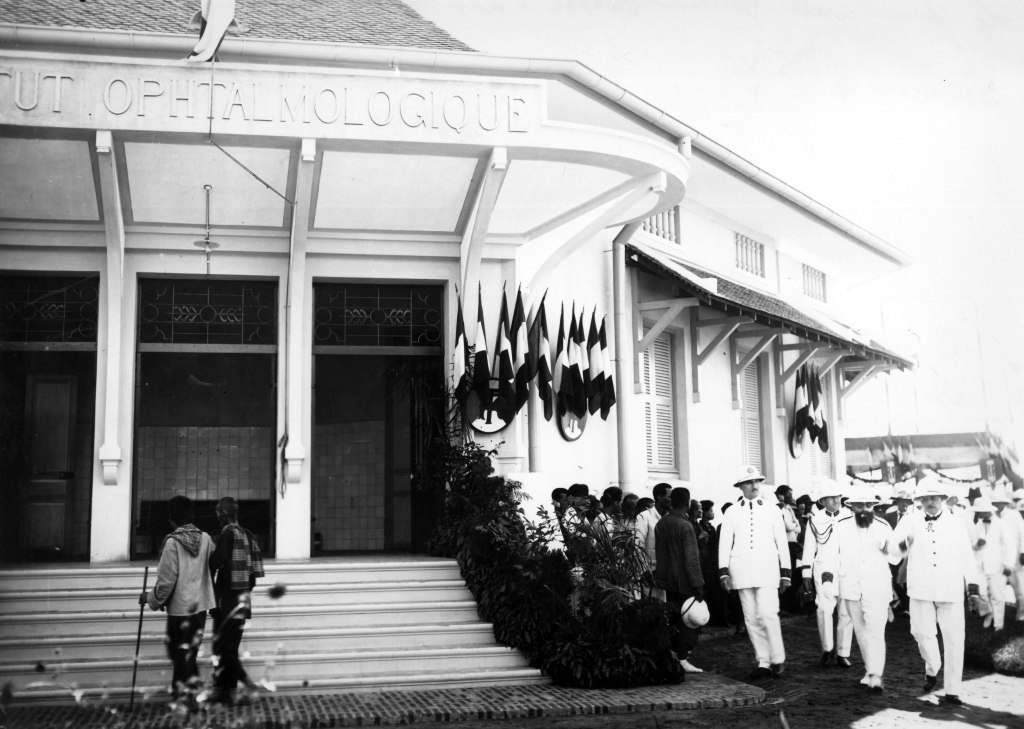
Any account of health in Cambodia must begin by recognizing the scale, depth and complexity of the crisis it confronts. Health in Cambodia is ‘haunted’ by remnants of colonial medical institutional structures, legacies of violent Cold War interventions and the afterlives of protracted conflict and genocide. Another spectre exists in the form of ongoing entanglements with global humanitarian governance and health capitalism that came in as a result of post-genocide (neo)liberal reconstruction/ restructuring of the political system and the economy. Not only has this history damaged Cambodian health infrastructure, it has also left an indelible impact on how health is imagined.
Overdetermination towards a certain kind of future is one way in which alternative potential futures are eradicated from political consciousness. These lost futures, unrealised and ‘unrealisable’ under the onslaught of the homogenising drive of nationalist and techno-capitalist teleology, remain as haunting spectres. Hauntologies of health –which refers to these multiple ‘haunting’ existences after Jacques Derrida’s notion of hauntology, which explains how lost or potential futures and unassimilated and compulsively repetitive pasts haunt contemporary existence (1994) – make the bio-temporal logic of capitalist health chronopolitics deeply palpable. The conceptual framework of hauntology exposes the state’s appropriation of health futures and pasts, as well as the enduring presence of transnational actors, including former colonial institutions. Although they have revamped in accordance with the changing world, these institutions continue to perpetuate colonial arrangements. Their agendas continue to shape how health systems in places like Cambodia are ‘organised’ along such trajectories.
Hauntology enables a bidirectional temporal critique (Fisher 2012) that can unravel the state chronopolitics of health because it attunes us towards an ethical engagement with all that which ‘haunts’. It reactivates lost or unrealized ‘pastfutures’ and shows other trajectories that were (and perhaps still are) possible. Most crucially, hauntologies of health refuse singular developmentalist narratives of health and recognise that future-oriented solutions are always entering already compromised temporal fields.
Health chronopolitics narrows the imagination by enforcing a limited set of acceptable futures for bodies and populations. Its temporal logic informs the discursive production of the ‘national body’ as both aspirational and vulnerable, while aligning individual ‘citizen bodies’ with developmental narratives naturalised through biopolitical means. The ‘national body’ is figured as a healthy, productive body—able, disciplined, and oriented toward social, economic, political and biological reproduction of the nation. The national body is also moralized, such that health becomes both a civic duty and a marker of national belonging. The compliant ‘citizen body’ is the one that receives and adheres to the metanarrative of progress and the teleology of the nation-state, participates in national development by supplying labour to the national cause, and is encouraged to become an active manager of its own health. The iconisation of certain ‘citizen bodies’ in national media, and the valorisation of their corporeal attributes in terms of masculine strength or feminine beauty are often used in service of political consolidation; for instance, their image may be intrumentalised by the national elite towards militarisation or corporatisation. Health chronopolitics, as the means through which they are co-opted by political power, are literally inscribed onto bodies.
In this context, the aspiration toward ‘good health’ is neither abstract nor externally imposed upon the Cambodian people; it is a deeply grounded desire tied to dignity, security, and the possibility of a viable future. These factors are available for the state to mobilize towards developmentalist ends through the promise of a managed future as the immanent outcome of the sequence of development, growth, progress and accumulation. Cambodia’s current developmental trajectory is governed by Vision 2030 and Vision 2050, which aim to transform Cambodia from a low-income to upper-middle-income and high-income status. These visions are not merely economic targets, however. They are blueprints for the management of the population through a ‘biopolitical mode of governing that centres on capacity and potential of individuals and the population as resource that may be harnessed and managed by governing regimes’ (Ong 2006, 6). The Rectangular Strategy Phase IV and the Industrial Development Policy (2015–2025) emphasize ‘human capital development’ as the engine of growth; the ‘citizen body’ is constantly oriented towards the needs of the market by the state. Health and education are prioritized as inputs insofar as they enhance the human capital of the nation.
A hauntological outlook opens up new ways of thinking about health justice because it demands a confrontation with the anachronic returns that are often neglected by liberal optimism– the debris and recuring crisis of imperial and capitalist projects. In Cambodia, the intensification of neoliberal process over the last few decades has produced deep inequalities, structural barriers and processes of precaritisation that exist and will be exacerbated under authoritarian developmentalism. The state, by selectively applying neoliberal logics, produces forms of exclusion that render large segments of the population effectively marginal to full citizenship (Ong 2006). With the state’s pro-business policies and repression of unions, many Cambodians find themselves exposed to endemic poverty, land dispossession through legally dubious means, environmental toxicity, and exploitative and insecure labour conditions that endanger their life and health. Efforts to ‘humanise’ capitalism through reform remain limited because such measures are ultimately absorbed into a system structurally predicated on inequality and extraction. Even when borrowing from socialist welfare models (recast as liberal humanitarianism), these interventions do not unsettle the arrangements that maintains the production of a permanent labour underclass. The National Social Security Fund (NSSF), which is the central institution for social protection, administering health insurance, occupational risk safeguards, and recently, pension schemes, excludes a large number of subcontracted or ‘informally’ employed individuals who make up a significant part of the Cambodian workforce. Unprecedented levels of indebtedness, the erosion of land-based livelihoods, and growing climate vulnerability further compound these conditions, producing a population that is structurally made more susceptible to ill health. The effective virtuality of open futures has collapsed entirely for these human beings wasting under the debilitating effects of neoliberal slow violence.
Emerging techno-biomedical initiatives by public and private health actors, including AI-driven health systems, extend these dynamics by generating new forms of subjectivisation and control, often reproducing global inequalities in less visible ways. Technocratic solutions to what is framed as a developmental lag in Cambodia have intensified processes of capital penetration, more deeply and at times violently incorporating Cambodia into global supply chains. The country’s continued dependence on foreign aid, particularly in the health sector, has often enabled entanglements in transnational circuits of capital and ‘expertise’ without adequate protections. More recently, these dynamics have been rearticulated through the growing integration of AI into healthcare systems. Cambodia’s AI landscape remains nascent but is rapidly expanding. The government positions AI as a key enabler particularly in sectors like health (Kiripost 2025). Institutions such as the Ministry of Industry, Science, Technology & Innovation and the Ministry of Health have articulated ambitions to digitize the biological life of the population. The HealthTech Roadmap 2022, which serves as a strategic plan for their goals, emphasises datafication, telemedicine, and AI integration, the latter increasingly framed as solutions to systemic constraints by accelerating operational processes and reducing operational costs (Ministry of Industry, Science, Technology & Innovation (MISTI) 2022, 17). These technological ambitions are being anchored in appeals to digital upskilling of the health workforce.
The past is again strategically tapped into: Buddhist ethics have been widely discussed in healthcare and tech spaces. High-profile conferences propose that vernacular ethical frameworks derived from religious scripture can mitigate racial biases of imported AI technology, counter epistemic dominance of the West and even ‘decolonize’ scientific knowledge. One only needs to look towards elitist projects of nationalist revitalization in other parts of the world, however, to become aware of the risks of atavism that is harmful for minorities and lead to its own set of political closures. Furthermore, overdetermined techno-optimism that frames AI as inevitable or progressive sidesteps the ways in which these systems remain embedded in and reproduce longstanding colonial asymmetries of power that enable the violent extraction of resources, data and labour and the allocation of human costs onto expendable populations in the Global South (Muldoon and Wu 2023).
Hauntological attention rejuvenates our political imagination to begin thinking beyond what is delimited by the state-capital nexus. It would allow us to acknowledge and act on, for instance, that though maternal and infant mortality rates have drastically fallen over the last decades in Cambodia, other and new forms of reproductive precarity are always emerging under this political-economic regime. It would allow us to go beyond superficial engagements with ‘social determinants of health’, and produce real ethico-political engagements with lived lives. Hauntologies of health also open space for alternative configurations of care. Specifically, it gestures towards how these ‘hauntings’ are already engaged and negotiated in everyday life. It can reveal how alternative arrangements of health and wellbeing are worked out by people through strategic performances of (deeply political) apoliticism and interpassivity that emerge from the grassroots level when they redirect official state rhetoric or outsource political action to non-state actors towards achieving their political goals (Lilja et al 2024). Cambodians are not purely passive recipients of health subjectivisations; rather, they resiliently navigate the existing situation to secure survival and care.
Hauntologies of health also raise a more urgent question: can democratic health futures be realised in the absence of democracy? ‘Undemocratic’ conditions of political unfreedom are often painted through Orientalist renderings as being a natural condition of the non-Western world. Nonetheless, West-backed processes of neoliberalisation through entities like the UN, IMF and the World Bank have produced forms of democratic closure across much of the world, particularly in Cold War–affected regions of Asia. In Cambodia, neoliberalism has been a ‘malevolent harbinger of death’. Here, the failures of development under patronage politics alongside the overwhelming dominance of international commercial organizations, and foreign governmental and non-governmental representatives, the production of market-oriented subjects, and ongoing processes of accumulation through dispossession continue to structure everyday life (Springer 2015, 2).
Hauntology unsettles and challenges liberal metanarratives, such as Francis Fukuyama’s end of history triumphalism, that hail the global victory of liberal democracy and the realisation of its promised rights at the end of the Cold War. Instead, hauntology foregrounds the disjuncture between these promises of prosperity and the material destruction of the worlds and ruination of peoples in the Global South over the last three and a half decades. In this context, health remains one of the most intimate ways in which the empire manifests today and the most crucial site at which these histories and power relations are lived on a daily basis. Hauntology reintroduces politics into this area that is being increasingly evacuated of political content. In doing so, it makes us listen for and act on the political claims behind health aspirations of ordinary people that are so often stifled.
Works Cited
Derrida, Jacques. 1994. Specters of Marx: The State of the Debt, the Work of Mourning and the New International. Taylor and Francis.
Fisher, Mark. 2012. ‘What Is Hauntology?’ Film Quarterly 66 (1): 16–24. https://doi.org/10.1525/fq.2012.66.1.16.
Hang, Punreay. 2025. Cambodia’s First 10-Year Health Plan Targets Multifarious Challenges – Khmer Times. October 9.https://www.khmertimeskh.com/501770257/cambodias-first-10-year-health-plan-targets-multifarious-challenges/.
Kiripost. 2025. ‘Cambodia Bets on AI and Data Security for Healthcare Future’. https://kiripost.com/stories/cambodia-bets-on-ai-and-data-security-for-healthcare-future.
Ky, Chamna. 2024. ‘PM: Funan Canal to Resurrect Ancient Kingdom’s Pride’. Cambodianess. https://cambodianess.com/article/pm-funan-canal-to-resurrect-ancient-kingdoms-pride.
Lilja, Mona, Mikael Baaz, and Malin Wallgren. 2024. ‘Passivity as Resistance: Counter-Conduct in Japan and Cambodia’. Global Society 39 (1): 86–102. https://doi.org/10.1080/13600826.2024.2390889.
Ministry of Health, Cambodia. 2025. Health Strategic Plan 2025–2034: “Effective and Equitable Health Services, for All, through Resilient, Responsive, and Accountable Health System.” Phnom Penh: Ministry of Health.
Ministry of Industry, Science, Technology & Innovation (MISTI), Cambodia. 2022. “HealthTech Roadmap” Phnom Penh: Ministry of Industry, Science, Technology & Innovation (MISTI).
Muldoon, James, and Boxi A. Wu. 2023. ‘Artificial Intelligence in the Colonial Matrix of Power’. Philosophy & Technology 36 (4): 80. https://doi.org/10.1007/s13347-023-00687-8.
Ong, Aihwa. 2006. Neoliberalism as Exception: Mutations in Citizenship and Sovereignty. Duke University Press.
Rohany, Isa. 2023. ‘Healing the Empire: Angkor’s Chapel Hospitals’. Cambodianess. https://cambodianess.com/article/healing-the-empire-angkors-chapel-hospitals.
Springer, Simon. 2015. Violent Neoliberalism: Development, Discourse, and Dispossession in Cambodia. Palgrave Macmillan.
Stanhope, Grace, and Hannah Buckley. 2024. ‘The Murky Waters of Cambodia’s Funan Techo Canal | Lowy Institute’. https://www.lowyinstitute.org/the-interpreter/murky-waters-cambodia-s-funan-techo-canal.
Cover image: Alexandre Varenne: Gouverneur Général en Indochine, Fondation Varenne