


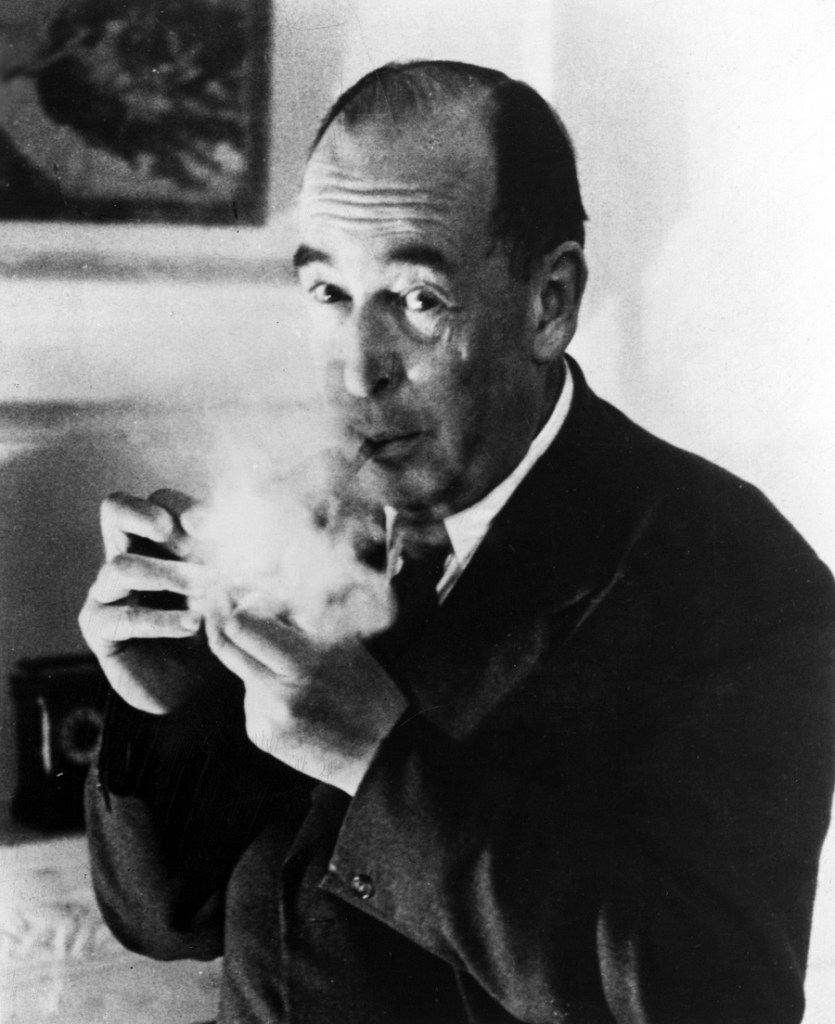
C.S. Lewis, as Great Gerwig’s upcoming adaptation of The Magician’s Nephew (1955) reminds us, wrote spectacular stories of imagined worlds. Yet Lewis also bears a significant connection to the Medical Humanities—one of his best friends was a physician. Robert E. Havard (1901-1985), an Oxford and Cambridge-trained physician, scientist, and writer, was a contributing member of the Inklings, the famous Oxford literary circle whose members included not only Lewis, but also J.R.R. Tolkien, Charles Williams, and Owen Barfield.
Havard was both the only scientifically-trained member of the circle and one of the writing group’s most faithful attendees, despite his busy medical practice and five children at home. During meetings at local pubs or Lewis’s rooms in Magdalen College, Havard listened to his friends read drafts of books they were writing—including The Lord of the Rings (1954-1955), The Screwtape Letters (1942), and The Problem of Pain (1940). In addition to asking questions, providing feedback, and encouraging their efforts, he also shared work of his own. In his poems, short stories, and non-fiction essays on medicine, religion, and the arts we encounter a physician-writer deeply committed to narrative and whole-person care. As the “Medical Inkling” in a room of literary giants, Havard therefore provides a compelling example of disciplinary re-integration.
One Havard-Lewis collaboration provides insight into Havard’s approach to his patients’ suffering, particularly his approach towards mental illness. Lewis’s The Problem of Pain ends with a short “note on the observed effects of pain …kindly supplied by R. Havard, MD, from clinical experience” (143). However, an earlier unpublished draft by Havard is far more indicative of Havard’s holistic medical imagination. While the original draft totals over 1000 words, the published version—presumably edited by Lewis—is only half that length.
All portions of the piece have been altered; however, Havard’s intended emphasis on mental suffering is nearly eliminated. The published version provides a rather dispassionate and confused account of severe mental illness:
In actual insanity the picture is darker. In the whole realm of medicine there is nothing so terrible to contemplate as a man with chronic melancholia. But most of the insane are not unhappy, or, indeed, conscious of their condition. In either case, if they recover, they are surprisingly little changed. Often they remember nothing of their illness. (162)
Severe depression and psychosis may be “terrible,” but such suffering is rendered both devoid of consciousness and the capacity for retrospective meaning-making. In contrast, the same passage in Havard’s handwritten draft is nearly four times as long! Havard not only indicates the personality changes wrought by psychosis in an era before the DSM or antipsychotics, but also approaches the supposed clinical situation with humility:
Our ignorance of the cause or cure of most examples of insanity is still complete. We are often spectators, helpless to cure, alleviate or even understand the suffering, or the victim. (46)
In speaking of the “man with chronic melancholia,” Havard turns to the arts to understand his condition:
In the whole realm of medicine there is nothing so terrible to contemplate as a man with chronic melancholia. To speak with him has all the pitiable + terrible effect of witnessing high tragedy, only transferred from the stage to life. (46-47)
Finally, Havard makes room for meaning—on both sides of the clinical encounter:
It is impossible to form a conception of what insanity means to the sufferers themselves, but to look after the insane is an experience which is full of valuable discipline. It teaches gentleness and self-control. It induces a deep humility in when it is recognized that reason itself is a gift which can be lost.
The possibility of meaning (and the very process of narrative meaning-making) remains for both the patient and the clinician: psychiatric care becomes a locus of not only professional formation, but also the practice of virtue.
Speculating on the reasons for Lewis’s edits is beyond the scope of this brief essay. Nonetheless, the “Appendix” demonstrates both the depth of Havard’s medical imagination as well as how his vision of medicine exceeded one of the most acclaimed literary imaginations of the 20th century.
References:
Lewis, C.S. The Problem of Pain. HarperOne, 2001.
Havard, R.E. “’Pain and Behaviour in Medical Practice:’ Robert E. Havard’s Draft of the Appendix to The Problem of Pain.” VII: Journal of the Marion E. Wade Center, vol. 36, 2019, pp. 45-47.