


If you will forgive me a moment of biography, I’d like to explain an interest that’s been rattling around in me for some time now. First, it may be helpful to know that I originally did not set out to be a writer or an academic, but, rather, a dancer. Once one is a dancer, a part of her always remains a dancer. Dancers’ bodies are their instruments, and human bodies occupy so much of our study and our imagination as health humanists. Because of this, I have developed an interest in how dance relates to my current work in health humanities, because understanding the human form, the way a dancer comes to know it, offers interesting and compelling implications for health and medical professionals as well as those of us in health humanities spaces.
However, I am also a creative writer, often writing poetry and sometimes working with ekphrasis, or the verbalization of a visual representation. Most commonly, ekphrasis is used by poets who take a piece of visual art as their subject, but prose writers, too, can employ ekphrasis. Recently, I’ve turned my attention to photography. I’m specifically thinking of a poem I wrote after finding a photograph of a relative I only knew through the photos and stories of him. My desire to enter into conversation with this relative I did not know is, of course, not a desire that is unique to me. Photographs often invite us to view, which is to say know in a specific context, their subjects. For me, knowing is completed through the act of writing, and ekphrasis, then, is one way to discover what I “know” about a piece I have spent time viewing. As Andrew Miller, a scholar specifically interested in the ekphrasis of photographs, writes, “Time and time again, the ekphrasis of photographs comes to celebrate the photograph not merely as a representation but as an essence of the thing itself” (4).
Miller and others maintain that photos create an ekphrastic moment specific to photography as an art form. In drawing upon the work of James Heffernan, Miller muses that there are significant elements that characterize the ekphrasis of photography. The first is “the activation of the pregnant moment that’s depicted in a still or plastic image, and a representative friction between the ekphrastic language and the materials of the ekphrastic object” (11). Miller suggests that there are necessary narrative acts that attend the viewing of a photograph. There is the fixed form of the photograph itself, which requires a narrative thrust as we apply language to describe it. That narrative is not internal to the photograph but external. We describe our viewing of it. We are not witnessing something in real time, and so a gap occurs between the depicted event and its subject and any viewing of the photograph. Photos, themselves, are described as “taken,” and Miller writes clearly about this distinction: “as representations, photographs are traditionally considered to be ‘taken’ rather than made things” (13). It is a viewer who creates the narrative depicting what she sees, participating in the “making” of it.
One reason for my interest in dance photography is that its movement is choreographed and repeatable. The before and after of the captured moment actually exist and can be known. This changes the pregnant moment of the dance photograph. Even a viewer unfamiliar with the specific phrase knows that the image is excerpted from a real sequence, and so any movement she imagines exists alongside the movement that was performed. A viewer who knows the choreography can place the image within its phrase, or deliberately re-render it. Both scenarios, invention and recognition, offer rich opportunities for ekphrasis.
In dance, many choreographers will describe “making” their works on specific dancers, which implies that those specific bodies are the canvas onto which choreography is applied. Modern dance master Alvin Ailey choreographed numerous pieces on the dancers in his eponymous dance company, dancers he personally selected to perform this work. Alvin Ailey’s oeuvre is also well-captured and cataloged in photographic archives. Let us consider an often-photographed moment captured from Ailey’s masterpiece, Revelations:
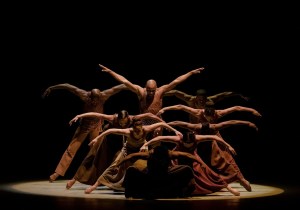

(Alvin Ailey American Dance Theater in Alvin Ailey’s Revelations. Photo by Paul Kolnik)
Because a viewer may or may not be familiar with this choreography, for some this will only ever be experienced as a static image of the artists of the Alvin Ailey American Dance Theater company. The dancers’ bodies are arranged in a specific way, captured in a frozen moment in time. Here, we see the bodies as part of a collective dance image. Depicted here are dancers of color. A viewer encountering the image without context cannot know from the photograph alone that Ailey created Revelations from what he called his “blood memories” (qtd. in “Revelations”) of the Black church in his Texas childhood, or that he made it on dancers he chose. Like the choreography that precedes and follows the captured moment, this context exists whether or not the viewer brings it to the image. In a close viewing session, a facilitator might choose to withhold it at first, letting participants describe what they see before learning what the photograph cannot tell them. Such a session draws on the framework of narrative medicine, which calls us to recognize, absorb, interpret, and be moved by stories (Charon et al. 1).
In such a session, we might consider the tension of the light and shadow, how the dancers pose in a circle of light while the rest of the stage is darkened. We might consider the way the dancers’ arms suggest flight, or the wedge-like pattern of their arrangement. We might also note the bowed heads and the torsos that lean forward as being counter to the way the arms stretch away from the rest of the body. What is bowed and what is extended could also be examined. Some might read the image as a tree, with roots and branches, others as birds in patterned flight. We might note the costuming, the bare feet, and the pants and dresses in shades close to the dancers’ skin tones, which, in this pose, blur the edges of each individual dancer, perhaps suggesting a collective. These are just a few ways a discussion of the photograph might go, noting specific detail and pondering significance and context.
After a close viewing of this photograph, participants in a narrative medicine session would be invited to write to a prompt that obliquely connects the photograph to their own feelings or experiences. They would follow this with discussion of that writing using close listening to volunteers who share their prompted work. Examples I brainstormed for session prompts for this photograph include: “write about a time when you were one part of a larger whole,” or “write about a time when you held a pose.” Writing in the shadow of the discussion of the Revelations photo hopefully elicits responses that combine subtle textual residue from the close viewing session with the prompt writer’s lived experience. Additionally, the second prompt invites a former dancer, like me, to consider insights from that training. In the case of this particular photograph, it brings to mind a concept most dancers know well, which is that the body may appear still but is rarely truly static when holding a pose. The muscles themselves exert equal and opposite energy to create the illusion of stillness. Thus, balances, which an audience of either the dance or the photograph will interpret as still, require movement in the dancer’s body offset by countermovement. When I think about resistence and counter resistence inherent in a “still” pose, I’m reminded of what one of my early ballet instructors explained as the way to excute the step reléve: “Press down to rise up” (allowing one to balance on the ball of the foot or the tip of the toe).
There is also movement both before and after every pose. Photos of dance actually capture a single frame of a body in motion. Artfully considered, this complicates how we analyze images of dance. We might be looking at something that is artificially “still,” meaning that it would register as part of a movement sequence if the dance phrase were viewed in real time.
The dance photograph, as a relic “taken” from a moment of movement, will always have movement that comes before and after the moment of the image, until, of course, the choreography is completed. If one happens to know the choreography, she need not imagine what movement comes before or after—though she might be invited to re-render it imaginatively in another way. If the choreography is unfamiliar to a viewer, it is her imaginative capacities that fill the gaps that bring her to the suspended movement of the photo and allow her to move from it. Because we know it is dance, and dance relates specifically to movement, we cannot regard this suspended moment of movement without a sense of activity, which is the performance of the choreography it was taken from. And it becomes ekphrastic when we write about it, such as when we use a dance photo for a narrative medicine session.
There is a term used when a poem takes dance as its subject: ballophrastic (Hetherington and Atherton 4)). But a photo of dance isn’t quite ballophrastic. As I begin to tease out what I am calling the Kinetic Ekphrasis of the dance photograph, I have been considering how an image from a work of choreography, like the example from Revelations, enacts a kind of simultaneity, at once static and always, too, suspended within a moment of movement. Does a viewer need to recognize this relationship between action and counteraction to appreciate a moment of dance?
When we start to see animated bodies suspended in their movement, there could be significant resonance with how we come to recognize and understand the very idea of embodiment. Consider how what we perceive as a non-moving balance is actually an action itself, and how knowing this might enrich our discussion and analysis of dance, especially within a health humanities context. Isolating the moment allows us the deep, close viewing we may desire to understand unspoken narratives in dancing bodies. By using the photograph of the dance as our object of inspection, we are also engaging in two actions at once: viewing the fixed moment of the image and imagining its movement. Thus, I use “kinetic” descriptively, since these images relate to or result from motion. In future writing, I will discuss photography that isolates moments of motion, such as a dancer at the apex of a leap, for their potential use in understanding my ideas around Kinetic Ekphrasis.
One of my favorite ballophrastic responses to Ailey’s Revelations comes from Noah Jean Marie, a nine-year-old poet working with 826NYC, a nonprofit organization in Brooklyn, New York, that helps students ages 6 to 18 develop their creative and expository writing skills (“Read This Poem”). Marie’s bilingual poem “Dancing / Bailando” is written “after Alvin Ailey’s ‘Revelations,'” and imagines dancers who “twirl on silk waves” (“Ellos giran sobre ondas de seda”). The poem appears to draw on the work’s river baptism section, in which fabric stretched across the stage becomes water:
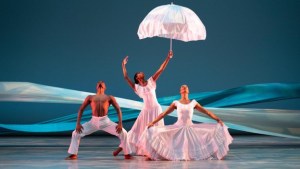

(Ailey II in Alvin Ailey’s Revelations. Photo by Nir Arieli)
Placed beside this photograph, Marie’s lines become a kind of key to Kinetic Ekphrasis. The photograph shows the silk river held still until the poem sets it moving again. “Twirl,” in particular, names a motion the image cannot contain: no single frame can show a turn, only a body somewhere within one. Marie, writing after the dance, supplies what the camera suspended. A viewer encountering only the photograph must do the same imaginative work, filling in before and after, turning stillness back into choreography. Whether the poet saw a performance, a video, or an image, the poem demonstrates the movement a dance photograph asks its viewer to restore.
Miller offers an understanding of photographic ekphrasis that can be particularly useful as we consider Kinetic Ekphrasis. He calls this the “chronotope of the photograph,” a taxonomy based on a description of the image of “an encounter between the photographic subject and its ekphrastic viewer” (18). For Miller, chronotope is a way of characterizing and categorizing the ekphrastic moment within a photograph based on Mikhail Bakhtin’s concept of the literary chronotope. To get a sense of what this means, it is useful to look at an example chronotope. Miller assigns the chronotope, “The Snapshot Elegy,” to describe the act of writing a poem in response to a photo from the past, like an unknown relative, or any similar moment when a poetic speaker accesses the dead via photographs. Miller describes this as “often resurrecting them by way of describing their images. Such resurrections complicate—even foil—the distancing work of mourning figures prominently in the elegiac tradition” (5).
Though Miller doesn’t offer a chronotopic taxonomy for captured movement, such as dance, I would consider “Kinetic Ekphrasis” a type of chronotope, where movement is depicted by way of describing the stationary moment captured in an image from a work of choreography.
The Kinetic Ekphrasis chronotope can be used to develop specific narrative capacities, such as in early medical training, where learners who spend hours with inanimate cadavers in anatomy lab might benefit from developing their imaginative capacities for bodies in motion. In this way, Kinetic Ekphrasis would be of specific interest to individuals working in health, medicine, arts, and humanities, because the subjects of these photographs are and will always be human bodies, an area of interest that overlaps within and connects these disciplines. Which bodies, in which spaces, in which moments, would and should become a rich topic for further reflection and study.
Works Cited
Arieli, Nir. Ailey II in Alvin Ailey’s Revelations. Alvin Ailey American Dance Theater, https://ailey.org/repertory/revelations. Accessed 11 Nov. 2026.
Charon, Rita, et al. The Principles and Practice of Narrative Medicine. Oxford UP, 2017.
Hetherington, Paul, and Cassandra Atherton. “Ballophrastic Poetry: Defining Verbal Conduits to the Dance.” New Writing, vol. 23, no. 1, 2026, pp. 3–19.
Kolnik, Paul. Alvin Ailey American Dance Theater in Alvin Ailey’s Revelations. Alvin Ailey American Dance Theater, https://ailey.org/repertory/revelations. Accessed 11 Nov. 2026.
Marie, Noah Jean. “Dancing / Poema Bailando.” 826 Digital, 2024, https://826digital.com/wp-content/uploads/resources/Writing-10932_dancing-poem-poema-bailando.pdf.
Miller, Andrew D. Poetry, Photography, Ekphrasis: Lyrical Representations of Photographs from the 19th Century to the Present. Liverpool UP, 2015, http://public.ebookcentral.proquest.com/choice/publicfullrecord.aspx?p=4616273.
“Read This Poem: 826NYC.” Poets.org, Academy of American Poets, poets.org/poetsorg/read-poem-826nyc. Accessed 24 Nov. 2026.
“Revelations.” Alvin Ailey American Dance Theater, www.ailey.org/repertory/revelations. Accessed 11 Nov. 2026.