


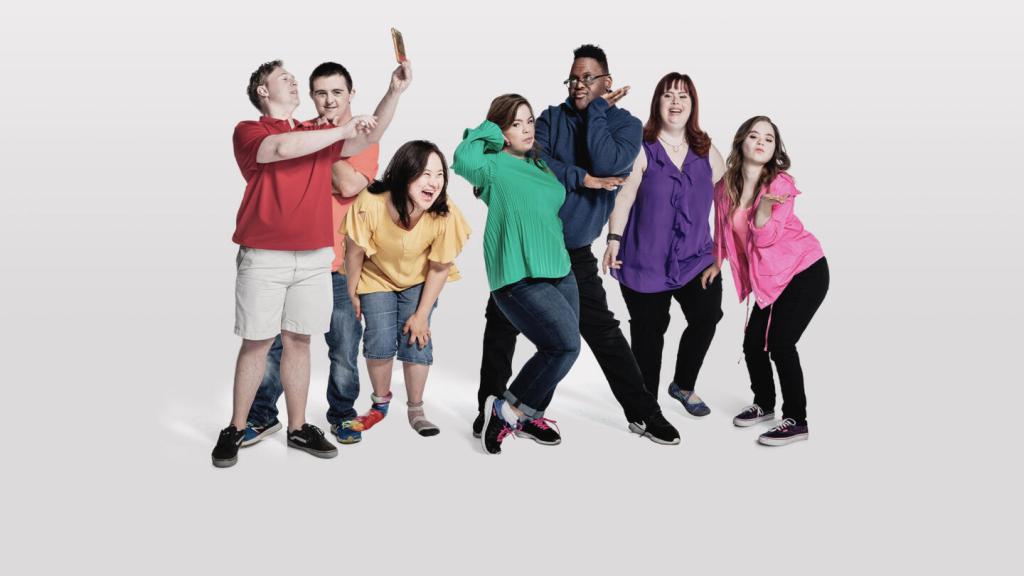
A&E’s Emmy-award winning reality television show Born This Way (2015-2019) was undeniably progressive for its time, serving as one of the first mainstream reality television programs in the United States to center people with intellectual disabilities as primary narrative subjects. Following seven young adults with Down syndrome—Cristina, Elena, John, Megan, Sean, Steven, and Rachel—the series challenges the historical hyper-invisibility of individuals with Down syndrome and reverses what Rosemarie Garland-Thomson calls the normate gaze by placing their lived experiences at the forefront. In doing so, the series disrupts conventional media narratives to demonstrate that adults with Down syndrome actively value and pursue independence, relational autonomy, and professional self-determination.
Yet, in revisiting the show, it reveals a tension between the cast members’ desires for independence, romance, and fulfilling careers, and its pull toward traditional media tropes that reduce disabled lived experiences to affective catalysts for non-disabled viewers. By framing normative adult transitions through a lens of extraordinary triumph over biological deficit, Born This Way risks commodifying its cast’s agency into a digestible, feel-good aesthetic that caters to non-disabled viewers rather than challenging underlying systemic barriers faced by adults with Down syndrome.
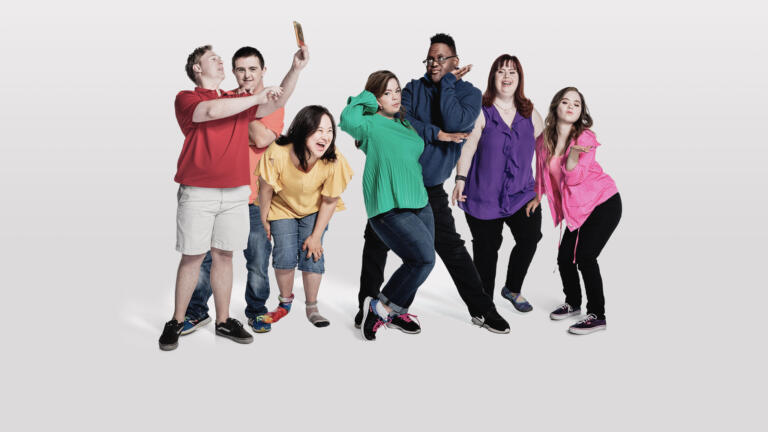

Promotional cast photograph for Born This Way, season 2. A&E, 2016, play.aetv.com/shows/born-this-way/season-2.
Extending disability theorist Robert McRuer’s concept of compulsory able-bodiedness, in which he argues that able-bodiedness repeatedly needs to be performed in order to remain “natural,” the series establishes compulsory optimism, where cast members are most celebrated when they perform optimistic aspirations toward meeting “safe” adult milestones like landing a job, exploring a budding romantic relationship, or giving motivational speeches. Once cast members assert messier forms of adult autonomy, the tone gives way to developmental gatekeeping. This is especially important in medical humanities and disability bioethics because how society views cognitive disabilities directly shapes how parents, educators, and clinicians understand disabled bodies in the real world, which is often through a lens of the deficit and medical models of disability.
Nowhere is this gatekeeping clearer than in the show’s treatment of intimacy and sexual literacy. In Season 3, as the cast attends an adult sex education workshop, their mothers gather for drinks. During the conversation, Megan’s mother, Kris, laughs as she admits telling her adult daughter (who follows a gluten-free diet) that “penises have gluten” and will make her sick. Edited as lighthearted banter amongst the mothers, when the show cuts to the workshop, we see Megan ask the workshop educator in earnest about this, fearing she can actually get sick. While this is meant to be comical to the viewer, Megan’s lack of sex education reveals a harsh truth, that disabled adults are frequently denied sexual health knowledge both at school and at home. As Kris confesses in an interview, acknowledging Megan’s sexuality means accepting that Megan is officially an adult, which is a transition she desperately wants to delay. Through this framing, the series subtly exposes how parental protective instincts can morph into a form of institutionalized infantilization that denies disabled adults full self-determination.
Kris’s gatekeeping relies on a cognitive framework that views Megan almost exclusively through her functional deficits rather than her potential for growth. This deficit-based lens becomes even more pronounced when Megan expresses her adult aspirations to marry and have a child. Rather than exploring how Megan might be supported as a parent, Kris preemptively shuts down the possibility entirely, eventually getting Megan a simulator baby doll—a tool designed for teen pregnancy prevention—in order to “prove” the difficulties of parenting. In the episode “Oh Baby,” viewers see Megan struggle to figure out what the baby simulator needs and her visible frustration when she can’t figure it out. By staging a performative test where Megan is expected to fail strips Megan of her reproductive futurity rather than affording her the dignity to try.
Independent living also follows a similarly conditional logic. Unlike non-disabled young adults who routinely move out into their own apartments or shared living spaces like dorms as a baseline step into young adulthood, Cristina’s transition out of her parents’ home is largely due to a traditional heteronormative milestone: her marriage to her fiancé, Angel. While Cristina has clear support from her parents, Bea and Mariano, and other support staff who teach Cristina and Angel how to care for a home such as washing dishes, doing laundry, and paying bills, her independence is clearly tied to the institutional milestone of marriage rather than self-determination. In fact, Cristina has reservations about the move. Yet, her parents’ push for her to live independently is a result of them wanting her to learn how to be independent so when she and Angel are married, she will know how to manage a household.
Even when the series celebrates triumph, its reliance on compulsory optimism obscures structural realities. Throughout its four seasons, Born This Way highlights career milestones like Megan’s successful clothing brand, John’s rap career, and Elena’s barista training. However, framing employment as an inevitable reward for perseverance and a positive attitude, while empowering for the individual cast members, renders invisible the stark socio-economic reality facing the broader population of adults with Down syndrome, who continue to navigate systemic labor discrimination, sub-minimum wage loopholes, and institutional exclusion.
In the end, Born This Way reveals the limits of compulsory optimism. Celebrating milestones that make the non-disabled viewer feel comfortable because it grants the cast members just enough autonomy to have a false sense of independence does little to change reality if institutionalized support and parental anxieties continue to hold young disabled adults back from being able to experience the messiness that is everyday autonomy. Non-disabled young adults are granted the freedom to make mistakes and grow into adulthood, so why not the same for disabled young adults? Moving beyond spectacle means shifting from deficit-based models of disability to supported decision-making which would give disabled adults the ability to fully claim their own futures.
Works Cited:
Garland-Thomson, Rosemarie. Extraordinary Bodies: Figuring Physical Disability in American Culture and Literature. Columbia UP, 1997.
“Homecoming.” Born This Way, directed by Laura Korkoian, season 3, episode 9, A&E, 11 July 2017. A&E, play.aetv.com/shows/born-this-way/season-3/episode-9.
McRuer, Robert. “Compulsory Able-Bodiedness and Queer/Disabled Existence.” The Disability Studies Reader, edited by Lennard J. Davis, 5th ed., Routledge, 2017, pp. 396–405.
“Oh Baby!” Born This Way, directed by Laura Korkoian, season 2, episode 10, A&E, 20 Sept. 2016. A&E, play.aetv.com/shows/born-this-way/season-2/episode-10.
Promotional cast photograph for Born This Way, season 2. A&E, 2016, play.aetv.com/shows/born-this-way/season-2.
“What Love Means.” Born This Way, directed by Laura Korkoian, season 3, episode 7, A&E, 20 June 2017. A&E, play.aetv.com/shows/born-this-way/season-3/episode-7.