


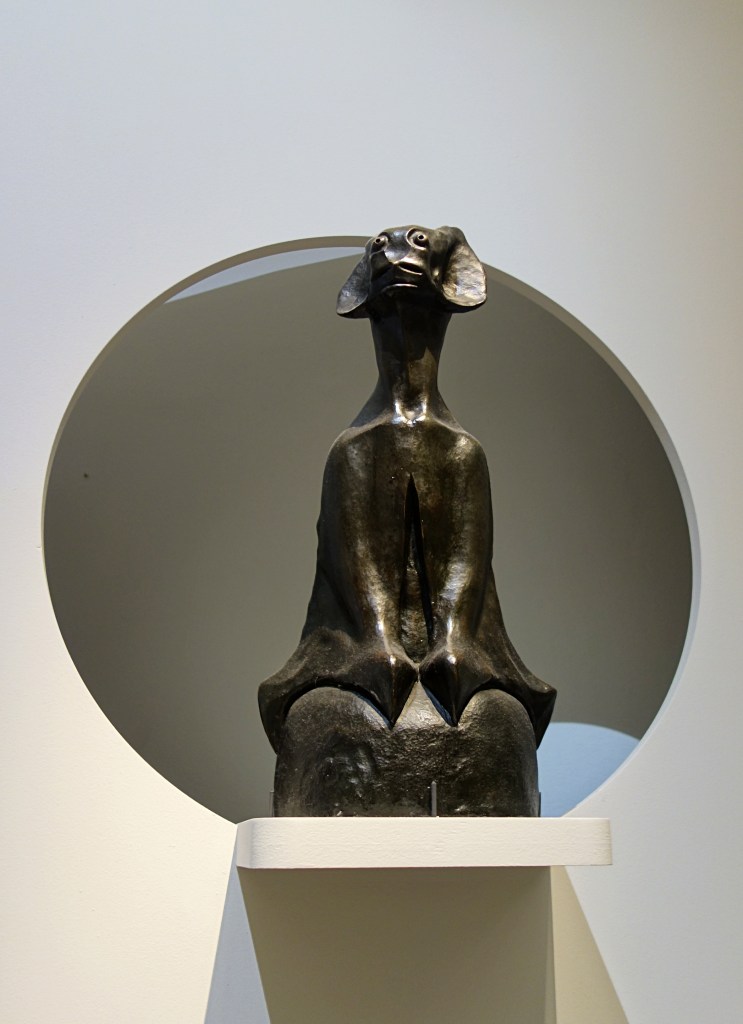
This article is a reflection on visual artist and writer Léopold Chauveau’s creative worldview in the context of present-day challenges relating to equity, diversity, and inclusion. Chauveau’s present-day reception context is particularly significant because he is a long-neglected figure attracting a resurgence of interest, following the donation of his works to the Musée d’Orsay and the museum’s major 2020 exhibition “Au Pays des Monstres” (In the land of monsters). The starting point for my doctoral research, to which this article gives a brief introduction, is the striking similarities between Chauveau’s utopian concept of positive monstrosity and utopian ideas developed within the neurodiversity movement.
This article begins by discussing two short texts by Chauveau, conserved in the Musée d’Orsay archives, that convey ideas about the cathartic value of monstrosity and creative practice amidst personal and political traumas (all translations are my own). I then present two examples of visual artworks in different genres, relating them back to the ideas presented in the texts. As this article can only present a small sample of Chauveau’s extremely prolific œuvre, I would invite readers to consult the catalogue of works held by the Musée d’Orsay. I would also encourage readers to watch my presentation for the 2026 panel discussion “Monstrous Pride” (Murray et al., 0:15:18-0:24:35), where I introduce and show reproductions of other significant artworks.
The panel title evokes parallels between Chauveau’s ekphrastic texts about his sculpted monsters and recent texts by neurodiversity activists, including the event chair, Scottish researcher and activist Fergus Murray. In 2021, Murray established Weird Pride Day (4 March) as an invitation for people to express pride in their weirdness, a traditionally negative term that Murray reclaims to refer to individual uniqueness and particularly to Special Interests. The capitalised term Special Interest is a re-appropriation of “special interest”, a medicalised term about autism that neurodiversity activists are reclaiming to celebrate idiosyncratic passions.
Chauveau’s intense interest in monstrosity and therapeutic relationship with his sculpted “monsters” is a powerful example of a Special Interest, which Chauveau explicitly conceives in terms of pride in uniqueness. Chauveau’s prose poem “Samöens décembre 1909”, written four years after he began sculpting, vividly presents these ideas and Chauveau’s deep bond with his sculpted monsters. His studio is depicted as a space of nocturnal recovery from the social alienation and sensory overwhelm Chauveau experienced in his traumatic day job as a medical doctor:
Samoëns, December 1909
In my studio — I dream in the midst of monsters, I see again, frozen in hard matter, the painful contortions of my soul, and I forget, for a few moments, the encounters endured during the day.
I wash myself of the stains left in my ears by the words heard, in my eyes by the sight of ugliness and dirt, of vulgarity and baseness –
Dear monsters, happy monsters, you do not know anguish, you live calm in your tormented forms, proud to resemble no other being.
Alas! that pride is also mine, but to me it brings only torment and misery.
Chauveau’s sentiments are echoed by David Grey Hammon in his reflections on Weird Pride Day, where Hammond writes about the violence he has suffered for not being “normal” and ends by addressing “my fellow weirdos”. Thus, both Chauveau and Hammond find refuge in a heteroclite community that celebrates individual uniqueness. They address this community in the second person, re-appropriating terms used to denigrate otherness: “monster” (monstre, Chauveau) and “weirdo” (Hammond). However, unlike Hammond, Chauveau does not have access to the forms of community generated by more recent knowledge of neurodiversity (and other forms of difference) or by organised movements.
For myself as a neurodivergent researcher, access to these forms of community creates opportunities for knowledge exchange within and beyond academia. For example, the 2026 event prompted me to reflect on how monstrosity and weirdness are all-encompassing categories, created to other any being who does not fit within arbitrary (and constantly shifting) mental and physical norms. My co-panellist Surekha Davies coined the term “monstrification” to refer to this process of othering. I have started to conceptualise Chauveau’s creative practice as a manifestation of the opposite phenomenon Davies calls “monstrofuturism”, which “does the work of imagining a future where difference is celebrated rather than shunned” (236).
These concepts have helped me to analyse the political significance of Chauveau’s thought, as it relates to wider questions of diversity and more specifically to anti-fascism. Murray’s short text “2026: Weird Pride in a Hostile World” situates the celebration of weirdness over normality as a form of everyday resistance against far-right movements. Similarly, in a diary entry dated 27 September 1939, Chauveau presents his creative practice as a form of everyday resistance that expresses monstrofuturist values diametrically opposed to totalitarianism: “I draw monsters — very sweet, very gentle, very inoffensive; very ridiculous compared to the real, living monsters now shaking up the world — very un-monstrous even compared to Hitler’s hideous mug.
The term “ridiculous” (ridicule) points to the central importance of comedy and satire throughout Chauveau’s varied œuvre, and I will now analyse how Chauveau uses humour in complimentary ways in two visual artworks in different genres. One of Chauveau’s earliest sculptures, named in the catalogue as Monstre (autoportrait?) [Monster (self-portrait?)], comically exaggerates Chauveau’s physical features, including his prominent nose and ears. Here, Chauveau uses self-deprecating humour to convey humility but also self-acceptance and indeed pride in his unique identity, which is shaped by his Special Interest to such an extent that he depicts himself as a goblin-like “monster”.
The second example is a black ink illustration for Chauveau’s story Le Bouffon Babriot [Babriot the Bouffon], a monstrofuturist satire in which a court jester becomes king and enacts a programme of anarchic, utopian reforms. Here, Chauveau re-appropriates the history of jesters’ performances, which in medieval and Early Modern Europe depicted as absurd any attempt to undermine the aristocratic social order. Current research projects such as “AMEND-Early Modern Neurodivergence” are exploring the deeply problematic history of how jesters were exhibited as “fools” and how court artists frequently depict them as physically deformed “monsters”. Chauveau satirises hierarchies of intelligence with his depiction of the cunning Babriot, a name derived from babiller (to babble) and idiot (idiot) that Chauveau had previously given to one of his sculpted monsters. He depicts not Babriot but the previous king and his supporters with grotesque features, in a powerful response to modern totalitarianism.
The modern context is conspicuous in this absurdly anachronistic drawing of Babriot leading a group of Black soldiers against the former king’s executioners, each displayed with his instrument (rope, kindling, impalement spear, axe, and poison) on the floor. Chauveau’s subversive approach to humour is evident in the drawing’s caption, included in a document conserved at the museum: “The black troops lead by Babriot rush in./ The five assistant executioners hold up their hands”. Here, Chauveau subverts the expectation of contemporary audiences that the term “black” (noires: not yet a standard term for people of African descent) refers to Fascist Blackshirts, instead depicting solidarity between groups subject to Fascist monstrification. Throughout his œuvre, Chauveau imagines how people from multiple backgrounds could build an inclusive society based on monstrous pride.
Works Cited
“AMEND: eArly Modern European NeuroDivergence”. https://www.earlymodernneurodivergence.com/. Accessed 15 Nov. 2026.
Chauveau, Léopold. “Carnet 1, Mémoires de Léopold Chauveau, fin août 1939 — au 9 octobre 1939, H. 14,2; L. 11,7 cm” (Notebook 1, Memoirs of Léopold Chauveau, late August 1939 to 9 October 1939, H. 14.2; L. 11.7cm). Paris, Documentation du Musée d’Orsay, Fonds Léopold Chauveau, Boîte 2, DOC.MO.2019.15.35. Page reference to electronic transcript.
—.Le Bouffon Babriot. c.1931-3. Musée d’Orsay, Paris.Accessed 14 Nov. 2026.
—. “Manuscrit sous formes de légendes du Bouffon Babriot (les 54 feuillets sont classées dans l’ordre de l’histoire)” [Manuscript of captions for Le Bouffon Babriot (the fifty-four sheets are classed in the order in which they appear in the story)]. Paris, Documentation du Musée d’Orsay, Fonds Léopold Chauveau, Boîte 1, DOC.MO.2019.15.34.
—. Monstre (Autoportrait?). 1908. Musée d’Orsay, Paris. https://www.musee-orsay.fr/en/artworks/monstre-autoportrait-202181. Accessed 13 Nov. 2026.
—.‘Texte écrit à Samoëns datant de décembre 1909 évoquant le processus créatif de petits monstres (1 feuillet) H.19,7cm; L14,5cm’ [‘Text evoking the creative process for the little monsters (1 page)’]. Paris, Documentation du Musée d’Orsay, Fonds Léopold Chauveau, Boîte 1, DOC.MO.2019.15.26.
Davies, Surekha. Humans: A Monstrous History. Oakland: University of California Press, 2025.
Hammond, David Gray. “Weird Pride Day: Changing the Narrative”. NeuroClastic. 4 Mar. 2021. https://neuroclastic.com/weird-pride-day-changing-the-narrative/. Accessed 12 Nov. 2026.
Murray, Fergus. “2026: Weird Pride in a Hostile World”. Weird Pride Day. 2026. https://weirdpride.day/2026-context. Accessed 13 Nov. 2026.
Murray, Fergus (chair), Surekha Davies, Sumita Majumdar, Nat Paterson, and Elizabeth Ito. “Monstrous Pride”. YouTube. 4 Mar. 2026. https://www.youtube.com/watch?v=0KjgcBFYhAQ. Accessed 12 Nov. 2026.
Cover image: Léopold Chauveau, Pernimase, 1919, hammered bronze, Musée d’Orsay, Paris. Image © Velvet, 2020, reused without changes under the Creative Commons Attribution-Share Alike 4.0 International license.