


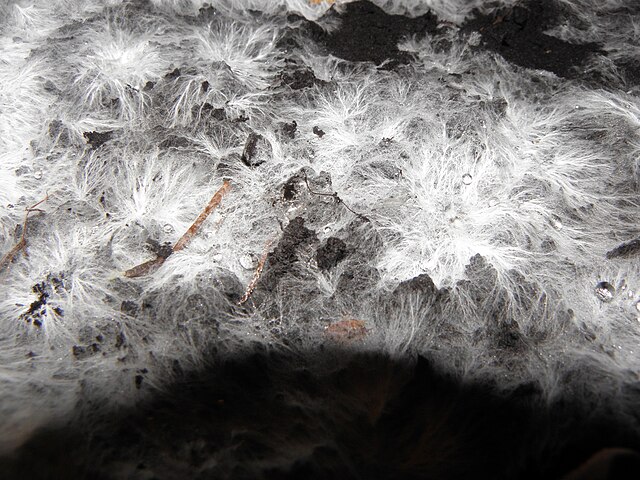
Image Credit: Photograph of fungal mycelium by Rob Hille, used under Creative Commons licence.
.jpg)
If we end the story with decay, we abandon all hope––or turn our attention to other sites of promise and ruin, promise and ruin.
The Art of Noticing, Anna Tsing
Crip theory has often sought out conceptual frameworks that resist linearity and embrace multiplicity. Scholars have turned to Deleuze and Guattari’s rhizome as a model for spatial and temporal thinking that is “multilingual, multidirectional, and multiple rather than binaristic, and horizontal rather than strictly vertical” (Chen et al. 19). Petra Kuppers likewise employs the rhizome as a framework for reimagining disabled ways of living, the concept of disability, and disability poetry (Kuppers, 2009). She proposes a “rhizomatic model of disability that can hold a wide variety of experiences and structured positions in moments of precarious productive imbalance” (93). Rhizomatic thinking emerged as a conceptual framework to challenge hierarchical structures and resist colonial and territorial logic. However, scholars like Mel Chen have argued that the rhizome does not preclude violence or encroachment. As they observe, “the rhizome doesn’t eliminate the possibility of single-source growth from iconic, dubious schematic origins, and it does not remove the fantasy of territorial growth from its fantasy of distribution of knowledge. Even the rhizome can be colonial” (Chen et al., 16). This necessitates other models of thinking.
As such, this essay considers fungi as an alternative model for disability justice––one that marks a shift from horizontality to web-like thinking. Fungi play a fundamental role in ecosystem collaboration and resource distribution among plants and animals. They serve as vital pathways for resource exchange within forests and contribute to the overall health and balance of ecosystems. Through mycorrhizal associations and other symbiotic relationships, fungi facilitate the exchange of nutrients, information, and support among various organisms. Their interconnected networks span vast distances underground, connecting disparate elements of ecosystems and promoting resilience and mutualism. Isn’t this exactly the kind of supportive, distributive work that disability justice prioritizes? Fungi, as such, teach us a similar ethic of care. It leads us to ask: what if the future isn’t about progress or making new worlds, but about reimagining survival amongst the ruins? This essay considers how fungal ecologies can animate understanding of disability, care, and post-capitalist futures.
I argue that fungi may act as an alternative metaphor to the rhizome for reimagining alternative forms of temporalization and spatialization, as well as relationality, resistance, and regeneration. The relationships and knowledge formed through our interactions with fungi, I argue, embody a politically and theoretically potent intimacy—one that challenges dominant epistemologies, particularly those that have been violent toward disabled people. Inspired by Anna Lowenhaupt Tsing, who traces the story of global capitalism through the lives of mushrooms, this essay invites a synthesis of crip ecologies and multispecies ecological ethics, centering mycorrhizal networks as models for collective care and relationality.
As a chronically ill and neurodivergent person who relies on lion’s mane mushroom extracts for support, I am both materially and metaphorically aligned with thinking through fungi. This orientation informs my engagement with fungi not only as biological entities but as epistemic guides. My thinking is also shaped by what it means to think criply—to think about collaborative survival. Crip being is being-with: it is an insistence on relationality. To consider crip life in the ruins of capitalism is also to think beyond it. Crip thought attends to the ruins, finding in them the possibilities that Tsing describes. For some, these ruins represent a distant future; for others, they have always defined the conditions of life. Disability itself can be understood as a form of ruination. To think criply with fungi, then, is to cultivate an imagination for survival within and beyond these ruins. Crip studies call us to recognize and honor the interdependent networks—human and more-than-human—that sustain life and to learn from their symbiotic wisdom.
“Making worlds is not limited to humans,” writes Anna Tsing (22). She calls on us to consider mushrooms as they teach us about “collaborative survival in precarious times” (2), for when Hiroshima was destroyed by the atomic bomb in 1945, the first living thing to emerge from the blasted landscape was a matsutake mushroom (3). Fungi not only make worlds—they also unmake them, recomposing as they decompose. I extend this invitation by asking: what happens when we consider mushrooms criply? When read through a crip lens, fungal temporalities challenge the mechanization of time under capitalism, resisting the demands of efficiency, accumulation, and colonial futurity. Tsing describes fungi as operating within “temporal polyphonies,” unfolding through multiple, intersecting temporal rhythms rather than adhering to a single, teleological timeline (viii). This indeterminate and adaptive temporality mirrors crip time, which similarly unsettles normative expectations of productivity and embodiment. Fungal indeterminacy further offers a generative site of knowledge. Fungi thrive in unpredictable and adaptable ways, resisting rigid categorization. When read through a crip lens, this indeterminacy disrupts ideas of the ‘normate’—the mechanization of ableism, gender conformity, and heteronormativity. As Tsing notes, human bodies are shaped by social expectations of normativity, demanding certain determinate forms and traits. Fungi, by contrast, continuously shift and reshape themselves in response to their encounters. Their modes of survival resist fixity, offering a model for imagining post-capitalist and crip ecologies—two frameworks that, ultimately, cannot exist without one another.
This line of thinking also requires an acknowledgment of its inherent risks. It is difficult to think aspirationally about ruins while ongoing genocides devastate entire lands, lives, and ecosystems. Ruins are not merely conceptual; they mark destruction—of people, infrastructures, lineages, vegetation, and resources. Yet, even as we honor these realities, it is crucial to recognize endurance and regeneration—not just as distant horizons but as practices in the present. The imaginative and scholarly work we undertake, then, must carefully and care-fully attend to those who build worlds within ruins. It requires a commitment not just to decay but to reparation. This is where fungi help our thinking.
However, these webs also bring forth complications. Fungi, as disabling agents causing environmental illnesses, are also embedded in capitalist circuits of production and labor. Further, Tsing’s study of the Matsutake mushroom highlights how fungi participate in an informal economy reliant on the labor of “invisible interlopers”—disabled white veterans, Asian refugees, Native Americans, and undocumented Latinos (18). Historically, fungi played a key role in plantation economies, exploited for sugar and molasses production and, enriching white owners through enslaved labor (Tsing 149). Fungi have also been weaponized to justify racial and class segregation, with mold and fungal infections used to stigmatize the “contaminated” racialized poor, particularly women in lower-income communities (Tsing 150). For example, exposure to toxic molds is disproportionately higher among certain communities of color in the Global North, often due to housing precarity and racial segregation. Fungi’s multivalence as both a sustaining and toxic agent allows us to understand toxicity as a layered and relational designation—one through which certain homes, spaces, and bodies are rendered more toxic than others. These disparities are not incidental but emerge from material conditions shaped by structures of race and class, where environmental exposure becomes a mechanism of racialized and economic stratification; linking fungi to disability in ways that transcend metaphor.
As such histories are unearthed, fungi take on a deeper political valence in relation to disability. They are everywhere, shaping our crip stories. Fungi offer not just metaphors but lived relations—kinships that embrace our permeability, particularly in the context of climate catastrophe, settler colonialism, racialized violence, and the biopolitical death of disabled people. They invite us to think not of a singular future but of futures. Fungi teach us how to weave poetries and webs of care after ruination. If we believe that the world as it is cannot sustain us, fungi remind us that there may still be futurity without its dissolution––a site of promise and ruins, the promise of ruins.
Works Cited
Chen, Mel Y., Kafer, Alison, Kim, Eunjung and Minich, Julie Avril. Crip Genealogies, New York, USA: Duke University Press, 2023. https://doi.org/10.1515/9781478093725
Kuppers, Petra. “Toward a rhizomatic model of disability: Poetry, performance, and touch.” Journal of Literary & Cultural Disability Studies, vol. 3, no. 3, Dec. 2009, pp. 221–240, https://doi.org/10.1353/jlc.0.0022.
Tsing, Anna Lowenhaupt. “Arts of Noticing.” The Mushroom at the End of the World: On the Possibility of Life in Capitalist Ruins, Princeton University Press, 2015, pp. 17–25. JSTOR, https://doi.org/10.2307/j.ctvc77bcc.6.
“Unruly edges: Mushrooms as companion species.” Environmental Humanities, vol. 1, no. 1, 1 May 2012, pp. 141–154, https://doi.org/10.1215/22011919-3610012.