


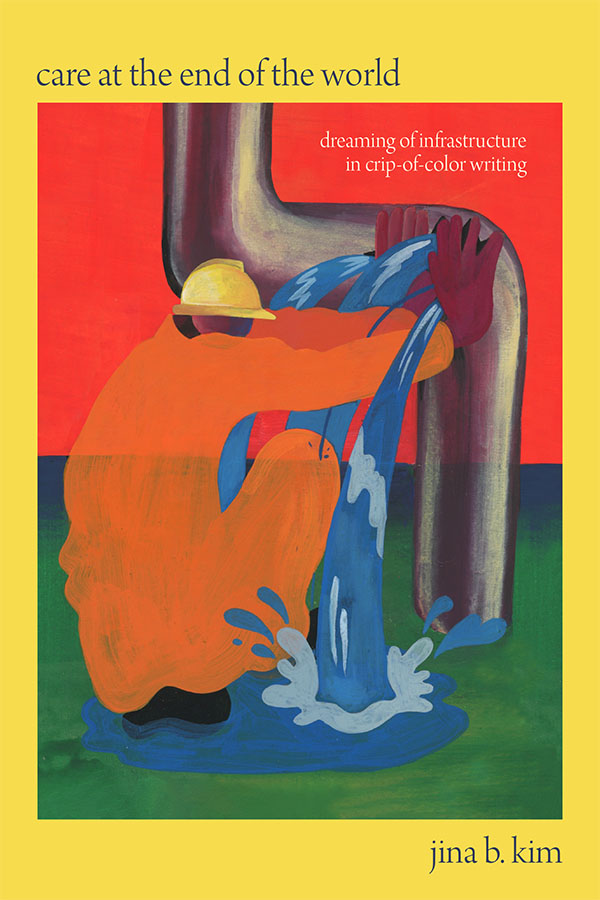
Image Credit: © Jina B. Kim, Care at the End of the World: Dreaming of Infrastructure in Crip-of-Color Writing (Duke University Press, 2025), reproduced under fair use provision (review).
Jina B. Kim begins her new book – as the title, Care at The End of The World: Dreaming of Infrastructure in Crip-Of-Color Writing (2025), makes clear – at the end. Kim details the difficult passing of her best friend from brain cancer. Yet, she presents this ending as a beginning: the lack of care that her friend received – from long waits at the hospital to difficulties with her partner-caregiver to accumulating costs – leads Kim to begin “dreaming of other, more expansive arrangements of care” (1). She stresses the novelty of such dreaming: disabled Korean American women like her are not allowed, or at least not expected, to dream. As Kim expounds, disability “is so often seen as antithetical to freedom” in being understood in the popular imagination as bound, whether to a bed, house, or wheelchair (2). She counters this casting of disability outside the scope of political liberation: Kim does so by considering how contemporary ethnic American writers – from Sapphire and Jesmyn Ward to Samuel Delany to Octavia Butler and Karen Tei Yamashita – “bring disability and dependency to the forefront of their literary freedom dreaming” (2). What disabled folks dream of, she explains, is infrastructure.
Kim offers another ending as the primary context for such literary dreaming: the evisceration of the welfare state. Beginning at this ending allows Kim to question the very beginnings of the field of disability studies. Kim notes that early disability scholarship aligned itself with the 1990 Americans with Disabilities Act (or ADA), even crediting the passage of this legislation for the very emergence of the field. She, following Samuel Bagenstos, reads the ADA as colluding with the “conservative logics” of welfare reform, pointing out that supporters posed this legislation as vital to weaning disabled citizens off public assistance and sending them into the workforce (5). Kim models an analysis of disability focused on anti-welfare and austerity policies. She chooses the 1996 Personal Responsibility and Work Opportunity Reconciliation Act (or PRWORA) as her periodizing event. What interests Kim is the rhetorical framework of this welfare reform: the mythical threat of state dependents – namely, the welfare queen, the disabled nonworker, and the parasitic immigrant – draining the nation’s resources. She contends that such a narrative of “pathological dependency” has shaped not only policy but also disability writing produced under the long shadow of Reagan (9).
Kim develops the concept of infrastructural violence to name the debilitating effects of uneven resource distribution produced by the anti-welfare policies of the state. Such a concept allows her, in an echo of Cathy Cohen, to “expand” the scope of state violence to include not only the carceral system and police brutality but also the defunding and militarization of public schools, attacks on Medicaid, and the privatization of the health/care system. She builds on the work of scholars like Akemi Nishida and Jasbir Puar in offering accounts of disability not as an individualistic identity but rather as the effect of processes of racialized disablement. For instance, in chapter one, Kim describes how the education system represented in Sapphire’s Push (1996) structurally reproduces illiteracy in vulnerable populations, with Precious’ “prospects for economic stability and social mobility” remaining “foreclosed” throughout (39). She extends the domestic to the transnational, in chapter three, reading California freeway fictions, like Butler’s Parable of the Sower (1993) and Yamashita’s Tropic of Orange (1997), as depictions of how trade regulation – namely the North American Free Trade Agreement (or NAFTA) – produces unequal mobility, with the freedom enjoyed by resourced populations “linked” to the constriction of the vulnerable (94).
Such imaginative engagements with civic infrastructure permit a recuperation, according to Kim, of the maligned condition of dependency: not as evidence of failure, but rather as the name of a social bond that makes life more possible. Kim demonstrates that sanitation work derives its importance in Delaney’s Through the Valley (2012) “from dependency – that is, from the reliance of municipalities on the regular, effective management of waste” (77). She shows that the novel eroticizes waste management as sexy and joyful, lifting up labor and enabling dependency to be seen as such. Kim utilizes a crip-of-color critique methodology that – in moving disability studies away from a single-issue focus, as evidenced in the scholarship of Sami Schalk and Julia Avril Minich – allows disability to be revealed as the key in Through the Valley to “imagining the multiplicity of ways different bodies might enjoy sexual and social contact” (67). This methodology enables her to name abjection as the mode through which Black, queer, and disability politics converge in the novel, with pleasure deriving from the partial and relational nature of selfhood.
Kim shifts later to the health/care infrastructural landscape that followed the passage of (and assaults on) the 2010 Affordable Care Act. She does so by turning to the “wild disability justice dreams” that she discovers in the disability justice life-writing of Leah Lakshmi Piepzna-Samarasinha and Aurora Levins Morales. Such dreams, according to Kim, “manifest infrastructures of abundant care capable of supporting disabled life and brilliance” (144). The concept of “abundance” has recently been used by liberal thinkers like Ezra Klein and Derek Thompson to propose, as Malcolm Harris has shown, an alternative to the policies of the “socialist left” like welfare state expansion. Kim reappropriates this concept for the left, using it contrastingly to express a “queer and crip longing for more – more resources, more support” (144). Kim returns at the end, through a close reading of Alexander Chee’s “After Peter,” to the beginning – to dreaming of infrastructure, of friendship. What her book reveals and then continues is a tradition of infrastructural freedom dreaming that reimagines what is and reaches towards what could be.
Works Cited
Bagenstos, Samuel. “The Americans with Disabilities Act as Welfare Reform.” William and Mary Law Review 44, no. 3 (2003): 921–1027.
Cohen, Cathy. “Punks, Bulldaggers, and Welfare Queens: The Radical Potential of Queer Politics?” glq: A Journal of Lesbian and Gay Studies 3, no. 4 (1997): 437–65.
Harris, Malcolm. What’s the Matter with Abundance? The Baffler, 18 March 2025, https://thebaffler.com/latest/whats-the-matter-with-abundance-harris
Kim, Jina B., and Sami Schalk. “Reclaiming the Radical Politics of Self-Care: A Crip-of- Color Critique.” South Atlantic Quarterly 120, no. 2 (2021): 325–42. https://doi .org /10 .1215 /00382876 -8916074.
Klein, Ezra, and Derek Thompson. Abundance. Simon & Schuster, 2025.
Minich, Julie Avril. “Enabling Whom? Critical Disability Studies Now.” Lateral: Journal of the Cultural Studies Association 5, no. 1 (2016). https://doi .org /10 .25158 /L5 .1 .9.
Nishida, Akemi. Just Care: Messy Entanglements of Disability, Dependency, and Desire. Philadelphia: Temple University Press, 2022.
Puar, Jasbir. The Right to Maim: Debility, Capacity, Disability. Durham, NC: Duke University Press, 2018.