

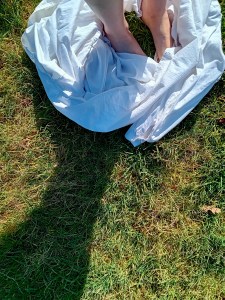
like a dress
made of light.”

ADDICTION
In Matthew Nienow’s verse collection If Nothing (2025), the writing “I” looks back on his experience as a long-time addict. Some poems’ titles explicitly indicate the thematic coherence of the collection (“Four years to the day,”, “Getting off antidepressants,”, “My Disorder”), while the word “toke” recurs no less than twelve times, like a sticky negative mantra, in “Bookending the day.”. However, it is no coincidence that the word “alcohol” is nowhere to be found, even though heavy drinking is implied throughout the book. Indeed, Nienow’s work is not another sensationalistic glimpse into an addict’s life. It is a retrospective reflection – as tortured as it is elegant, as remorseful as it is hopeful – on how addiction functions as a seductive trap that alienates your body, imprisons your mind and squanders your life.
BRIGHT
There is a lot of light shining through If Nothing, as though it were the transubstantiation of life itself. Self-hatred and despair will “di[m it] with doubt[s].” But more often, Nature anchors the self and redeems it, bountifully offering its “bright kernels” or “lassos of light,” which “hi[t] the leaves” or “summer through” them… Brilliance permeates the entire collection, like the glimmer of hope that comes with a second chance.
CARRYING
On the book’s cover, a man holds a child at arm’s length, in a posture that is both dangerous and perfectly safe. “Cover photo provided by the author.” Matthew Nienow carries his son with pride and determination. And with him, his past as an irresponsible parent, his present as a recovering adult, and his future as a loving father.
DISAPPOINT
What If Nothing teaches you is that the main thing about being an addict is not how you will cheat death with an insolent luck you can’t explain. It is how, through this cheating, you will disappoint others and, above all, yourself.
EMPATHY
“I kicked the dog. / Screamed at my sons. / Broke every promise / I’d made.” (“Beginner’s Mind”). This book puts you in the delicate position of spontaneously empathizing with someone who’s on their courageous path to sobriety – someone who then writes this. Without going so far as to compare Matthew Nienow with Shakespeare’s Richard III (when he famously lets you in on his dark deeds at the start of the play), it is true that reading If Nothing gives you a similar sense of unease: one that makes you feel how someone writing to you from a place of confidence is not essentially a good person.
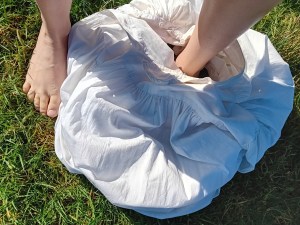
made of the self
-spun cocoon.”

FRAGILE
Here is another word you will not find in any of the poems. And yet, fragility exudes throughout this collection – not as weakness or frailty, but as a renewed relationship with a reality that now escapes the logic of shielding, finally allowing the writer to embrace his inner rifts; to tell his truth without wrapping it in a “story to save [him] from [himself]” (“Cocoon”).
GUILT
“I do not / deserve this / chance to be good.” (“Beginner’s Mind”) – “No apology will ever be enough.” (“Dusk Loop”) – “having, / in the dreams, worked to mend all the hurts / I’d caused” (“Getting off antidepressants”) – waking with bruised / knees from my constant / kneeling & even still / I do not forgive myself” (“Even if the Past Is Not a Place You Can Visit”) – I am, with my life, / carving my apology from this stone.” (“Apologia”).
HINDSIGHT
Despite the harshness with which Matthew Nienow judges himself throughout the book, it remains breathable. Indeed, the poet sometimes demonstrates an ability to step back, putting his past suffering into perspective by giving it an absurd dimension. He does it with a timely sense of derision, pinpointing the ridiculousness of some of the typical addict situations in which he found himself (such as the impish “What Luck,” in which the poet crowns himself “King of Lost Keys”).
INNOCENCE
The goodness with which your child looks at you makes it unbearable to look at yourself.
JOY
If guilt were the only flow running through the poems, they would compose a dry collection. But one of its opposite currents is that of gratitude. For the shoulders of a woman, the freedom of a bird. For the wind in a child’s hair. For the space you are finally able to hold for someone else. For all the hardships, and all the forgiveness.
KALEIDOSCOPE
What could have or should have been. What I should or could have done. If I had not been drinking. If I had not stopped drinking. There is a slippery slope that fiction can make you go down. A precipice that it is better not to look at too closely. The only time the poet leans over it, he does it without complacency: his clinical poem “Alternate Endings” lists all the random twists and turns his life could have taken, from “vivi[r] en México con la novia y sus abuelos” to heavier drinking still.
It was not about beauty.
Beneath my shame,
the body
was a raw, red thing,
untrained in acceptance.”
LOOP
Reading the collection in one go may give you an impression of repetitiveness, as if all the poems were saying the same thing through a different form. As if you were “somehow stuck on a short loop” (“Dusk Loop”) of grip and release. But maybe that’s the point. For life is a fast-flowing river, memory is a handful of water, and writing is a single drop under a microscope.
MERCILESS
The poet does not glorify himself; neither for embarking on a journey towards redemption, nor for writing about it. He is all too aware of the banality of such a path – almost dissociated, for example, when he writes “[I] have / enrolled in forgiveness studies” (“In the Mirror Looking Back”). This clever casualness makes him relatable – if not likable.
NOTHING
Nothing is a scary word. Counting for nothing. Coming to nothing. But in this work, “nothing” is plenty. Nothing is quiet. Nothing is reasonable. It is about acknowledging a void at the centre of oneself and the universe, and making room for it .
OWNING
If Nothing depicts dependence as a pit that swallows everything you thought you owned – starting with your sense of self. But after all these years of this costly habit, the ultimate eureka of deprivation seems to be that ownership is a vain construct. Because what you would most love to reclaim now is everything that went down this pit – and yet “the past cannot be owned” (“Ghazal of lost years”). So, what can you own, then? A tangible patch of land (“Ownership”), the work of your hands (“Regret”)? But most of all, will you stand up for all that is lost, and own “a portion of the pain” you have caused (“Begin Again”)?
PITIFUL
The writing “I” can be pitiful.
But the poet does not want you to pity him.
This dignity will turn your pity into compassion.
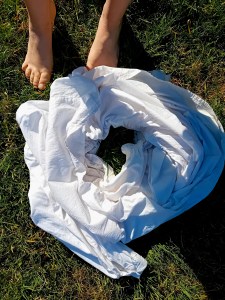
and cool as a mother
blowing gently
on a burn.”
QUENCH
Quench or quell. Edge or ledge. Cure or curse. Error or mirror. Struggle or sobriety. The collection is dotted with effects of sonic and semantic parallelism; possibly the formal equivalent of the notion of second chance, on which the entire text is built. Certain words thus seem to return slightly transformed – same but different, like the author himself.
REDEMPTION
Yet another word you will not find in If Nothing – although you will find a treacherous “Lord of the sour stomach” (“Useless Prayer”), or a ruthless “Green God” of smoking (“Bookending the Day”). Indeed, the poet’s path to redemption seems utterly terrestrial, as if he refused looking for external excuses and leaning on moral crutches.
SHAME
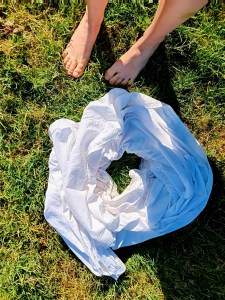
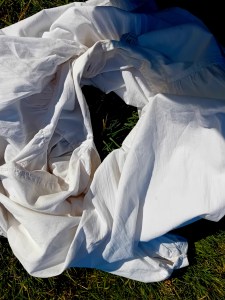
Since a reader’s subjectivity is bound to express itself in irrepressible outbursts, this is the moment for me to say how I find the poem “And then”, which closes Matthew Nienow’s collection, to be an absolute gem that, alone, justifies reading it. It has the concision and clarity of a vision. It condenses, while shedding everything that was written before. It is both earthly and spiritual, and speaks directly to your soul while prompting your body to respond to it in a way it will find. Did you know shame is a dress?
TIME
Like guilt, time is a theme that suffuses If Nothing. There is that one moment of pure innocence frozen in a clear, eternal image: the birth of a first son (“On the Condition of Being Born”). But this primordial time, “who can remember [it]”? There is the years-long loop of a day getting wasted – in every sense; “no such / thing as time”, then (“What Luck”). The recovered addict playfully jokes about it: “time was like math in 11th grade — / I didn’t get it (“In All the Wrong Places”). But at the end of this years-long day, there comes the cruellest deity of all – “Lord of How Time Flies” (“Useless Prayer”) – demanding tribute.
UNMETRICAL
The poems, which are never rhymed, display great stylistic variety. Some verses are diary-like, dealing with the mundane aspects of addiction as if they were not deserving of technical work: “Drunk again. One tall bottle of that monk brew Golden / Monkey and a sixer of Rainier that went down like water.” (“Daily Log #104”) Other verses are long streams, only interrupted at the end of the line so you can catch your breath along with the poet: “And because we have seen this done so many times now / in that same repeated movie, we can believe it really happens, and because / we can believe it, it must be so.” (“Dusk Loop”) On occasion, the language is sparse and dry, each verse a lapidary aphorism in itself: “Forget your blanket of wants.” (“In Deed”) But brevity is not always synonymous with abruptness. Sometimes, very short verses follow one another as if in a hurry, trying to catch up with a dream-like vision that slips away: “[…] nothing lost, actually, / nothing ever actually lost / in the borderless realm / of time and the shapes / that case the misplaced / energy of the stars.” (“After the Fire”) And there are these beautiful short verses that drop down your soul, like light touches the bottom of a well: “I was / this close / to erasing my name.” (“Sometime in March 2017”)
in the fabric,
I thought it my skin.”
VERTIGO
A knife to the chest. A foot close to a ledge. A knife in one hand. A calling from the edge. O to still be there. Despite all odds. What nonsense. What a miracle.
WASTE
“I have wasted so many days.” (“Raison d’être: Night Work”) Harsh in substance and neutral in form, this life assessment is not an elegy. At no point is this collection a complaint; at no point does the poet reclaims the debt of a life wasted by his former self. But there is waste indeed, and that is a fertile feeling. Because you can only know something has been wasted when you want to preserve it. “To dig in the dark for night sounds / To sniff at the earth caught under fingernails / To wonder at what grows in the turnover / of freshly mulched mounds” (“Raison d’être: Night Work”). What grows is waste, turned into life.
X’S AND O’S
In one of the very last poems of If Nothing, Matthew Nienow writes about all the things he does not mention in his letters to “old friends turned strangers” (“Just Across the Wheel from You”). The precious pulp of the hours. Life’s smallest-biggest moments, frozen like Polaroid pictures whose importance no one can truly grasp. He observes that this should be shared, rather than the conventional “xs & os” scribbled at the end of a message. But in the end, isn’t what poetry is made for?
YEARS
“Four Years to the Day”, “Five Years Now”, “Ghazal of Lost Years” … Highlighted in several poem titles, years are a prominent theme in If Nothing, and indeed a complex math problem. The years of sobriety add up. But lost years must be subtracted. The “years of binge” (“Cocoon”) count triple – or are they equivalent to 0, since time was then frozen? The “forty years” it took to face [a] father (“Begin Again”) will be designated by the letter X. The “twenty years away” (“I Almost Forget”) will be designated by the letter Y. Given that, how much are all those “years of being sorry / for being” (“Multitudes”) worth?
ZING
“[…] what is left but the bright zing / of something tender for the sun.” (“If You Think You Know the Way”)
What is left for you to do but read this book?
how new
anyone forgiven
can become.”
Work Cited: Nienow, Matthew. If Nothing (New Gloucester, Maine : Alice James Books, 2025)
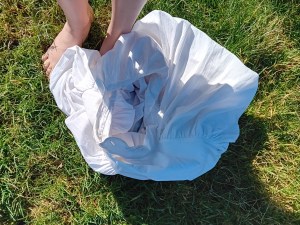
Series of photographs by Pauline Picot, inspired by the poem “And then” by Matthew Nienow.
More about If Nothing : click here.