


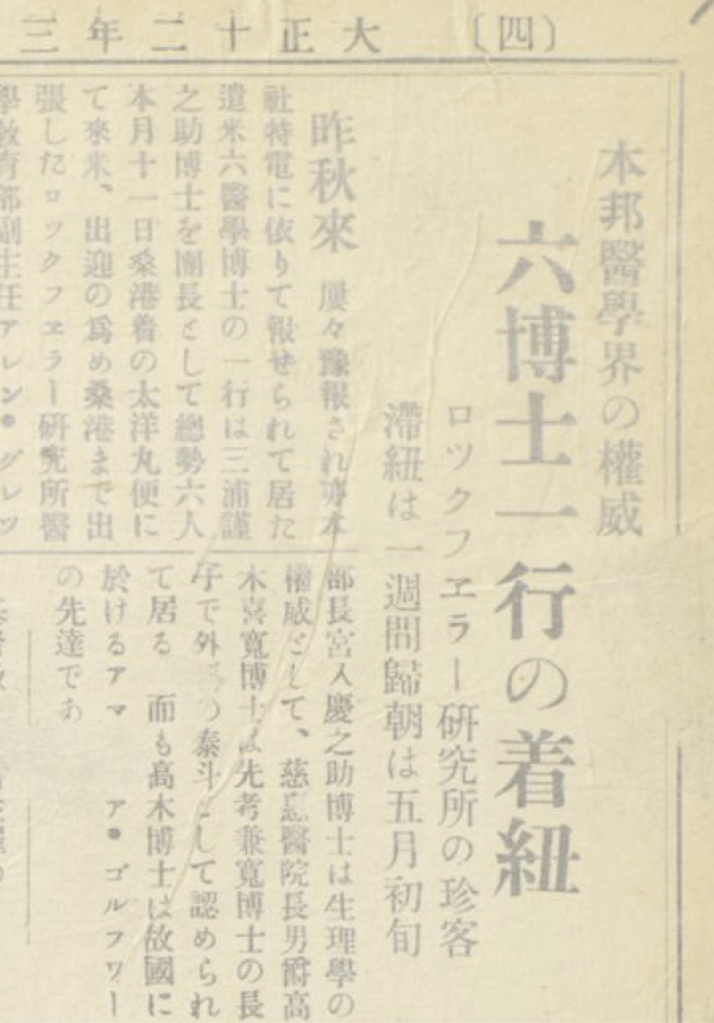
Foreword by author: this research series centers around the mutual impact of medicine and diplomacy in the history of U.S.-Japan medical exchange and collaboration. It will explore how key agencies, in the medical and diplomatic worlds, pursued U.S.-Japan medical exchanges throughout the ups and downs of the bilateral relationship. Continuing from Part I, this article examines how American medical professionals designed and learned from this commission’s plan to promote “American medicine” in Japan.
In April 1922, the Rockefeller Foundation’s proposal of inviting an official Japanese medical commission’s visit to the United States reached the table of Japanese Minister of Education Nakahashi Tokugorō (中橋徳五郎). Arriving soon after the conclusion of the treaties at the Washington Conference, which eased popular anxiety over the increasing geopolitical rivalry between the U.S. and Japan, the proposal was warmly welcomed by Japanese politicians and diplomats. During his visit to Japan in June, Embree recalled that the plan was greeted by “remarkable enthusiasm,” which indicated “much goodwill everywhere between Americans and Japanese” (Embree). [1] Very quickly, Ambassador Shidehara accepted the Rockefeller Foundation’s invitation on behalf of the Japanese government. It was hoped that the invitation would contribute to “the advancement of medical science” and “strengthen the ties of sympathy and common purpose” between the two nations (Shidehara). [2]
Receiving the government’s formal endorsement, the plan quickly underwent further consolidation in the hands of Japanese medical and diplomatic professionals. However, as it was designed to promote American medicine in Japan, the plan did not take shape without American intervention, particularly through the influence from Dr. Rudolf B. Teusler from St. Luke’s International Hospital in Tokyo. In August 1922, the Japanese Committee for Graduate Medical Study in the United States suggested seven candidates for this visit. In November, the list was shortened to five and sent to the Rockefeller Foundation. Nevertheless, Teusler was not entirely satisfied with the selection of the commission members. Writing to the Secretary of the Rockefeller Foundation, Mr. Edwin R. Embree, in early December, Teusler deplored the absence of a surgeon in the commission. Consisting of one internist and four “laboratory men,” the commission might fail to notice the “great advances made in surgery in the United States in recent years” (Teusler). [3] He then suggested inviting Dr. Takagi Yoshihiro (高木喜寛), who was a surgeon and the head of Jikei University School of Medicine, one of Japan’s largest semi-private medical universities. Upon his suggestion, the Rockefeller Foundation invited Dr. Takagi on board. Teusler was confident that this six-person commission would help disseminate “the greatest respect and confidence in American ideals and standards” among the Japanese medical profession, which was “so soaked with German ideas” (Teusler). [4]
In addition to the selection of commission members, Teusler was also much involved in the design of the itinerary. Despite Japanese medical professionals’ interest in the advanced laboratories in the United States, Teusler believed that “practical work” in American hospitals and “public health institutions would be most valuable educationally for the Japanese” (Gregg). [5] Upon this suggestion, the Rockefeller Foundation created a tour centered around the immersive exploration of American medical education, hospital management, and public health agendas. From March to May 1923 in over ten cities, the commission members visited top American medical schools and hospitals, including the medical colleges of the University of Pennsylvania, Washington University, Stanford University, Cornell University, and the Mayo Clinic. They also exchanged ideas with representatives from American public health institutes, such as the Bureau of Child Hygiene, the Philadelphia Board of Public Health, the American Social Hygiene Association, and the National Tuberculosis Association (The Rockefeller Foundation). [6]
With the departure of the six Japanese doctors from San Francisco Bay on May 9, Japan’s first official medical commission to the United States concluded successfully. Japanese medical professionals celebrated its constructive outcome. After the visit, more Japanese medical professionals, particularly those in fields related to public health, began to seek opportunities for exchange and training in the United States. They were able to receive generous fellowships from the Rockefeller Foundation. Only two months after the visit, three young Japanese doctors, including two from the Government Institute for Infectious Diseases at Tokyo Imperial University, were appointed as Rockefeller Foundation fellows (Nagayo). [7]
In the eyes of the Rockefeller Foundation’s officers and medical professionals, the tour brought favorable results, too. Writing to Dr. Richard M. Pearce in April, Dr. Alan Gregg, the associate director of Division of Medical Education at the Rockefeller Foundation, recorded the commission members’ increased interest in American medical training, public health works, and hospital practices. [8]
They have been impressed everywhere with the scope of public health work and the broad conception of what the hospital can mean to the community. The social consequences of tuberculosis for example, as investigated by the social service and P.H. nurses did not apparently ever seem so important to them in Japan as now. They are greatly impressed by this attitude toward disease and by the wide variety of cooperation which exists life insurance companies, city boards of health, private organizations, and federal authorities, etc…They have been impressed with how much the student is taught and how much in general in American universities is done for the comfort of the student. I think they regard so relentless an amount of teaching and guidance as a mistake and are somewhat surprised at it. Certain teaching methods such as for example the clinic-pathological demonstrations have made a great impression… (Gregg)
Nevertheless, beyond this initial celebratory response, Gregg’s letter also revealed Foundation officers’ self-reflections, and their somewhat difficult takeaways for future communication with the Japanese medical world. In Gregg’s opinion, most hosts on the American side were “hasty, sloppy, naively careless and unreflecting;” they showed “graceless, ignorant and uncurious cordiality.” [9] With some exceptions, the general lack of interest from the American side made medical exchange all show and no substance:
Opie was the first man to break an uninterrupted series—he asked Fujinami about the curriculum in Japan. It seemed to me amazing that so few questions were asked in real serious quest for information. Only in Chicago and St. Louis have they been asked to make addresses on medical subjects, though they all worked hard on the boat coming over, writing the talks they expected to be asked to give. I have been constantly uncomfortable because of the barbarous casualness of Americans and always trying to cover the spoors of these hartebeests! (Gregg)
More importantly, the visit exposed some factional divides within the Japanese medical world—a situation which the Rockefeller Foundation officers had no knowledge of. Inside the commission, Gregg recalled the “awkward situation” between Dr. Hata from Keio University medical school and Imperial University faction representatives Dr. Miura and Dr. Nagayo. With all members wanting to see different laboratories in the United States, Gregg suggested that six men should be the maximum for composing a similar commission in the future (Gregg). [10]
Strategically designed to foster understanding and appreciation of American ideas and practice of medical science, the visit of the 1923 Japanese medical commission to a great extent defined “American medicine” in the Japanese medical world. It was a model of medical science emphasizing a clinical approach to both medical education and research, with specific attention to public health and preventative medicine. The Rockefeller Foundation’s medical officers also tacitly accepted this definition. After the commission, with lessons learned about the factionalism in Japan’s medical community, the Rockefeller Foundation began to actively engage in Japan’s public health work and maneuvered to expand the influence of American medicine, while confronting the diverse agencies and diplomatic instabilities between the two countries. Their continued success and painful failures, as well as their breakthroughs and regrets in the subsequent years until 1941, are deserving of future research.
References:
[1] Embree, Edwin R. Report to George E. Vincent, 1 June 1922. Rockefeller Foundation records, Projects, SG 1.1, Series 609 Japan, Box 1, Folder 3, Medical Education Commission (Japan medical scientists, travel grant) Rockefeller Archive Center.
[2] Shidehara, Kijūrō. Letter to George E. Vincent, 18 July 1922. Foundation records, Projects, SG 1.1, Series 609 Japan, Box 1, Folder 3, Medical Education Comission (Japan medical scientists, travel grant) Rockefeller Archive Center.
[3] Teusler, Rudolf B. Letter to Edwin R. Embree, December 8, 1922. Rockefeller Foundation records, Projects, SG 1.1, Series 609 Japan, Box 1, Folder 3, Medical Education Commission (Japan medical scientists, travel grant) Rockefeller Archive Center.
[4] Teusler, Rudolf B. Letter to George E. Vincent, February 24, 1923. Rockefeller Foundation records, Projects, SG 1.1, Series 609 Japan, Box 1, Folder 3, Medical Education Commission (Japan medical scientists, travel grant) Rockefeller Archive Center.
[5] Gregg, Alan. Letter to Richard M. Pearce, January 16, 1923. Rockefeller Foundation records, Projects, SG 1.1, Series 609 Japan, Box 1, Folder 3, Medical Education Commission (Japan medical scientists, travel grant) Rockefeller Archive Center.
[6] The cities included at least: New York, Philadelphia, Princeton, Baltimore, Washington, Boston, New Haven, Albany, Cleveland, Chicago, Minneapolis, St. Louis, Seattle, and San Francisco. Itinerary of the Commission, Rockefeller Foundation records, Projects, SG 1.1, Series 609 Japan, Box 1, Folder 3, Medical Education Commission (Japan medical scientists, travel grant) Rockefeller Archive Center.
[7] Nagayo, Mataro. Letters to Richard M. Pearce and Alan Gregg, July 16, 1923. Rockefeller Foundation records, Projects, SG 1.1, Series 609 Japan, Box 1, Folder 3, Medical Education Commission (Japan medical scientists, travel grant) Rockefeller Archive Center.
[8] Gregg, Alan. Letter to Richard M. Pearce, April 30, 1923. Rockefeller Foundation records, Projects, SG 1.1, Series 609 Japan, Box 1, Folder 3, Medical Education Commission (Japan medical scientists, travel grant) Rockefeller Archive Center.
[9] Gregg, Alan. Letter to Richard M. Pearce, April 30, 1923. Rockefeller Foundation records, Projects, SG 1.1, Series 609 Japan, Box 1, Folder 3, Medical Education Commission (Japan medical scientists, travel grant) Rockefeller Archive Center.
[10] Gregg, Alan. Letter to Richard M. Pearce, April 30, 1923. Rockefeller Foundation records, Projects, SG 1.1, Series 609 Japan, Box 1, Folder 3, Medical Education Commission (Japan medical scientists, travel grant) Rockefeller Archive Center.