Enough of What Is and Isn’t So: Dying in Philip Roth
“At life’s close, you’re like the child whose parents
step out for a drive —”
– Max Ritvo, “The Big Loser”
Philip Roth puts Nathan Zuckerman through a lot. For every energizing success Zuckerman experiences throughout the three main novels of the Zuckerman trilogy – The Ghost Writer (1979), Zuckerman Unbound (1981), and The Anatomy Lesson (1983) – Roth forces his literary alter ego to endure a proportionally damaging hardship. After Zuckerman publishes his successful and scandalous novel Carnovsky (modeled after Roth’s own Portnoy’s Complaint), the fictional novelist must endure the ire of leading Jewish intellectuals like Milton Appel (a fictionalized Irving Howe). Being recognizable as an author has its social and sexual benefits, but it also has its downsides, such as the disturbing obsessions of Alvin Pepler, a quiz show contestant who believes he has been blackballed from television because he is Jewish and who also believes that Zuckerman can intervene on his behalf.
Much has been made of how Roth used his Zuckerman character to work through his own anxieties about writing: the fame, of course, but also the exposure, the public vulnerability, the sense of being responsible not just for his own fictional ideas but for ideas that others had about him. [1] In saying all this, there’s a risk in making the works sound overly grim. There’s humor in them, too, along with Roth’s trademark impish playfulness. No novel that features its main character philosophizing while “impaled” upon his lover’s knuckle can be 100% bleak, after all (Zuckerman 384). In these novels Roth is concerned with the emotional and ethical dilemmas of the writer, yes, but as with much of Roth’s fiction the Zuckerman trilogy is also interested in excess, and in particular with how the excesses of pain and suffering intermingle with those of joy, pleasure, and abandon. Roth described his writing a way of dramatizing the “unidyllic messiness and impurity of living all the intrusive improbabilities that throw certainty on its head” (“Primacy” 372), and while this messiness is certainly applicable to Alexander Portnoy and Mickey Sabbath, it also applies to Nathan Zuckerman, a man whose successes are always accompanied by grief, suffering, and loss, whose certainties are thrashed by inexplicabilities. For every excessive indulgence there is an excessive catastrophe.
Nowhere in the novels are the excesses of pain more poignantly dramatized than in the deaths of Zuckerman’s parents. His father dies in Zuckerman Unbound, and this loss follows him into The Anatomy Lesson, where his mother passes away. [2] Each of these deaths plays a significant role in the respective novels and figures prominently into Zuckerman’s development (and, in Anatomy, his decline). But beyond just serving as significant narrative events, these deaths also allow Roth to explore the problem of meaning and its relationship to the ongoing human fascination with our own annihilation. What does it mean to live in the wake of death? What, if anything, does death itself mean? And why do we feel so compelled to answer these questions?
Before his father dies, Zuckerman thinks he hears his father mutter “Bastard” as he slowly loses consciousness. Is that meant for him, he wonders – or did he mishear? “Over the course of some seventy-two hours now,” Roth writes, “[Zuckerman] had been wondering if his father’s last word could really have been ‘Bastard.’…To mean what? You were never my real son” (Zuckerman 274). Perhaps he said something else, Zuckerman thinks: “faster,” or “vaster,” or even “better.” Or perhaps the “bastard” was meant for one of his father’s nemeses, Hubert Humphrey or Richard Nixon. Or maybe his father really meant it. After all, Zuckerman’s novel Carnovsky was a runaway hit, meaning everybody read it, meaning everybody read his perverse and salacious portrayal of a family that looks an awful lot like his own. Zuckerman’s brother Henry believes this public humiliation is what drove the father to an early grave. Perhaps Zuckerman, “the apostate son,” is in fact precisely the target of that final “bastard” (270). And perhaps he deserves it. But how can he know for sure?
The interpretive trouble doesn’t end there. In The Anatomy Lesson, Zuckerman narrates how his mother, Selma, suffers a stroke in the wake of her husband’s death. During a subsequent neurological exam she was tasked with writing down her name: “but when [the doctor] asked if she would write her name for him on a piece of paper, she took the pen from his hand and instead of ‘Selma’ wrote the word ‘Holocaust’ perfectly spelled” (324). After her death, Zuckerman keeps nothing of hers but that piece of paper. Much like with his father’s “bastard,” Zuckerman is left to grapple with one word. And much like that “bastard,” this word is a mystery. Was Selma simply suffering from a neurological breakdown? Or was this some primal scream from deep within her subconscious? Roth writes: “Zuckerman was pretty sure that before that morning she’d never even spoken the world aloud. Her responsibility wasn’t brooding on horrors but sitting at night getting the knitting done and planning the next day’s chores. But she had a tumor in her head the size of a lemon, and it seemed to have forced out everything except the one word. That it couldn’t dislodge. It must have been there all the time without their knowing” (324). It’s no surprise that a Jewish woman of Selma’s age would be haunted by the Holocaust. But did she mean it when she wrote it down? And what would it mean, really, to mean it? Was it really a neurological slip or was it the expression of some deep, ineradicable trauma? And if that’s the case, what is Zuckerman supposed to do with it? [3]
In both of these instances Zuckerman is left with an interpretive problem on top of his emotional challenges. Or rather, the emotional challenge is an interpretive problem. Processing his father’s death requires some sense of what “bastard” meant and whom it was meant for. His mother’s death requires him to ask how much of his mother was there beneath the surface, how much of her life was actually haunted by profound sorrow. By linking these deaths to questions of meaning – a perplexing last word, an ambiguous scribble on a scrap of paper – Roth turns them into interpretive challenges. In doing so, he invites us to recognize the inevitable intertwining of death and interpretation, and leads us to further ask whether this intertwining is tragic. Are we doomed to make sense of death? Or fortunate to have the opportunity?
We do, after all, try very hard to make sense of death. Whether or not this is a tragic impulse depends on the question of whether it’s something we ought to do. We turn death into a metaphor, a commentary on our existence. We sometimes give it moral value, but we also sometimes try to strip it of any value at all by framing it as a mere biological phenomenon. We’ve given it all kinds of symbolic definitions: Death is a threshold we must cross so that we can enter the next stage of our existence. Death is something to wage war against through technological advancement. Death is what makes us human. Death is what makes us animals. Death is a holy mystery. Death is a biological drive. Death is what makes life worth living. Death is what makes life intolerable. Regardless of its particular meaning it always seems to have meaning, both in the general sense and in its particular manifestations. What Roth’s Zuckerman novels highlight is not so much the value of any one interpretation of a particular death but rather the inevitable impulse to interpret death. Those we lose always have last words, always leave behind ephemera that we must sift through and puzzle over. Maybe it would be better if they didn’t, and maybe it would be better if we didn’t feel compelled to try and sort all of it out. But that’s probably wishful thinking.
Can we ever experience death just “as it is”? For Roth, the answer appears to be no. Even our efforts to denounce meaning make meaning. By the deathbeds of our loved ones we can say, like Zuckerman by his father’s side, “Enough for now of what is and isn’t so” (269). And we can mean it; Zuckerman certainly does in that moment. But ultimately, Roth suggests, our drive to make sense of things is too strong to resist. For even after hoping to return to bare matter, to things as they are without the qualifying features of “what is and isn’t so,” Zuckerman can’t stop making sense of himself in terms of his father’s passing. Trying to understand his feeling of euphoria upon leaving Florida after the funeral, Zuckerman proposes that it was because he “had become himself again – though with something unknowable added: he was no longer any man’s son” (273). There has not simply been a death; there is now something “added,” something new, something identified and made sense of. Even when we most want things to simply “be,” we tragically can’t let them. Maybe whenever death knocks, so does interpretation. And we always have to answer the door.
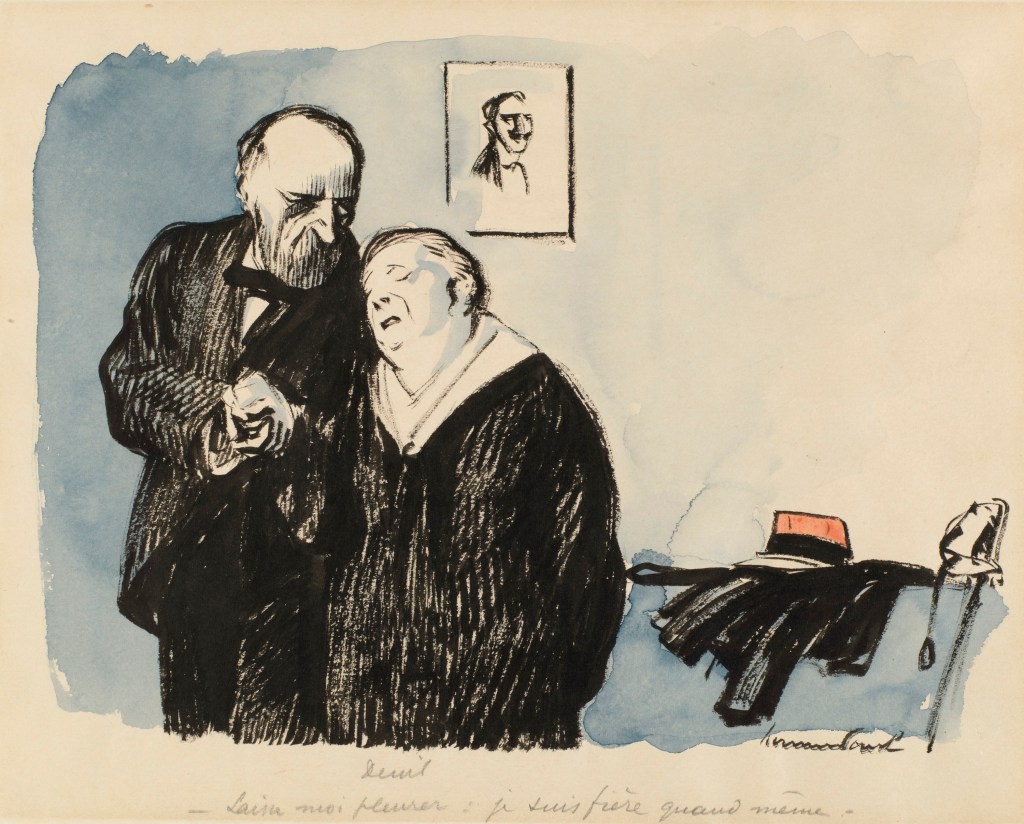
Image Credit: “Mourning” by René Georges Hermann-Paul , n.d. Source: Smithsonian American Art Museum, Gift of the Republic of France. CCO. https://www.si.edu/object/mourning:saam_1915.11.63.
1. For analyses of these themes see in particular Claudia Roth Pierpont’s Roth Unbound and the special issue of Philip Roth Studies, “Mourning Zuckerman.”
2. For all the perverse fun Roth has playing with the line between fact and fiction in the Zuckerman novels, the timelines and particulars of these deaths are quite different from the actual events in Roth’s life. His mother, Bess, died in 1981, and his father Herman lived until 1989. Roth details his father’s death in his 1991 memoir Patrimony.
3. For more on this particular scene, see Eric J. Sundquist, “Philip Roth’s Holocaust.”
Works Cited:
“Mourning Zuckerman.” Special Issue of Philip Roth Studies, vol. 5, no. 2, 2009, pp. 151-301.
Pierpont, Claudia Roth. Roth Unbound: A Writer and His Books. Farrar, Straus, & Giroux, 2013.
Ritvo, Max. Four Incarnations. Milkweed, 2016.
Roth, Philip. “The Primacy of Ludus.” In Why Write? Collected Nonfiction 1960-2013. Library of America, 2017.
—. Zuckerman Bound: A Trilogy and Epilogue. Penguin, 1989.
Sundquist, Eric J. “Philip Roth’s Holocaust.” The Hopkins Review, vol. 5, no. 2, 2012, pp. 226-256.