


Articulating symptoms of illness often first requires dis-articulation: this part hurts; this one thing happened; I started feeling this, then this; are these things related? First narrativized as a series of observations, symptoms separate out into individual signs (one symptom, after all, could be the effect of one cause, but a different symptom could be the effect of another). Often, these individual signs correspond to discrete body parts: my head hurts, my joints ache, my feet are swollen. Some symptoms are literal anatomizations (head, joints, feet), while others are figurative (parsing out experiences). In both senses, it’s frequently some kind of medical authority that officially separates symptoms and determines their relationships and causes—they de- and re-articulate the body.

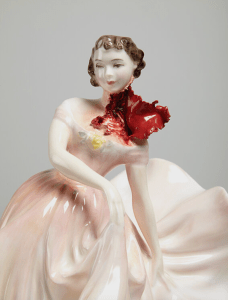


The anatomizing, piecemeal nature of the symptom struck me when I first saw Scottish artist Jessica Harrison’s (b. 1982) small ceramic figures collectively titled “Broken Ladies” (2010-present). Harrison gathers pre-existing female figurines reminiscent of Staffordshire and other regional decorative arts popular from the eighteenth and nineteenth centuries and acutely, meticulously mutilates them. Intestines unravel, fleshy hands disintegrate into bone, throats warp open at a slit. Without altering their polite smiles and graceful gestures, Harrison completely transforms these figures into surreal, haunting icons of what often appears to be self-inflicted violence—or at least violence in which the women find satisfaction, maybe even pleasure. While, as Julie Orlemanski describes in Symptomatic Subjects (2019), the symptom is “a somatic disturbance that…provokes interpretation,” here it’s difficult to interpret what these injury-signifiers tie to (16). What, exactly, is their cause?
Each figure only has one injury, singling out individual organs or “parts” like an isolated symptom or the page of an anatomy textbook. Combining feminized form with pedagogical isolations, the “Broken Ladies” invoke images of Anatomical Venuses, the eerie training models popular in eighteenth- and nineteenth-century medical education.

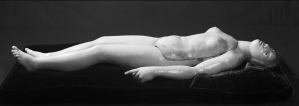
Made of wax, the Anatomical Venus is a model of feminized anatomy with a cavern of removable organs. They are sometimes pregnant with a full-term wax fetus. Despite their porcelain-white skin, it’s difficult to separate that feature from the violence of enslavement happening at the same time in America. Smoothly detachable, the Anatomical Venus echoes social lessons on how to perceive the enslaved Black female body as a feelingless vessel for the extraction of life, the illusory cleanliness and painlessness of separating woman and child. The body becomes a game, a puzzle to master.
Unlike later caricatures of anatomical models like “Operation Sam”—a portly cartoon with puns for parts and painful shock on his face—the Anatomical Venus is a Westernized beauty: “feminine” white body softly curving, long (real human) hair tousled or braided, and eyes gently closed or demurely half-open, sedate. In its hands-on pedagogy, the body of the Anatomical Venus is broken down into parts that the student pulls out and names; a bloodless dissection.
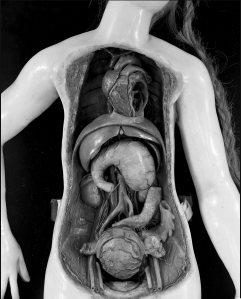
Despite its inherent misogyny and historically etched racial violence, the Anatomical Venus gives a depth to the female body that is so often erased from cultural representation. With their lifelike (though bloodier) viscera, Harrison’s “Broken” figures do the same. Typically shown as just a surface to look at, both Anatomical Venuses and Harrison’s “Ladies” instead have interiors and dimension. For the Venus though, that dimension is inextricably tied to medical legibility. Or in other words, because the Anatomical Venus is a professional training tool, it stages the (feminine) interior as a series of parts for the medical student, and medical student alone, to understand.1 Despite yielding paradoxically simple grammar (This is the pancreas. This is the heart. This is…) the Anatomical Venus’s parts become predetermined property of medical discourse, historically and still a field overrepresented as masculine.

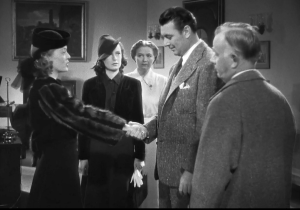
Mary Ann Doane describes something similar happening in 1940s film. In what she calls the “medical discourse film,” women experience various mental and/or physical symptoms that they can’t make sense of or even perceive. Their surface symptoms and causal interiority “attribute to the woman both a surface and a depth” (207). But like the Venus, that interior is only coherent to a male doctor who enters the film—and often, her—as “a technician of essences” to decode her puzzle. Only he can put the pieces together; dis- and re-articulate her body (ibid). The doctor stands in, Doane suggests, for medicine in general as he extracts her body’s parts and interprets them for her.
Harrison’s figures reverse this tradition, this feminized passivity in the (dis)articulation of their own bodies. Rather than a doctor or student reaching into the body, the female figure offers it up herself, flaunting and even taunting with it. With gentle smiles in place of desperation, pain, and dependence, it becomes impossible for anyone but her to know how she got this way, let alone why or how she can bear it now.


I saw my first “Broken Ladies” figure in an exhibition on the brain at the Berlin Museum of Medical History. Quietly standing in a glass vitrine surrounded by nineteenth-century specimens and teaching models, she displays the top half of her skull and full brain inside, coyly holding her skirt up with her other hand. She offers the organ to you like a cocktail, dances with it. Unlike other objects around her that are captured and preserved in fluids or carefully bound in place by conservators’ gloves, forced to expose their knowledge within, she pulls it out herself—is this what you’re looking for? And despite being cracked open and offered up, her interiority remains sealed off. Her calm, awake vitality cast in smooth, seamless ceramic makes the symptom impossible to interpret. More familiar to sci-fi and horror film discourse than medical or museum studies, she is an inverted, surreal medical pedagogy, something that can’t be figured out. Hermeneutically sealed. Macabre fantasy (spilling, opening, shocking the world with your own viscera), metaphor for feminist praxis (refusing gentility, cleanliness, beauty), slashed and resewn tradition (reclaiming anatomical interiority, visceral selfhood); these pieces, both gruesome and graceful, are more than the sum of their parts.
Notes
- Several anatomical museums and sideshows advertised Anatomical Venuses as part of their exhibitions for the wider population, and “of special interest to ladies” (Wellcome Collection). Still, these exhibitions are marked by appeals to medical authority that bolster their alleged credibility and authenticity. Note in this example from the Wellcome Collection, the exhibit is “acknowledged by the most distinguished Medical Professors…to be faithfully correct in Anatomical Structure.” In another example from the Wellcome, the exhibition claims “one view even of which, is sufficient for those who are not Professors in medicine or surgery, to enable them to form an exact idea of the wonderful construction of the human body.” This boast tells more about the attention span and depth of learning anticipated by the exhibition rather than its legitimate pedagogical efficacy. If medical knowledge leads to the feeling of ownership of one’s body, as Doane suggests, how much medical knowledge was actually, meaningfully made available in these exhibitions?
Works Cited
Doane, Mary Ann. “The Clinical Eye: Medical Discourses in the ‘Woman’s Film’ of the 1940s.” Poetics Today, vol. 6, no. 1/2, 1985, pp. 205–27. JSTOR, https://doi.org/10.2307/1772130. Accessed 31 Jan. 2024.
Orlemanski, Julie. Symptomatic Subjects: Bodies, Medicine, and Causation in the Literature of Late Medieval England. University of Pennsylvania Press, 2019.
The Brain in Science and Art. 16 June 2023—8 Sept. 2024, Berlin Museum of Medical History, Berlin.
Images
1960’s edition of Operation by PaRappa 276 under license CC BY-SA 4.0 <https://creativecommons.org/licenses/by-sa/4.0>, via Wikimedia Commons.

Anatomical figure modelled in wax, circa 1760. Wellcome Collection. Source: Wellcome Collection.
“Dark Victory” (1939) (Movie Clip) “That cold scientific eye”. Turner Classic Movies, Turner Classic Movies, http://www.tcm.com/video/7824/dark-victory-original-trailer. Accessed 31 Jan. 2024.
French female figure modelled in wax, parts removed to show the stomach, kidneys, bladder. Wellcome Collection. Source: Wellcome Collection.
Harrison, Jessica. “Broken Ladies: Work.” Jessica Harrison Artist, jessicaharrison.studio/work/broken-ladies. Accessed 31 Jan. 2024.