After Yang and Posthumanist Care
“So if you don’t mind, we’re just gonna do a full check-up, and we’re gonna restore Yang as best we can… It won’t help with his ‘off’ state, but it should help with his preservation.”
One family’s search for the ultimate “fix” is the central conflict in filmmaker Kogonada’s 2021 sci-fi drama After Yang, adapted from Alexander Weinstein’s 2016 short story “Saying Goodbye to Yang.” Set in a gleaming, warm-toned future of robotic and cloned siblings, self-driving vehicles, and corporate spyware integrated into domestic space, the movie peeks into the lives of parents Jake and Kyra as they attempt to mend the beloved, broken techno-sapien companion, Yang, that they acquired for their adopted Chinese daughter, Mika. Purchased secondhand from a company called Brothers and Sisters Incorporated, Yang was tasked with keeping young Mika company and aiding her in developing her sense of an Asian identity through language learning and through access to his pre-programmed encyclopedic knowledge on China. He was also, as Jake acknowledges, “a great brother.”
When Yang suddenly malfunctions and shuts down, the mixed-race family desperately rushes to repair their robotic “son,” as Jake calls Yang. They discover that Yang was equipped with an illicit memory bank for recording select clips of his encounters and experiences. To their surprise, the family also learns Yang had cycled through several different owners, forming emotional bonds and contending with love and loss across his various lifetimes. Despite Jake’s many visits to legitimate and black-market robot specialists, the techno-sapien brother ultimately does not turn back on. Witnessing this tender and moving quest to bring Mika’s gege back “to life,” After Yang collapses the presumed expanse between human and robotic traits by marking capacities for grief, love, growth, personality, and care as the collective core beneath our flesh.

In several dialogue exchanges, After Yang employs a range of terms for what Jake, Kyra, and Mika might choose for Yang’s nonoperational body. According to a Brothers and Sisters representative, a third-party technician, and a staff member at a museum for deceased technos, all of whom Jake solicits for help, Yang cannot be “repaired,” though he could be “refurbished,” “recycled,” “replaced,” “restored,” or “preserved.” Given Mika’s devotion to and adoration for Yang, Jake and Kyra opt not to relinquish his body or substitute him with an updated robot model. Instead, they have Yang “hooked up on the simulator” temporarily so he will not begin to “decompose” while they endeavor to reverse the breakdown. Eventually, Kyra suggests their investigation is “dragging on too long,” and she insists they prepare to say goodbye and move forward.
While After Yang is not billed as a film about healthcare, it certainly frames Yang’s decline as a kind of sickness, his family’s mission as one of healing, and the finality of his absence akin to the material and affective experiences of end-of-life care. “My son… He’s not doing so well right now, health-wise,” Jake mourns. Additionally, as reviewer Jane Hu notes about their family history, “in the relative absence of Mika’s parents, Yang takes on an outsized role in the child’s life, much like a live-in caretaker (or older sibling) might.” In flashbacks, we repeatedly observe the sacred nightly ritual in which Yang and Mika tiptoed into the kitchen together so he could fetch her a glass of water, a symbol of their mutual attachment to the requisite, universal life-giving substance. Over the course of the movie, then, Yang as techno-sapien is figured both as deliverer and, in his deteriorating condition, as recipient of care.
In recent years, medical humanities scholars have taken up speculative literary and cinematic portrayals to interrogate how posthumanism alters the medical domain’s authoritative conception of the human body (and vice versa). For example, Anna McFarlane looks at David Cronenberg’s Crimes of the Future (2022) to consider how genetic engineering and augmentation shift our reliance on embodiment for humanness (McFarlane, “Posthumanism in the Medical Humanities”). Likewise, Amelia DeFalco evaluates Robot and Frank (2012) for its haptic display of the developing “continuum of care” consisting of both humans and nonhumans and for its displacement of “the illusion of human exceptionalism” (DeFalco 28).
Speculative stories, as McFarlane suggested with co-editor Gavin Miller in the introduction to their 2016 special issue of Medical Humanities, generate future worlds through which to perceive the design of our present. Science fiction, they write, “proposes concrete alternatives to hegemonic narratives of medical progress and fosters crucial self-awareness of the contingent activity which gives ‘the future’ substance in the here-and-now” (Miller and McFarlane 213). While many fantasies of an impending society are laden with the promises and disquietudes of biomedical development unleashed, other sci-fi films like After Yang resist machinic flairs and fears to evoke more immediate questions. What extraordinary measures should we take to heal someone? Can automaton interiority shake up what we catalog as human relation? How do ethical impulses determine whether we study the deceased or lay them to rest? And, sincerely, do we feel more or less human following our encounter with Yang’s story? Put another way, is the “after” in After Yang comparable to the “post” in posthumanism?
Like Jane Hu, I find that After Yang’s existential landscape is one startlingly grounded in the quiet intimacies of care exchanges, fueled by loyalty and desperation. Hu writes: “the eeriest thing about Kogonada’s science fiction is how its future feels pretty much already here” (Hu). The film generates an everyday that is familiar rather than fantastic, and its scale is domestic rather than planetary. And while several reviewers argue that After Yang joins a long line of techno-Orientalist projects that imagine a panicked world populated by Asian robots, this movie focuses not on the anxieties of technological takeover but on healing a body and recuperating the idiosyncratic subjectivity of a techno-sapien. Yang does not sleep, he does not necessarily feel happiness, and he does not count in the film’s civil society beyond his status as property. Yang is not human, nor does he desire to be, according to a clone friend of Yang’s whom Jake meets. And yet the film declaratively concludes that “his existence mattered, and not just to [the family].” In that After Yang emerges as a stunning collage of gorgeous, intersubjective moments of meaning, the robot’s capacities for curiosity, for romance, for acceptance, and for remembrance both enhance and exceed our own humanity.


To return for a moment to the implications of a distinctive posthumanist project like Kogonada’s for the medical humanities, I’ll turn briefly to a few scenes in which Jake, Kyra, and Mika consider available treatments for Yang’s failing body. First, Jake endures a disappointing visit to a certified storefront called Quick Fix where a sales representative claims their expensive diagnostic test revealed “all 12 parts were in working order; however, the readout did indicate that there was a core malfunction, unfortunately.” Yang’s body is never shown, and his name is never mentioned by this third-party vendor. An inscrutable diagram of what is either a techno or a human being hangs on the wall behind the smarmy employee. Jake is offered $1000 off an updated brother model if he chooses to fully recycle Yang’s body, or he can purchase the robot’s salvaged head installed with a voice box. The promotional, transactional quality of this exchange serves to anonymize Yang’s contributions as a member of a family, highlight the nonbiological status of Brothers and Sisters Inc.’s creations, and display the exaggerated costs of care procedures. As scholar N. Katherine Hayles might say, here Yang is made to signify how information is stripped of its (his) materiality, or how a body is split from its (his) data. Jake stares back at the sales representative with a look of disgust before he says what any anguished father might say in light of futility presented with diagnostic authority: “We’re getting a second opinion.”
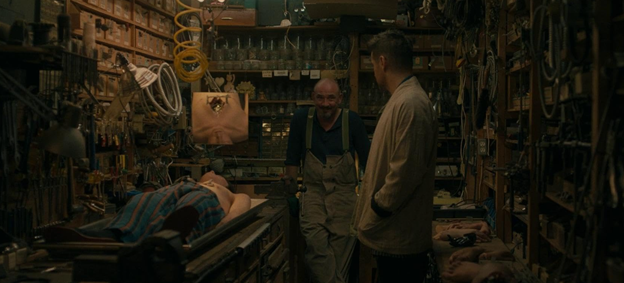
Jake then hauls Yang’s limp form to a shady technician named Russ. In a dimly lit backroom filled with hoses, tools, and a few severed feet, Russ explains to Jake that it’s illegal for him to “break open the core” because Brothers and Sisters conspired to protect internal elements he believes to be spyware, but he offers to do it anyway. Jake balks both at the notion of a data collection conspiracy leveled at his family’s most private moments and at the premise of hacking further into Yang as a curative approach. The space resembles a chop shop mixed with a surgical suite. In a mirrored reflection, we see the cavity in Yang’s bared chest held open by a silver retractor. Standing over the techno-sapien’s prone form, Jake (whose side profile looks remarkably like a doctor in a white coat) and Russ appear like a surgical team deciding not to continue an invasive procedure. In this snapshot from After Yang, we perhaps can recognize ways in which “a posthumanist perspective offers something to the medical humanities” (McFarlane, “Medical Humanities”). As medical humanities tend to prioritize physician empathy, humane application of medical apparatuses, and investments in remedy, then by drawing out Russ’s insensitivities, the visual resonances between a workshop and an operating room, and the analogy between mechanical core and anatomical core, this scene calls for recognition of “continuities between the body and technology” (McFarlane, “Medical Humanities”) and departs from dialectical conceptions of sickness and health, doctor and patient. Still, Jake collects Yang off the table and takes him elsewhere for evaluation.

“Yang’s existence would be an invaluable contribution to this museum” remarks a woman named Cleo at the last stop on Jake’s hopeless tour with Yang’s body. A scientist-curator, she proposes to pay Jake for possession of Yang, as he is one of only a few robot types outfitted with a memory device. She adds, “he would have his own area. We could put some of his memories on a loop, projected.” Though most of this scene in After Yang takes place in Cleo’s tidy office, one quick close-up depicts some of the exhibited bodies in the museum. The shot features two gray, skinless humanoids with (conceivably) their artificial organs and fat carved away to reveal sinewy insides, stationed in unsettling poses.
The image is, of course, reminiscent of the controversial cadaver shows popularized in the early 2000s thanks to plastination sciences. As Neda Ulaby said on NPR about the Body Worlds exhibition, and as the disturbing After Yang shot reminds us, though “science centers like to tout the educational value and public-health benefits of displaying [cadavers],” “there’s something forbiddingly intimate about peering into dead human bodies.” In Ulaby’s report, disability studies scholar Petra Kuppers suggests that these exhibits mediate the emotional experience of viewing death, and historian of medicine Michael Sappol connects the shows to the long history of anatomy as a transgressive and dark science that spurred race and class hierarchies while consolidating medicine’s status as an “enlightened” profession. Furthermore, investigators found that in many cases, the cadavers in these traveling exhibitions lacked documentation of their willing participation. The bodies nearly always came from China.
Despite its short-lived representation in After Yang, Kogonada’s critique of our corresponding reality whereby science merges with spectacle hints at another concern discussed by Leslie Bow in her recent scholarship on techno-Orientalism and racialized objects: posthuman bodies can “ironically exaggerate existing differences among us,” for even “imagined futures are bound to concepts of racial and gender difference” (Bow 146). Peeling back the identifying epidermis of their specimens actually materializes the contradiction in Body Worlds: the act of physical deracialization cannot universalize human flesh nor can it undo the unevenness of racism’s effects as the enabling historical factor in the project’s existence. Likewise, the inclusion of Yang’s body in the museum for researchers and public viewers cannot afford a “whole understanding of techno-sapiens,” as Cleo promises Jake, for the conditions of his involuntary display skew possible interpretations of robot bodily autonomy. At the end of the film, the family remarks that they “don’t want Yang to be on display in the museum,” but they believe they ought to “let [people] study his memories.” After Yang thus requires that, if only briefly, we acknowledge the voyeuristic urge that often undergirds our hopes for exhibitions of scientific learning.

In the end, Yang receives a much more sentimental send-off. Jake, using a technological viewer to rewatch footage of Yang’s memories in their living room, pulls off the reader glasses when Mika enters the room. He asks if she wants a glass of water and invites her to sit beside him. She softly begins to sing a haunting melody Yang taught her. Unable to say a proper farewell to the deceased robot himself, Jake and Mika grieve together as they rewrite their evening rituals sans Yang, laying the groundwork for a parent-child closeness previously absent throughout the film. In this final scene, as Anna McFarlane suggests of the new role of posthuman care in medicine, affective ties between robots and their users enable “issues of care [to] be reprioritized, no longer overlooked in favor of technical and technological interventions” (McFarlane, “Posthumanism in the Medical Humanities”). After Yang’s “after” is one which returns lovingly to our inter-human present, touched and transformed by the techno-human future.
Image credits:
Stills from After Yang. Directed by Kogonada, © A24, 2021.
Movie poster of After Yang from https://a24films.com/films/after-yang.
Works cited:
After Yang. Directed by Kogonada, A24, 2021.
Bow, Leslie. Racist Love: Asian Abstraction and the Pleasures of Fantasy. Duke UP, 2022.
DeFalco, Amelia. “Beyond Prosthetic Memory: Posthumanism, Embodiment, and Caregiving Robots.” Age, Culture, Humanities: An Interdisciplinary Journal, vol. 3, 2022, pp. 1-31.
Hayles, N. Katherine. How We Became Posthuman: Virtual Bodies in Cybernetics. UChicago Press, 1999.
Hu, Jane. “Where the Future is Asian, and the Asians are Robots.” The New Yorker, https://www.newyorker.com/culture/culture-desk/where-the-future-is-asian-and-the-asians-are-robots, March 2022.
Hullfish, Steve. “Art of the Cut: Kogonada on ‘After Yang’”- Frame.io Insider, https://blog.frame.io/2022/03/16/art-of-the-cut-kogonada-on-after-yang/, December 17, 2023.
Miller, Gavin and Anna McFarlane. “Science Fiction and the Medical Humanities.” Medical Humanities, vol. 42, no. 4, December 2016, pp: 213-18, https://pubmed.ncbi.nlm.nih.gov/27885035/.
McFarlane, Anna. “Posthumanism in the Medical Humanities.” The Polyphony: Conversations across the Medical Humanities, https://thepolyphony.org/2024/02/09/posthumanism-in-the-medical-humanities/, February 2024.
…”Medical Humanities.” Critical Posthumanism: Genealogy of the Posthuman, https://criticalposthumanism.net/medical-humanities/, September 2017.
Sappol, Michael. A Traffic in Dead Bodies: Anatomy and Embodied Social Identity in Nineteenth-Century America. Princeton UP, 2004.
Ulaby, Neda, reporter. “Origins of Exhibited Cadavers Questioned.” All Things Considered, NPR, 11 August 2006. https://www.npr.org/transcripts/5637687.