It’s sort of hard to remain current with haircuts as a resident. I usually like to go every six weeks or so to keep my coif from becoming too sheep-dog for clinical medicine. But sometimes, I push it a little longer, with the justification that, “Well, if mustaches are in, so too must other trends of the 1970s”—like the wings at my temples.
The other day, I really did need a haircut. I went to my local chain barber. I don’t know this new stylist/barber/hair artist well as I only met her once before. But she did a good job the first time, so I was comfortable going back.
That was a big deal for me. The same man cut my hair every single time but once from my first shearing through the end of medical school. The “but once” was when I had to graduate college. A stranger cut my hair, and it curiously felt wrong, disloyal, unfaithful. I got over it, but it still occurs to me, as it did the other day with my new barber.
My new barber and I made light small talk, as one does while in The Chair. She knew from my first visit that I was a psychiatry resident and so we talked in generalities about my work, exchanging some platitudes about mental health, etc. Curious, I asked whether in her line of work, she had any interesting professional experiences with the mental health of her clients. She nodded vigorously. “Omg a ton!”; snips of her scissors punctuated her words as she told me a few anecdotes. She added, “these days, in cosmetology, some people have to take a few classes about mental health because it’s so common to talk about that stuff when people are in the chair.”
I looked her in the face in the mirror and she made eye contact. We were having a real conversation at this point, rather than the sort of shadow boxing that normally occurs at the barber. She paused for a moment and considered. “You know, I think it’s people looking themselves in the face in the mirror that brings it out. No hiding while getting your hair cut.”
Hair is central to our identity. It is an essential component in our process of self-fashioning, symbolic to how we portray ourselves to the world. Cutting hair is thus an intimate, powerfully symbolic act. Human culture has recognized the importance of hair as symbolic object for millennia. The Biblical story of Samson and Delilah is pregnant with psychodynamic content of virility and emasculation. In hegemonic pop culture, magazines blithely discuss post breakup haircuts as a means of self-help. Too much transformation can be a bad thing: consider the reams of coverageof Britney Spears’ shaved head in 2007. Clearly, our culture sets a fine line for women between self-expression and outright madness. The lack of awareness of alternative hair-care ways of communities of color reinforces discrimination and marks others as deviant. Sites for hair care thus constitute essential sites for community cohesion and crucibles for solidarity amidst structural racism.
That’s why there’s something particularly exciting about some of the practical efforts that my barber mentioned. As this thoughtful article in Allure (!) discusses, nonprofits are working to use hair salons as sites for prevention. The Confess Project, for instance, has developed trainings for barbers on issues of mental health, with the goal for particular outreach to Black men, a population less likely to engage with traditional mental health services. They offer training and a vocabulary for addressing these issues, and provide resources training for appropriate triage and referral for more emergent situations.
We care a lot about hair. We just don’t necessarily always attend to the psychodynamics of hair that often. Hair is about autonomy, about relationships, about power. And maybe paradoxically, that’s a real opportunity here. Sitting in the chair is a Trojan Horse for self-disclosure, an “on the couch” moment where we are, sometimes in spite of ourselves, in a reflective mood.
My barber had it right. Looking at yourself in the mirror, as fragments of yourself drift slowly to the floor, you can’t hide that part of you is lost. But something can be gained, too.
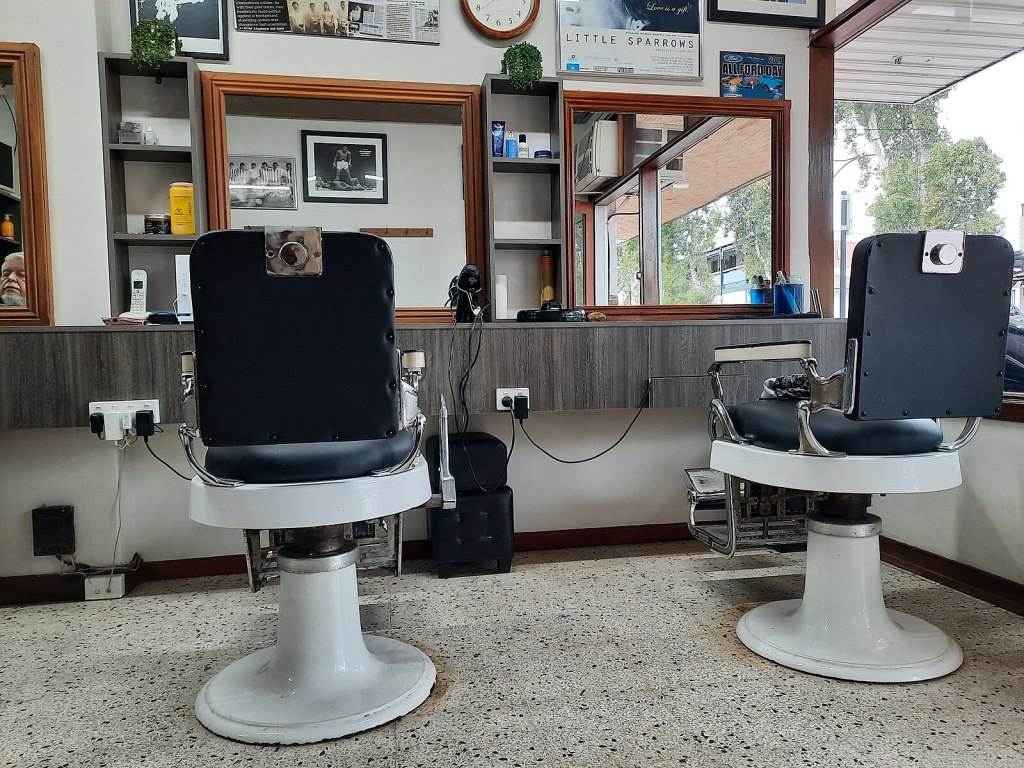
Photo credit: Gnangcomapp, “barber chairs classical Australian barber shop in bassendean,” 9 May 2024, https://commons.wikimedia.org/wiki/File:The_barber_chairs_gn.jpg.