The Name of a Bird
Just before turning another year older in the summer of 2024, I learned that I had been wrong. What I grew up considering a type of “swallow” is a drastically different kind of bird. Allow me to explain by going back in time.
In April 1936, an ornithologist named Canuto G. Manuel (1902–unknown) went to the Palawan archipelago in western Philippines to investigate a small, cave-nesting bird. At the time of his field work, there was a dearth of scientific literature on his subject. Working for the Bureau of Science at the Department of Agriculture and Commerce in Manila, Manuel’s motivation was both scientific and economic. The species of birds he sought to track built their nests out of neither dirt nor twigs but from the unusual material of solidified saliva in limestone caves, and were the key architects behind the niche yet lucrative industry of “edible birds’ nests” or EBN. Regarding the bird’s classification, Manuel remarked:
“Several notions have been held concerning the birds that build edible nests. Some people believed them to be swallows. It is now generally conceded, however, that edible nests are built by a swiftlet, belonging to the genus Collocalia, a bird far removed from the swallows.” (1937, 380)
In Mandarin Chinese, swallows and swifts (including swiftlets) share the same character yan (燕) in their names, hence my false impression of their relation. This, however, is only the tip of an iceberg of self-reckoning.
The Fame of a Nest
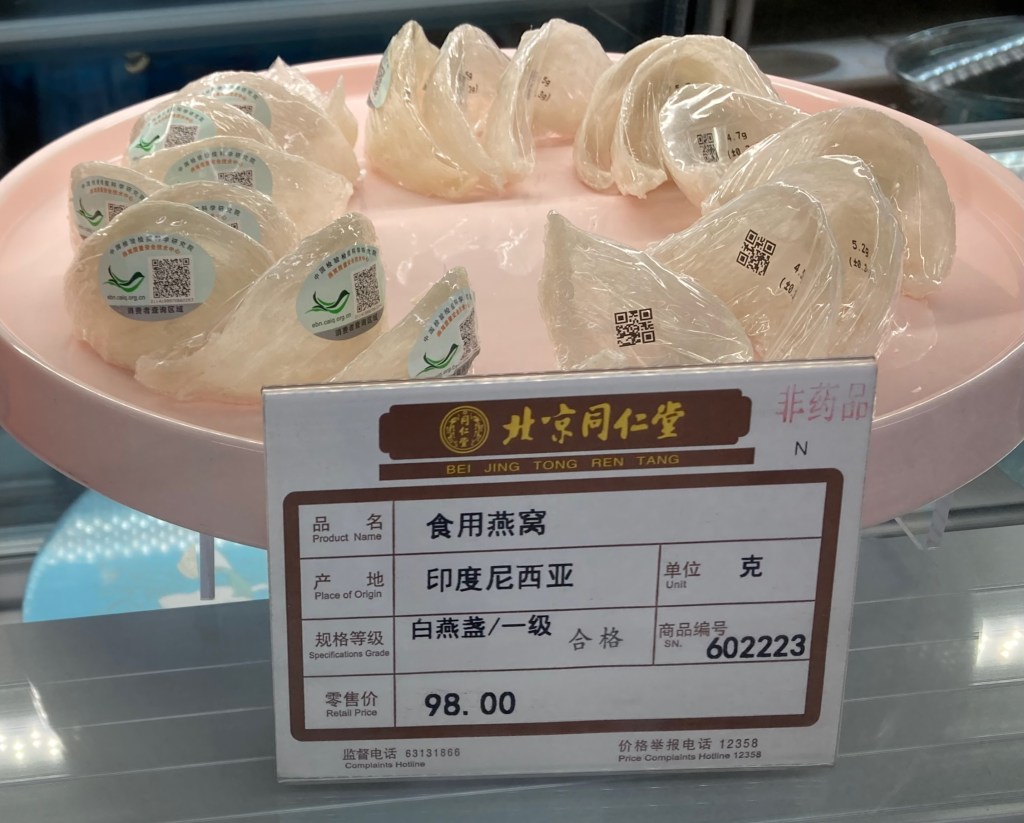
Manuel went on to record more feathered natives of the Philippines and helped rebuild the bird specimen collection at the Natural History Museum of Manila following the country’s war of independence (Manuel and Gilliard 1952, 1). Over two thousand miles away and oblivious to the ornithologist’s career, I laid eyes on a display case of EBN for the first time at a pharmacy of traditional Chinese medicine this summer in Beijing. While relying on the Philippines and other Southeast Asian countries for its supply, the EBN industry has counted on China for the bulk of market demand over the past centuries (Sankaran 2001, 283, 285; Thorburn 2015, 182). A 1909 issue of the business periodical Chinese Federation Review (Hua shang lian he bao), for example, credited EBN as “the most precious among all supplements” before acknowledging the foreign import’s success in domestic sales (94–95). The inaugural issue of News from the South Sea (Nan yang qing bao) similarly commended the high nutrient value of EBN and how its trade had financially benefited Chinese expatriates and merchants in Thailand (1932, 16–17). In his paper for the March 1937 issue of Philippine Journal of Science, Manuel also recounted the Chinese monopoly over the export of EBN since “the early days of Sino-Filipino trade relations” due to their value as “a delicacy and food for convalescents” (Manuel 1937, 379). Behind EBN is a time-honored trade of animal products as well as a transnational history of therapeutic substances.
By and large, the observation shared among Manuel and his contemporaries about the connection between EBN and health management holds true at other moments. On the Chinese food and pharmaceutical market, EBN has long been coveted for its perceived therapeutic properties under the name yanwo (燕窩), literally “swallows’ nests.” In one scene from the eighteenth-century literary masterpiece of Cao Xueqin (1710–1765), principal female characters Baochai and Daiyu converse about a chronic illness and the efficacy of taking “the best quality bird’s nest”—a luxury comparable to the highly priced ginseng and a testimony to the two young ladies’ privileged upbringing (Cao et al. 1973, 395–399). From the same century, the Chinese poet Yuan Mei (1716–1797) opened the first entry under “Delicacies from the Sea” in Recipes from the Garden of Contentment (Sui yuan shi dan) with a terse affirmation: “Yanwo are too valuable to be casually used in the first place” (Yuan 1792, 20). The lofty status of EBN persisted even in the twilight decades of the Qing Empire. According to the missionary-run periodical A Review of the Times (Wan guo gong bao), Emperor Guangxu (1871–1908) bestowed yanwo on his officials as early as the first year upon his succession to the throne while a four-year-old child (1876, 352).
The Sociotechnical History of a Therapeutic Substance
What substantially added to the allure and prestige of EBN were the technical difficulties of their acquisition. The habitats of edible-nest swiftlets in the Philippines consisted of various islands characterized by smooth-surfaced limestone caves with steep cliff openings and meandering tunnels. The indigenous people who collected nests must not only know their way in and out of the terrain, but also how to locate and secure the tiny nests on the walls of deep caves. Citing a report from his colleague, Antonio V. Perez of the Bureau of Forestry, Manuel highlighted the “painful and patient crawling” and “dangerous climb” involved in the collector’s labor all while risking “his neck, his limbs, and even his life” (1937, 386). It came as no surprise then that the collector and the concessioner of EBN in the Philippines maintained a close relationship, with the latter supporting the former throughout the year in exchange for his skills and labor during the swiftlet’s nesting season (ibid).
Technological modifications of natural topography were also introduced to mitigate the danger historically faced by edible-nest collectors. As a series of photographs in the September 1934 issue of China Pictorial (Zhong hua tu hua za zhi) demonstrated, indigenous collectors from British Borneo—now the territory of Brunei and Malaysia—wore special head gear and carried bamboo knives for detaching edible nests from cave walls. “Ropes” made of wood or bamboo were hung towards the floors of selected caves to assist the vertical mobility of collectors, whereas a “frail scaffolding” of similar materials was attached to the cave roof (1934, 20). Whether they were developed to scale a cave or navigate the ocean, technologies paved the way for the overseas trade of a tiny nest no bigger than half of my palm. And these technologies would have justified my awe of yanwo this summer as a rare, mysterious, and out-of-reach wonder of the natureculture if not for a QR code.
But the QR code changed everything. It took one scan for me to realize that the landing page for the QR code is no cliché advertisement but the official website of the Chinese Bird Nest Traceability Management Service Platform, an authenticating system managed by the Chinese Academy of Inspection and Quarantine. As it transpired, the EBN I saw at the pharmacy of traditional Chinese medicine all have their own official online profile, which describes not only their grade and designated ID, but also their physical journey from Southeast Asia to Beijing. Specifically, the batch of EBN I came to examine was sourced from a location called “Sudirman 1” in Indonesia.
The Sociotechnical Reality of a Human-Nonhuman Relationship
On the platform website, this location receives the classification of “yanwu (dong),” meaning either a manmade swiftlet “house (wu)” or a nature-made “cave (dong).” Locality matters in the appraisal of pharmaceuticals. In her monograph Know Your Remedies, He Bian explores the history of pharmacy in China and points to the configuration of authenticity through the notion of place-based specificity between the sixteenth and eighteenth centuries, a phenomenon closely linked to the integrated long-distance trade of materia medica (2020, 132–137). Be it based on immunochemistry or chromatography, the authentication of EBN has evolved over the past century to utilize a dazzling variety of technoscientific methods (Lee et al. 2017). The molecular-biologist Aly Farag El Sheikha (2021) even posited geo-origin as a factor in the nutrient variation of individual EBN to contextualize the industrial application of geo-tracing technologies. Apparently, the Chinese government is also onboard with the idea of matching each and every EBN that crossed its border to the geo-origin of their making.
It was this government-endorsed application of locating technologies that propelled me to question the identity of the birds who built the nests that I saw. Recent scientific literature on edible-nest swiftlets has shown that for the past two decades, EBN collection in Indonesia has taken place in manmade nesting buildings in urban areas (Ito et al. 2021). I have yet to identify the exact techniques and technologies used to persuade edible-nest swiftlets to nest somewhere other than their natural habitats. But the migration of birds from limestone caves to concrete buildings means that “Sudirman 1” is just as likely a specimen of a cave as it is a specimen of brutalist urban architecture located a good distance from the sea.
Without projecting any anthropocentric interpretations onto the decision-making of swiftlets, I found my first in-person encounter with EBN as informative as it is humbling. Back in 1937, Manuel pondered some of the swiftlet population’s choice to nest in caves that were too small and/or dangerous to fit in a human as a “natural factor for the perpetuation of the species” (388). It seems that swiftlets of the twenty-first century are entering a counterintuitive though potentially symbiotic, if not mutualistic contract with human society and no longer operating in the same way that their ancestors once did. There is at least some safety for the birds from predators under the concrete roof and watchful eyes of the contemporary nest collector, whose labor is perhaps now better described as that of a co-architect and production manager.
Acknowledgements: My research during the summer of 2024 is supported by the Weatherhead East Asian Institute and the Department of East Asian Languages and Cultures of Columbia University.
Featured Image: Photo taken by the author at a Tongrentang store in the Dashilan district of Beijing, China. Note that the QR codes can be scanned and direct to the following webpage of the Chinese Bird Nest Traceability Management Service Platform (中国燕窝溯源管理服务平台) of the Chinese Academy of Inspection and Quarantine (中国检科院): https://ebn.caiq.org.cn/2020/index.html?qr=3im0lEg#/
References:
Bian, He. 2020. Know Your Remedies: Pharmacy and Culture in Early Modern China. Princeton University Press.
Cao Xueqin, and E Gao. 1973. The Story of the Stone: A Chinese Novel in Five Volumes. Translated by David Hawkes and John Minford. Vol. 2. Penguin Classics. Harmondsworth: Penguin.
Chen Qiying 陳其英. 1932. “Yanwo zhi caiqu yu zhizao 燕窩之採取與製造.” Nan yang qing bao 南洋情報, November 1932.
El Sheikha, Aly Farag. 2021. “Why the Importance of Geo-Origin Tracing of Edible Bird Nests Is Arising?” Food Research International 150 (December):110806. https://doi.org/10.1016/j.foodres.2021.110806.
Hua shang lian he bao 華商聯合報. 1909. “Ji yanwo 記燕窩,” February 1909.
Ito, Yutaka, Ken’ichi Matsumoto, Aswin Usup, Yuki Yamamoto. 2021. “A Sustainable Way of Agricultural Livelihood: Edible Bird’s Nests in Indonesia.” Ecosystem Health and Sustainability 7 (1): 1960200. https://doi.org/10.1080/20964129.2021.1960200.
Lee, Ting Hun, Waseem A. Wani, Yin Shin Koay, Supparmaniam Kavita, Eddie Ti Tjih Tan, and Sheikh Shreaz. 2017. “Recent Advances in the Identification and Authentication Methods of Edible Bird’s Nest.” Food Research International 100 (October):14–27. https://doi.org/10.1016/j.foodres.2017.07.036.
Manuel, Canuto Guevarra. 1937. “Beneficial Swiftlet and Edible Birds’ Nest Industry in Bacuit, Palawan.” The Philippine Journal of Science 62 (3): 379–91.
Manuel, Canuto Guevarra, and E. Thomas (Ernest Thomas) Gilliard. 1952. “Undescribed and Newly Recorded Philippine Birds.” American Museum Novitates, no. 1545 (February), 1–9.
Sankaran, R. 2001. “The Status and Conservation of the Edible-Nest Swiftlet (Collocalia Fuciphaga) in the Andaman and Nicobar Islands.” Biological Conservation 97 (3): 283–94. https://doi.org/10.1016/S0006-3207(00)00124-5.
Thorburn, Craig Carpenter. 2015. “The Edible Nest Swiftlet Industry in Southeast Asia: Capitalism Meets Commensalism.” Human Ecology 43 (1): 179–84. https://doi.org/10.1007/s10745-014-9713-1.
Wan guo gong bao 萬國公報. 1876. “Daqingguo jingbao quanlu 大清國京報全錄,” February 1876.
Yuan Mei 袁枚. 1792. Sui yuan shi dan 隨園食單. n.p.: Jing lun tang 經綸堂. Digital collection of the National Institute of Japanese Literature. https://kokusho.nijl.ac.jp/biblio/200016594/25.
Zhong hua tu hua za zhi 中華圖畫雜誌. 1934. “Yanwo zhi caiji 燕窩之採集 [Search for Edible Birds’ Nests],” September 1934.