//
Early in Elizabeth Bowen’s novel Eva Trout (1968), two adults meet to discuss the strange behavior of the eponymous young protagonist: her guardian, Constantine Ormeau, put in charge of her care after the death of her father, and Iseult Arble, Eva’s former teacher with whom Constantine has placed Eva as a payed guest, until she reaches the age of 25 and can inherit her father’s fortune. Constantine is glib and witty, with a tendency to think “of everything” (31); Iseult is well educated and “highly intelligent” (10). They understand each other perfectly, despite only a superficial acquaintance. And yet, both are struggling to understand Eva: her motivations, feelings, actions, are a riddle to them both.
Eva’s way of thinking and lack of interest in verbal expression stand out from the outset. Her ideas “startle” (61), but do not cohere; she experiences time, for example, not as a linear progression but rather “like various pieces of a fragmented picture,” which may be “grouped into patterns—patterns at least. Each pattern had a predominant color and each probably had meaning, though that she did not seek” (42). Throughout the novel, Eva’s difference from others is accepted as fact by the other characters. In the school she attended, “latitude” was “being allowed her on the grounds of her being partly foreign”—having been raised outside of England by her global businessman father—“and partly handicapped: in what particular or for what reason she was to be taken to be the latter was not gone into” (61).
The unspecified “handicap” that defines Eva’s character has to do with her way of speaking—while in possession of language she is somehow “unable to speak—talk, be understood, converse” (62)—as well as with her way of thinking. While still in school, Eva fell in love with Iseult (then a young, unmarried, passionate schoolteacher), who attempted to teach her how to think: “try joining things together,” she exhorts Eva; “this, then that, then the other. That’s thinking” (61). But Eva doesn’t see the point. She does not, as another character remarks, have “the attitude of a thinking person” (5).
Eva’s unique orientation in thought and language has been convincingly identified by Valerie O’Brien as neurodivergence, a term meant not as a diagnosis but rather a descriptive designation of Eva’s cognitive difference. O’Brien claims that “while Eva is often read as flat because of her non-normative behaviors, the novel’s portrayal of her neurodivergent sensory relation to the world actually gestures toward her complex interiority.” (77)
Eva’s “handicap” is thus used by the novel to illuminate and critique the way neurodivergent people may be perceived by their environment as lacking interiority. But a casual remark from Constantine, during his meeting with Iseult in the novel’s second chapter, potentially expands the way the concept of “handicap” operates in the novel. “You are highly intelligent” he tells Iseult appreciatively, to which she replies, referring to Eva’s desire to leave her residence with the Arbles, “yet how I’ve blundered, apparently!” (32). In response, Constantine reassures her: “Mrs. Arble, in any dealings with Eva intelligence if anything is a handicap” (32).
True to character, Constantine is being flippant in his reapplication of the “handicap” label from Eva to the “highly intelligent” adults who fail in their “dealings” with her. This reversal, however, gains seriousness in being echoed later in the novel, when Eva’s adopted son Jeremy, who is deaf and mute, makes other around feel handicapped for not keeping up with his other senses—his enjoyment of his food, his quick glance, his visual pattern making: “the boy, handicapped, one was at pains to remember, imposed on others a sense that they were were, that it was they who were lacking in some faculty” (172). In my reading, this phrase can be understood in (at least) two different ways. First, it implies that handicap is, in some cases, relational rather than fixed and innate. What can be normative and valued in certain contexts—like Iseult’s intelligence, which made her a star teacher at the school where she first met Eva—can be an impediment in another.
In its emphasis on context, this interpretation suggests that Bowen’s novel anticipates the late-twentieth-century social model of disability. This model, in Carol Thomas’ words, casts disability as arising “from the interactions between those individuals and groups who are relatively powerful because of their non-impaired social status and those who are relatively powerless because they have been marked out as problematically different, as inferior, because of their physical or cognitive characteristics” (22).
However, the notion that intelligence—a socially valued characteristic—can be considered a handicap in certain situations diverges from this model by breaking the connection between a privileged social status and neurotypicality: the relationality suggested by Constantine’s comment is not the relationality of macro social dynamics, but rather that of micro-level interaction. In other words, it suggests that handicap is not only socially constructed but interpersonally constructed. This, in turn, can be read as willfully ignoring the systemic issues that face people with different abilities, but it can also serve as a powerful reminder of the fluidity of definitions, and a gesture prodding at the privilege of neurotypical intelligence.
A second way of reading Constantine’ phrase would zero in on Iseult’s particular type of intelligence. An English teacher before her marriage, and a translator of fiction from the French, Iseult is immersed in the world of literature and her intelligence manifests itself in her way of close reading the world as if it was a poem—or a novel. Thus, in analyzing her meeting with Constantine, Iseult recalls “‘frankly,’ he kept beginning. In more than half a mind, each time, to be frank. Each time, abhorrence of me stopped him” (97). Her emotional intuition regarding Constantine’s state of mind hinges on her close reading of his rhetoric, his hesitation, his repetitions. She then rejects this habit as finicky and trifling: “to what size do I go on blowing up that photograph?” she contemptuously says to herself. However, her readerly attitude cannot be so easily shaken, and this dismissal is immediately followed by a literary reference: “Imagining oneself to be remembering, more often than not one is imagining: Proust says so” (97).
In Iseult’s character, then, Bowen’s novel conflates otherwise distinct features of cognition: neurotypicality, acute intelligence, and a literary frame of reference. In other words, Iseult’s inability to understand Eva, the handicap that is her intelligence, is directly tied to her tendency to read reality as one reads a book. In this, Iseult is not alone: in an influential article from the 1980s, “Life as Narrative,” Jerome Bruner hypothesized that “we seem to have no other way of describing ‘lived time’ save in the form of narrative” (12), as a way of applying narrative-analysis strategies to humans’ mental construction of their lived experience—their always-under-construction autobiographies.
But if life is a narrative, as in the title of Bruner’s article, then Eva is a non-narratable object. Her own conception of time—“like various pieces of a fragmented picture” (61)—is distinctly non-narrative, and, perhaps consequently, her life does not resemble anything like a story. The novel’s full title is Eva Trout; or Changing Scenes, and indeed, many of the events of Eva’s life recounted in the novel do not cohere, have no evident causal relationship, instead following one another like the changing views glimpsed out of a car window. And as if to really drive home the point about Eva’s non-narrative existence, her last words before being accidentally shot to death by her son playing with a pistol—a random tragedy—are: “what is concatenation?” (301). The novel thus ends with a macabre emphasis on Eva’s inability to see how events cohere into a story, how things come together and result from one another.
Iseult’s particular type of intelligence thus becomes a handicap in her dealings with Eva because her limited narrative-analysis toolbox does not allow her to understand Eva’s non-narrative experience. In this reading, the notion that “intelligence” might be a “handicap” suggests that a novelistic perspective is limiting, and might even be cruel—Iseult’s lack of understanding of Eva’s lived experience leads her to hurt Eva in significant ways, and ultimately Iseult unwittingly supplies the pistol with which Jeremy shoots his mother. Within the world of the novel, Iseult is being thoughtless and self-centered, leaving the pistol among Eva’s belongings to which she is not supposed to return. But at the meta-novelistic level, it is strikingly ironic that Eva is killed by a fundamental principle of narrative construction, being shot to death by Chekhov’s gun.
In upending the normative alignments of neurotypicality, intelligence, and cognitive difference, Bowen’s last novel thus makes a case not only for the emotionally and psychologically complex interiority of people who do not express this interiority traditionally through language, but also for the limits of the novel form in compassionately representing this experience.
//
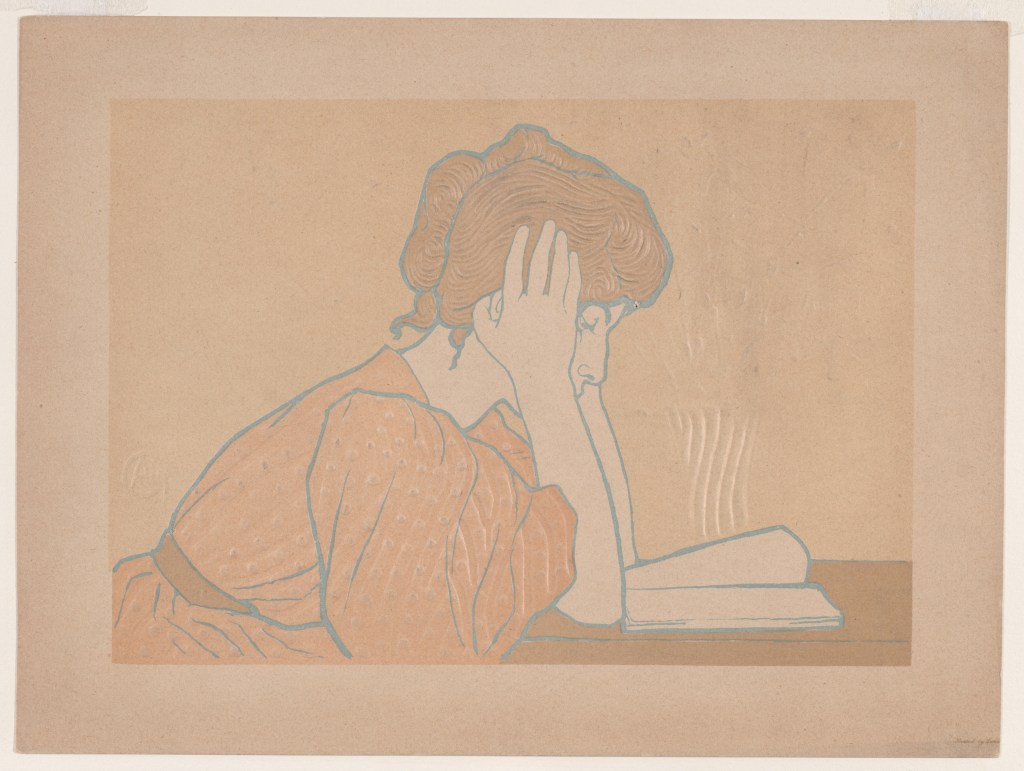
Image: Young Woman Reading, print, Alexandre-Louis-Marie Charpentier (MET, 1992.1061). Wikimedia Commons.
//
Works Cited:
Bowen, Elizabeth. Eva Trout. Anchor, 2003.
Bruner, Jerome. “Life as Narrative.” Social Research, vol. 54, no. 1, 1987, pp. 11–32.
Thomas, Carol. “Rescuing a Social Relational Understanding of Disability.” Scandinavian Journal of Disability Research, vol. 6, no. 1, July 2009, pp. 22–36. doaj.org, https://doi.org/10.1080/15017410409512637.