


Trigger Warning: This essay discusses attempted suicide.
What Happened in the Hallway?
The story of “Mrs. Taguchi” had a happy ending. Having attempted suicide by hanging for a third time while an inpatient at the Tokyo Matsuzawa Hospital, an elite psychiatric facility where she received treatment in 1930, the 42-year-old’s symptoms took a sudden turn for the better. Nomura Akichika (1902–1985), her doctor at the time, linked the beginning of her inadvertent recovery and eventual discharge to an incident in the hospital hallway. According to the psychiatrist, Mrs. Taguchi fell and broke an arm one day while running in the corridor along with some other patients, but somehow regained her long-lost composure in the aftermath of the injury, so much so that the excruciating fear that had been exhausting her will to live began to ebb (Nomura 1936, 14).
Mrs. Taguchi’s own memory reveals a different point of departure towards recuperation. According to the mother of six herself, a fellow patient approached her when she fell asleep in the hospital hallway one day. Rather than judging her for not sleeping in bed, this other patient asked her to put on a kimono robe for the simple reason that “it’s cold” (ibid., 15). Until then, Mrs. Taguchi had been experiencing persecutory ideation to such an extent that she refused to eat under the false belief that her meals were poisoned (ibid., 13). But that day, for the first time in a while, she did what she was asked to do without resistance, suspicion, or accusation. She put on a kimono robe and started feeling better.
I came across Mrs. Taguchi’s nearly fatal “midlife crisis” through her case history, which Nomura Akichika published in the June 1936 issue of the medical journal Nervousness. Displaying an unusual effort to underscore the patient’s side of the story, the psychiatrist made it clear that his publication drew evidence from both his “objective” observation during the progression of Mrs. Taguchi’s illness and his patient’s own “recollection” of her taxing journey of healing (ibid., 12). Thanks to the explicit discrepancy in the resulting narrative, this collaboration brought to the fore the question of what (actually) happened to Mrs. Taguchi—a puzzle that the present essay seeks to appreciate if not untangle.
What Happened on the Tram?
The onset of Mrs. Taguchi’s ordeal took place on a tram in Tokyo around seven o’clock in the evening on October 3, 1929, a couple weeks before the Wall Street Crash set off the Great Depression on the other side of the Pacific Ocean. While traveling on the tram, the then 41-year-old was suddenly overwhelmed by dizziness and an intense sense of discomfort in her chest. Feeling that she was about to faint, Mrs. Taguchi tried taking her own pulse but felt nothing. In a panic, she got off the tram and went directly to see a doctor. At the doctor’s, Mrs. Taguchi requested thiamine injection herself based on her own judgment that what she experienced was a heart failure caused by beriberi and received six doses of the medication.
What Mrs. Taguchi did, along with the level of conviction she did it with, was remarkable. To begin with, the cause of beriberi had been an issue of high-level medical and political dispute in imperial Japan (1868–1945). As a “national disease,” beriberi significantly contributed to the noncombat casualties of the Japanese Imperial Army, which stubbornly supplied its soldiers with a vitamin-B deficient diet until well into the 1920s (Bay 2012). At a time when the medical profession was dominated by men, Mrs. Taguchi was up-to-date on the etiology and treatment of a recently contested illness thanks to her own occupational background. Right after graduating from the equivalent of a junior high school, she became a nurse and practiced for five years thereafter. In theory, Mrs. Taguchi could have served as a nurse of the Red Cross during the Russo-Japanese War between 1904 and 1905 and witnessed the death toll from beriberi first-hand. At the age of 23, she married an attorney and became a mother in the years to come. It was nevertheless her past as a professional woman that drove Mrs. Taguchi to speculate the cause of her lightheadedness and heart issue to be beriberi, for which she continued to request and receive thiamine injections from multiple doctors, though to no avail (ibid., 12–13).
By June 1929, Mrs. Taguchi was a woman haunted by her own anxiety and fear. Despite her repeated change of doctors, her blood pressure always showed up in examinations as normal. The protein level in her urine test raised no alarm. Neither was there any organic changes to her heart. In other words, medical science was able to find no fault with her body, even as the state of her mind continued to deteriorate. It was the last doctor that she saw who successfully convinced Mrs. Taguchi to seek psychiatric care instead, who proposed that hers was “a condition of hysteria caused by the way of blood,” a dual diagnosis both specific to its own historical context and meaningful in its own right (ibid., 14). Initially an androgynous notion concerning circulation, the “way of blood” evolved into an equivocal catchall for “women’s illnesses” over the course of the Tokugawa period (1603–1868). Between the late nineteenth and the early twentieth centuries, the political endorsement of Western medical science in general and the development of psychiatry in particular facilitated the assimilation of “hysteria” into Japanese medical nomenclature. As a piece of longstanding common knowledge circulated among the lay population, the “way of blood” assisted patient-physician communication by acting as a native counterpart and cognitive bridge to the European-derived and yet unfamiliar “hysteria.” Because of its perceived ontological proximity to “hysteria,” the “way of blood” itself took on the meaning of a disorder of the nervous system. In the specific case of Mrs. Taguchi, both the native and the assimilated diagnoses did their job well. Mrs. Taguchi voluntarily sent herself to Matsuzawa, where Nomura Akichika concurred that her disorder was indeed of a psychiatric and hysteric nature (ibid., 14).
But was it just that?
What Happened to Healthcare?
What I read in Mrs. Taguchi’s plural and pluralist diagnoses was both a strong-willed woman’s attempt to navigate her own illness and a medical pluralism in motion. During the bygone Tokugawa period, the latter manifested itself through the “plurality, syncretism, and emphasis on self-treatment” in the day-to-day experience of healthcare (Burns 2023, 503). Tokugawa physicians themselves studied then-mainstream Chinese medical canons, translated European medical texts from Dutch to Japanese, and compiled chronicles on the realm’s native medical history (Trambaiolo 2013). Into the postwar period (1945– ), however, Japan’s medical pluralism phased into what anthropologists have described as an “orchestrated” hegemony (Lock 2008). The third quarter of the twentieth century not only witnessed the revival of kanpō—literally “Chinese medicine”—in Japanese society, but it also saw the time-honored craft being “appropriated by biomedical practitioners” and standardized to fit into the existing framework of the national health insurance system (ibid., 42).
What Mrs. Taguchi experienced first-hand was the medical pluralism of imperial Japan, a shift in the landscape of power that bridged the two successively hegemonic regimes of kanpō and biomedicine. By the late 1920s, the epistemic prestige that kanpō had once enjoyed during the Tokugawa period was no more. Born well after the Medical Regulations (Isei) of 1874, Mrs. Taguchi’s generation came of age when “doctor” was already a legal concept, referring by default to those who practiced under a government-issued license based on a biomedical education. Emerging as a women’s profession, nursing came to adopt a Western model, too (Takahashi 2003). Judging by her working history and her choice of injections as the initial solution to her dizziness and other subject, nonspecific symptoms, Mrs. Taguchi’s affinity for biomedicine remained unwavering even after her departure from the field. Had the former nurse been open-minded enough to consider the therapeutic traditions that had predated the arrival of biomedicine and to see a physician of kanpō after getting off the tram, she might have received a diagnosis of “tram sickness” and a “blood-regulating drug” for her condition. By no coincidence, the pioneer kanpō revivalist Wada Keijūrō (1872–1916) remarked as early as in 1910, when trams were still fairly new, that a “blood-regulating drug” was no different than what kanpō would consider a drug for women’s “way of blood” (Wada 1910, 233). Incidentally, Wada Keijūrō simultaneously believed the “way of blood” to be a more appropriate name for hysteria the disease than “hysteria” the diagnosis, which in medical literature was often rendered through transliteration into hisuterii (ibid., 234–235).
What Happened to Mrs. Taguchi?
In all honesty, I doubt I will ever find out what actually happened to Mrs. Taguchi. Perhaps a contemporary diagnosis per the most recent revision of the Diagnostic and Statistical Manual of Mental Disorders would put her in the category of an anxiety or panic disorder. Perhaps it would not. In any case, what I have indeed come to realize is the importance of asking the question of “why we don’t know what we don’t know” and of looking closely at the operation of medical uncertainty in both the patient’s lived experience of illness and the health professional’s educated judgment. As a retired nurse who found herself a patient in a psychiatric ward, Mrs. Taguchi inhabited both identities, but even she did not correlate the treatment regimens she had received at Matsuzawa to what saved her life. On that note, perhaps it was a simple gesture of kindness—one that neither sought to assert the authority to diagnose nor displayed an urge to medicalize—that worked wonders. In a purely speculative narrative, I imagine this gesture to have taken the form of a fleeting comment in Mrs. Taguchi’s case, coming from one “mad” woman to another:
“Why don’t you put on a kimono robe? It’s cold.”
Featured Image
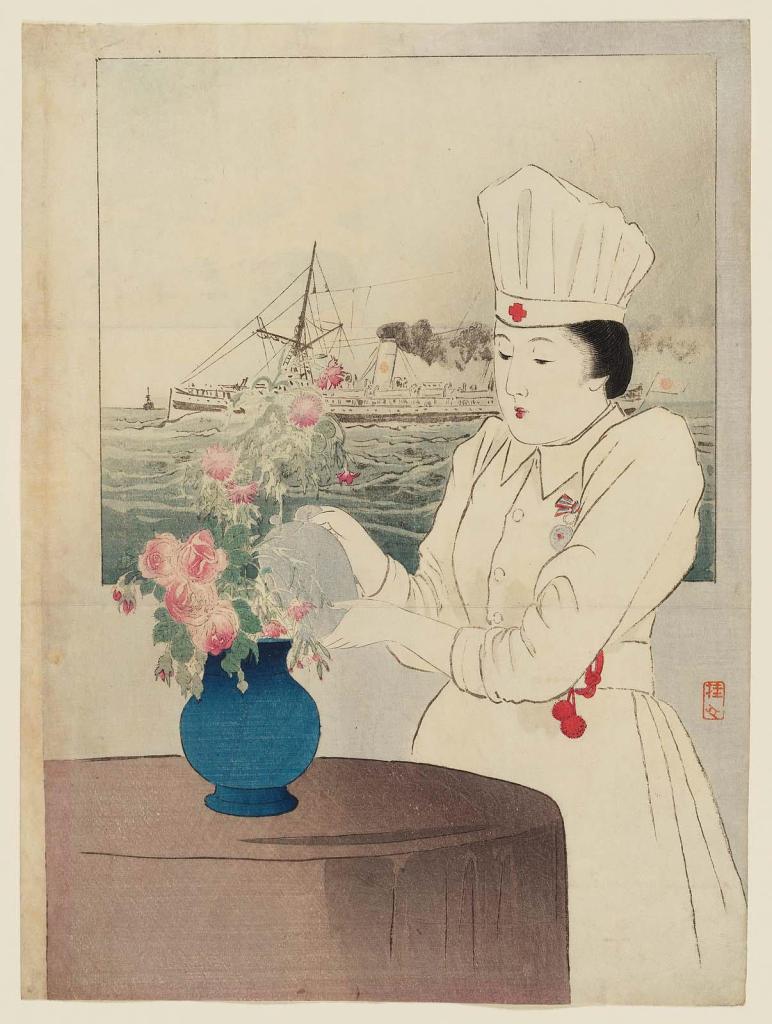
Takeuchi Keishū. Nurse (Kangofu), frontispiece illustration from Bungei kurabu, vol. 10, no. 6. April 20, 1904. Woodblock print (nishiki-e); ink and color on paper, 29.5 x 21.7 cm. Museum of Fine Arts Boston. Accession number 2000.328. https://collections.mfa.org/objects/130008/nurse-kangofu-frontispiece-illustration-from-bungei-kurab
Works Cited
Bay, Alexander R. 2012. Beriberi in Modern Japan: The Making of a National Disease. Rochester Studies in Medical History. Rochester, NY: University of Rochester Press.
Burns, Susan L. 2023. “The Medical Revolution in Early Modern Japan.” In The New Cambridge History of Japan, edited by David L. Howell, 1st ed., 478–506. Cambridge University Press.
Lock, Margaret. 2008. “Rationalization of Japanese Herbal Medication: The Hegemony of Orchestrated Pluralism.” Human Organization 49 (1): 41–47.
Nomura Akichika 野村章恒. 1936. “Shinkikōshin kyōfu no keitai kara hisuterii-sei seishinbyō ni hattenshita ichirei 心悸亢進恐怖の形態からヒステリー性精神病に發展した一例.” Shinkeishitsu 神経質 7 (6): 12–15.
Takahashi, Aya. 2003. The Development of the Japanese Nursing Profession: Adopting and Adapting Western Influences. London: Routledge.
Trambaiolo, Daniel. 2013. “Native and Foreign in Tokugawa Medicine.” The Journal of Japanese Studies 39 (2): 299–324.
Wada Keijūrō. 1910. Ikai no tettsui. Tokyo: Nankōdō. https://dl.ndl.go.jp/pid/832954.