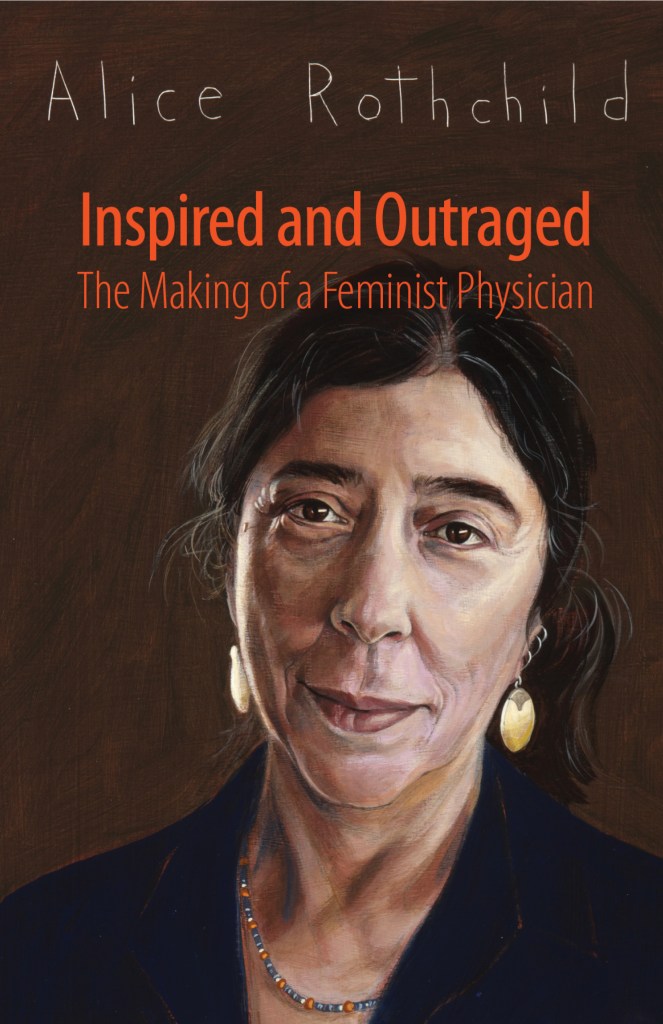
“[T]he analyst who points us out from our classmates and announced (disapprovingly)/ You women are taking the place of a productive male…You are here because of your Unresolved Penis Envy” (pp 166-7). These are the attitudes which Dr. Alice Rothchild, obstetrician and gynecologist at Beth Israel Hospital, Associate Professor of Obstetrics, Gynecology and Reproductive Biology at Harvard Medical School, author, filmmaker, and peace activist, has dealt with throughout her life and career as a woman in medicine. In her memoir, Inspired and Outraged: The Making of a Feminist Physician (2024), Rothchild traces her journey in the medical realm, her embrace of feminism, her experiences with “otherness,” and her personal growth.
Rothchild’s memoir is structured as a collection of free-verse poems. She employs this poetic style very effectively, making use of indentation, italics, and font sizes to create meaning and, in some instances, conversations. This unique format is fitting for the memoir of a woman who was determined to challenge the expectations her Jewish family imposed upon her.
As the title of her memoir states, Rothchild uses her poems to convey the moments of inspiration and outrage which shaped her personally and professionally. Rothchild writes about the female mentors who encouraged her and the resilient mothers who influenced her medical work. However, these inspirations are punctuated with shocking stories of therapists who made passes at her, colleagues who belittled her, doctors who made demeaning comments about female patients, professors who felt women had no place in medicine, and medical literature and terminology designed to make women feel ashamed of their bodies.
Rothchild’s memoir is divided into six sections which follow her life chronologically. Section one, “Prelude,” describes her grandparents’ experiences emigrating to the United States and her parents starting a family. Part two, “Childhood,” recounts Rothchild’s sense of otherness and unbelonging as a Jewish child in a Christian society, as well as the familial discord between Rothchild and her parents during her adolescence. Section three, “Battlefield,” focuses on Rothchild’s experiences at Bryn Mawr College and Boston University’s School of Medicine, where Rothchild’s feminist ideals prompted her to study obstetrics and gynecology – “I asked myself/ as a FEMINIST AND A WOMAN/ where would I make/ The Most Impact?” (p 177). Rothchild also discusses her passion for helping those who are disadvantaged in the “Lincoln Hospital Trilogy.”
In section four, “Obstetrics and Gynecology,” Rothchild documents her struggle against the “good old boys” (p 236) who dominated her field and provides snapshots of her (mostly negative) time as a resident at Beth Israel Hospital and (mostly positive) work as a physician at the Urban Woman and Child Health Clinic. Rothchild also describes her experiences juggling a demanding medical career with motherhood and familial responsibilities (“Having It All”). In the fifth section, “Grand Finale,” Rothchild provides reflective remarks on racism, sexism, contemporary medical controversies including Roe v. Wade, and the impressive nature of female anatomy. Finally, part six presents a brief, alternate “Herstory” of birth and medicine since 1300.
One of the most compelling aspects of Rothchild’s memoir is her honesty. She never holds herself above the reader but is raw and real about her struggles – a fact which is further emphasized by the poetic structure of her memoir. Throughout the book, Rothchild discusses her journey to find and assert her voice, whether as a child needing permission to use the restroom (“Humiliation”) or as a resident doctor being belittled by a department head in the operating room (“My most traumatic memory”). It is not until “Damages,” over halfway through her book, that a therapy session helps Rothchild realize how to use her voice (p 246). However, Rothchild does not suggest that her path to personal growth was linear, and that she never faltered again after that epiphany. In “Heart Sounds,” Rothchild assumes her inability to hear through her stethoscope is a sign she is losing her hearing or developing a brain disorder, until her patient points out that the problem lies with the faulty instrument (pp 308-9). Readers might not be able to relate to Rothchild’s prolific medical career, but many will relate to her insecurities and the way she conveys the complexities of overcoming personal hurdles.
While Rothchild’s memoir references moments of both inspiration and outrage, there are times when outrage seems to overshadow inspiration. This is particularly evident in Rothchild’s “Herstory.” Although she powerfully and effectively conveys the misogyny which has informed medicine, and she acknowledges many of the women of colour who were abused in the name of modern medicine, her revisionist history does not mention many of the women who worked within the medical field to achieve change, particularly during the early twentieth century. Where are the women who championed women’s health, contraceptives, and improved understandings of reproductive health, like Elizabeth Blackwell and Margaret Sanger? Rothchild does not pretend to present a comprehensive “Herstory.” However, her omission of the female activists who promoted women’s healthcare seems like a missed opportunity to address some of the figures whom women in medicine could look back to for inspiration today.
Medical and health humanities scholars will benefit from the ways Rothchild’s memoir exposes the racism and sexism which remained alarmingly dominant in the medical field throughout the twentieth century – and are still apparent today – and her experiences will undoubtedly serve as a source of both outrage and inspiration for academics and lay readers alike. However, while Rothchild’s book makes many important contributions to our understanding of the recent history of medicine, it is important that it is read primarily as a memoir, shaped by her own memories, experiences, and opinions. Indeed, Rothchild’s memoir is the story of her life, not just a commentary on the history of medicine.
Inspired and Outraged is fascinating for its complexity and multifaceted nature. It is a story of coming of age, of following one’s dreams, of serving the vulnerable, of being “othered,” of finding love and joy, and of struggling with relationships. Readers will likely be left outraged at some of Rothchild’s experiences, but inspired by her example of resilience, perseverance, dedication, and compassion.
Work Cited: Rothchild, Alice. Inspired and Outraged: The Making of a Feminist Physician. (New York: New Village Press, 2024).
Book Cover illustration from Shetterly, Robert. Portraits of Peacemakers. (New York: New Village Press, 2024).