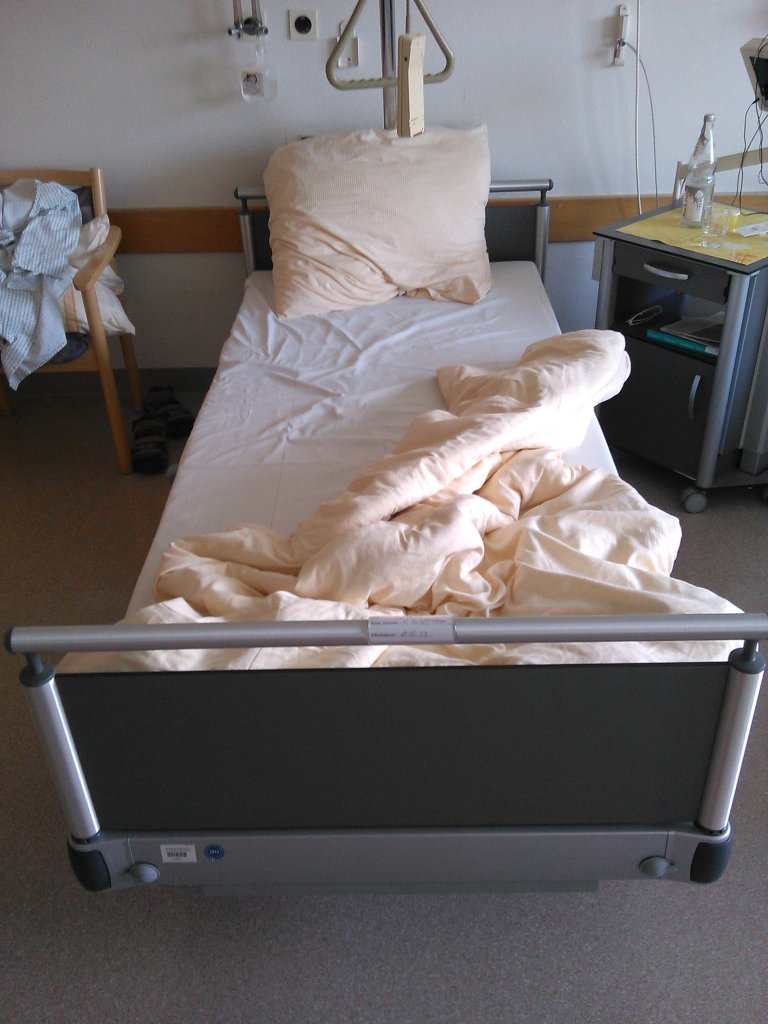
Fittingly, I begin this in a hospital. I am in the vascular medicine department of the Cleveland Clinic, awaiting a routine follow-up ultrasound for the “minimally invasive” procedure I had last week, when I begin organizing my notes for an essay on Garth Greenwell’s new novel, Small Rain (2024). I say minimally invasive, because this is the designation used to indicate how much of your body they cut. Susan Sontag famously critiqued the metaphor of invasion to describe disease—first cancer, later AIDS—but if invasive is inapt for illness, as Sontag insists, it is still felicitous for medicine. It doesn’t matter how minor or routine the procedure; when you have experienced medical trauma, every subsequent interaction with medicine is an invasion of one kind or degree.
I say fittingly, of course, because Greenwell’s novel takes place almost entirely in a hospital, charting the harrowing experience of a poet-patient-narrator who is admitted to the ICU for an aortic dissection during the early months of COVID-19. The narrator’s diagnosis puzzles the medical professionals tasked with his care; swiftly, his body is rendered an object of study and surveillance: prodded, monitored, mined for meaningful data. While technically tethered by IV lines and EKG leads, he is adrift in the myriad uncertainties and temporalities his condition inaugurates—the tracing of etiology, the interpretation of present symptomatology, the reckoning with prognosis. Meanwhile, he remains at the mercy of rotating shifts of providers, a project or problem for whomever clocks in.
The plot of Small Rain is occasioned by cardiac pathology, but I continually find my attention oriented elsewhere: coincidentally or consequentially, to the same part of my own anatomy that was minimally invaded so recently—the leg. The narrator first directs us here following his ER intake, when, after a revolving door of clinical encounters, a nurse lays her hand on his ankle, rubbing it soothingly. “It was a shock, her touch,” the narrator tells us, and it moves him to tears. “She was the first person here who had touched me in a way that had no medical purpose, no measurable end but comfort,” the narrator notes of this otherwise-inconsequential action—a kind of ordinary touch that is rendered all the more meaningful, he suggests, in having been evacuated from social life by the pandemic: “the daily unremarkable corporeality” now reserved only for lovers, for the most intimate of bodily bonds. Whatever the impetus, he continues, “I responded out of all proportion, I felt I loved her for that touch” (33-34).
It was a shock, this scene—in the swell of recognition that I, too, have felt disproportionate love for precisely this: for a nurse who, after sliding me into the cylinder of an MRI machine, pulled a blanket over my feet and paused to stroke my ankle before returning to the other side of the radiation-shielding partition. I was almost embarrassed for her at first; she doesn’t know that I’m accustomed to this, I remember thinking—that I have been having regular MRIs for most of my adult life, which is what happens when you’re first diagnosed with cancer in your twenties. But then, I realized, I have been doing this for years, and this is the first time anyone has offered such a kindness, such a small, good thing.
Today, I am called to the ultrasound room by a technician who does not tell me her name. I crane to see her ID badge, but it’s covered by a collection of other accoutrements swinging from the lanyard around her neck. I can only make out the first two letters: C-A. Catherine, maybe, I decide, the confirmation name I had chosen at sixteen: patron saint of scholars and teachers.
As Greenwell’s nurse humanizes his narrator with a touch, the narrator humanizes her with a name: Renee. In this way, the character is unlike much of the rest of the novel’s supporting cast of medical staff: “a young woman with another cart” (35) who arrives to stick electrode sensors on his ankles; “another woman with another cart” (38) who enters shortly after that for administrative purposes. Renee’s purportedly purposeless touch—the kind with “no measurable end but comfort”—becomes a notable foil for the host of purposeful, professional touches that follow: the doctor who forces her fingers into the narrator’s feet, “pressing hard right at the joint with the ankle, feeling for my pulse” (53-54); the doctor who asks permission to examine him, while “already pulling up the blanket from around my feet, reaching under the sock to press the tips of her fingers around the ankle, feeling for a pulse” (105); the no-nonsense rheumatologist who holds his foot in her hand, “rolling it in a circle as she felt the ball of my ankle in her other palm” (123), as they discuss his history with poppers.
C-A apologizes before pressing the ultrasound wand into the back of my knee, the incision site, where I had been warned to expect significant bruising (I felt a little thrill of pride in this; the invasion may have been minimal, but its effect was significant). She knows it will hurt, she says, squirting a stream of ultrasound jelly from the tube. But—my bioethics students might explain—the nonmaleficence of this inflicted pain is outweighed by the beneficent intent, mitigating harm. After all, her task is to search for a thrombosis in the deep popliteal vein, a rare but potentially serious—for serious, one must always read fatal—complication.
Greenwell’s narrator invokes Renee by name again later in the novel, during a deep reading of a George Oppen poem, as he considers the possibility that he is fascinated with the poet’s language of individuation because it throws the deficiencies of biomedicine, of the American health care system, into relief—because it “explained how the particularizing attention of the doctors and nurses, all the precise data they collected from my specific body, had nothing to do with me, really, left the crucial me unseen, untouched (only the first day, only by Renee’s hand on my ankle, that had been the only actual touch)” (183).
I wince, and C-A asks if I’m okay. A half-nod suffices as consent to continue.
Toward the end of his hospital stay, the narrator surrenders his (literal, and a certain amount of metaphorical) weight to another named nurse, Alivia, to whom he has developed a close attachment, a dynamic he likens to that of teacher and student: “a relationship that engendered intensity but had transience built in, so that the sign of it success was its ending” (235). In a scene that marries religious ritual with neoliberal brisk efficiency, Alivia lifts his leg by the ankle as she washes his body: “She was thorough but quick, entirely professional,” the narrator says, “so I can’t explain why it felt so intimate to release the weight of my limb into her hand as she ran the cloth down the back of my leg” (243). Yet he subsequently remembers an erotic encounter there, a hand on the back of his knee—or rather, he clarifies, “my body had remembered it, that inch or two of my body; how lovely that it remembered it, triggered by so different a touch, by Alivia smearing with the foul hospital disinfectant” (244).
I think of how, for me, the process has always been the opposite; how I brace and bristle at tender touches for how they trigger the memory of the clinical ones. My body remembers, too.
But then, I also remember my Alivia: Suzy, the labor and delivery nurse who held down the ward during the day I spent in labor with my first child. How her shift ended right before I was ready to push, and I felt a sting of betrayal, followed by a wave of embarrassment—because of course this was something she could clock out of without a second thought; it was her job, and she was going home. How, when she came back the next morning to find me alone, having delivered a barely-breathing baby who had been whisked by ambulance to a NICU in another city, she put her arms around me. And how, when I returned to the same ward three years later, I felt an electric thrill when her shift began just in time for the birth of my second child; how I scanned her face above the fold of her mask for a flicker of recognition that did not come.
In an interview for The Yale Review, editor Meghan O’Rourke asked Greenwell whether his novel might “help shine a light onto the human realities behind medical bureaucracy,” whether it might work its magic on the hearts and minds of health care providers. As a medical humanities educator whose work consists in training pre-medical and nursing students in the transferable skills of close reading and critical analysis—and of routinely defending the evidenced efficacy of such endeavors—I am all too familiar with arguments for the utility of literature. I find myself alternately bolstered and deflated by arguments about how narrative analysis and the explication of poetry align with the competency-based framework of medical education, justifying the existence of the humanities insofar as they can be instrumentalized in professional practice. Greenwell’s response seems to reflect a similar ambivalence. Initially, he proposes that “the usefulness of art depends on a commitment to defending art’s uselessness.” In the end, though, he affirms, “I do hope doctors and other care providers read this book. Art calls us to attention—attention to the world, to the personhood of others. And attention is the heart of care.” Indeed, attention is the first pillar of narrative medicine that Rita Charon identifies in her seminal essay on the practice. “How does one empty the self or at least suspend the self so as to become a receptive vessel for the language and experience of another?” Charon asks. “This imaginative, active, receptive, aesthetic experience of donating the self toward the meaning-making of the other is a dramatic, daring, transformative move” (263).
But Greenwell’s assertion about the “uselessness” of art is not strictly antithetical to a belief in its dramatic, daring, transformative potentiality. Rather, he clarifies, his point is that an artist cannot predict whom his art might transform, or in what ways. I might design well-intentioned learning outcomes, reflecting my hopes for how future health care providers could be transformed by Small Rain, but I cannot guarantee them. For my own part, I can only say that when C-A found it—the blood clot that is poised in my vein as I write this, the one the doctor on the phone assured me has an exceedingly small chance of actually killing me if I take a three-month course of blood thinners, the one she had earlier assured me had an exceedingly small chance of developing at all—Small Rain felt like a hand on my ankle: an act of care, a contact for unanticipated emergency.
It is possible for literature to be a light, a mirror, a tool. But sometimes the transformations it engenders are less conspicuous. And this is why we love it out of all proportion.
Works Cited
Charon, Rita. “Narrative Medicine: Attention, Representation, Affiliation.” Narrative, vol. 13, no. 3, 2005, pp. 261-270.
Greenwell, Garth. Small Rain. Farrar, Straus and Giroux, 2024.
Image: Wikimedia Commons