What art works would adorn the place where the ultra-rich go to die? Zero K (2016), a more recent work by the American writer Don DeLillo, perhaps best known for his novels White Noise (1985) or Underworld (1997), offers a sardonic answer: art that represents the traumatic conditions of how we live now. The novel dramatizes a family’s journey through an institution where the elite undergo cryogenic freezing in hopes that they will live again in the future. The narrator, Jeffrey, bears witness to the deaths of his stepmother and father, who undergo this form of quasi-assisted death. Jeffrey recounts these scenes of loss in a disjointed, somewhat disaffected narratorial style—which I do not mean pejoratively since such a style sets the emotional tone of the novel. I find the novel to be a deeply moving study of life, death, time, language, and embodiment.
Yet what interests me most in Zero K is how it stages the relationship between aesthetic representation and trauma or loss. The novel’s deterritorialized cryo-facility called “the Convergence” seems full of unsettling art objects, most notably, several video installations of global uprising or disaster. Like much of DeLillo’s work Zero K has a cinematic sensibility. Not quite ekphrasis—the description of art via literature—but something else, something more and less: an overwhelming image, rendered only partially.
The centre itself even appears as one big art installation according to Jeffrey’s stepmother, Artis (nearly an “artist” herself, if only for the missing “t”), who describes the Convergence as “as a work-in-progress, an earthwork” (DeLillo 10). Inside, however, the art works skew more frantic than natural. The novel presents several scenes in which the narrator encounters a screen from which images of violence and catastrophe appear. In one video, “scenes of rain” give way to “people everywhere running, others helpless in small boats” as water keeps “rising in city streets, cars and drivers going under” (11). The screen enlarges, which seems to extend time and gives the catastrophic images a looming quality. Jeffrey thinks: “It was there in front of me, on my level, immediate and real” (11). He looks for another witness, someone who might also bear the burden of the viewing these images. Looming, extended, and excessively real—these are the qualities of trauma art.
In Disability Aesthetics (2010), Tobin Siebers considers trauma art to be a formal strategy achieved through unsettling images of embodied violence, harm, and disability. Yet these are not just traditional works that happen to represent trauma. Instead, trauma art collapses context and blurs the distinction between the real and artificial to provoke an affective response in the viewer. For Siebers, Andy Warhol’s images of car crashes and race riots accomplish this effect. In DeLillo, it is accomplished by a video depicting a tornado’s destructive wake. “The camera linger[s]” on the bodies, whose “violent end” Jeffrey finds “hard to watch” (36). Yet watch he must, because, as Siebers argues, “these works of art disturb because they attach an excess of meaning to the objects designed to convey meaning,” those objects being the “materiality of the body” and more specifically, the disabled or yet-to-be disabled body (103). Trauma art, so excessive and yet without language, challenges mediation and becomes, in the dual sense of the word, “immediate.” Thus works “reveal that trauma is the principal signifier of the cultural as such” (Siebers 114). Trauma art posits that trauma isn’t merely incidental to contemporary culture but the visual language through which culture takes shape.
And trauma art, at least in Siebers’ formulation, has a collective function rather than an individual one. Much of contemporary trauma discourse largely individualizes trauma by prioritizing the ability of art to excise the negative affects associated with traumatic experience (an often necessary and life-affirming therapeutic function to be sure). But Siebers thinks of trauma art as a cultural experience: rather than excising personal feeling, trauma art works as an exercise in communal definition. Trauma remains unreconciled, even as it is folded into the texture of the collective.
Through Sieber’s frame we can understand that the images in Zero K accrue meaning through embodied violence and disability, meaning which becomes excessive. Excess, that feeling of seeing too much, is what distinguishes trauma art.
Take for example when Jeffrey sees a video of self-immolation. When confronted by the “burning men, mouth open” Jeffrey “[steps] back from the screen” (DeLillo 61-62). Overcome by the embodied violence—the context of which he cannot know—Jeffrey turns away from the screen. Recoiling from the maimed body thereby dramatizes trauma art’s symbolic power as the “excess of communication that arcs from specific objects or individual bodies to responses related to collective emotions” (Siebers 104). In the absence of language that might give traumatic events meaning, trauma itself becomes the discursive object and product. Given that the Convergence is entirely oriented toward the future—it aims to not only preserve the bodies of a select few but also to solve the ills of the past through a new culture, a new language—the presence of trauma art serves as a warning to the inhabitants of the future: don’t be like us.
Then there are the bodies themselves. In opposition to a future of disability and death, Artis and Ross, Jeffrey’s father, elect to freeze their bodies in hopes that one day they might live again. Zero K does not reconcile the ethical quandary of choosing to die instead of living a disabled life (Artis has MS, Ross later develops tremors). What the novel does do, however, is transpose this question into aesthetic terms. The “cryogenic dead, upright in their capsules” exist as “art in itself, nowhere else but here” (DeLillo 74). The disabled body literally becomes an art object. Human statues and traumatic images exist as “part of the foundation” of the Convergence (51). And insofar as the Convergence space is an “earthwork,” it itself becomes a work of trauma art too. Thus, the bodies, the physical infrastructure, and the videos reproduce “death, disability, and disaster” through artistic means to construct “collective representations in which the body as spectacle is presented to the public as a symbol of its own collective nature” (Siebers 113). As such, the crowded images that confront Jeffrey index trauma as the aesthetic value par excellence for the modern public body.
Moreover, Zero K’s use of trauma art aligns with Cathy Caruth’s revisions to trauma studies, the field in which she remains foundational. Caruth pushes against an interpretation of her work that reduces trauma to “the unrepresentable.” It is not that trauma cannot be represented exactly, but that no “frameworks of representation” will ever be entirely successful at the task. Caruth goes on to say that this rearticulation “by no means suggests that I can’t find some mode of testifying; it just means that my framework for living and thinking from now on will no longer be the framework in which I lived before” (51). Such is the effect of traumatic images in Zero K. Representative methods including discourse, embodied or near performed art, audio-visual media, and architecture all prove to be inadequate to their representational tasks. Yet upon each viewing the characters cannot go on in the way they lived before.
If trauma art tests the limits of representation, then Zero K remains skeptical as to whether any artistic forms will be equal to the representational demands of the present. Classical forms won’t work; paintings only “make the past seem permanent” (emphasis mine, DeLillo 15). By contrast, the traumatic scenes presented via futuristic audio-visual installations, while affecting, can’t actually connect the viewer to the person on the other side. And the cell phone, that ubiquitous tool, is in the novel a dehumanizing object capable of making spectacles out of persons. A scene outside of the Convergence demonstrates this risk. Jeffrey encounters a woman standing, unmoving, in a “stylized pose” amidst the bustling New York City street (209). Under his gaze she presents as an art object that he cannot help but move toward as if affected by her performance of silence. Yet others stop “just long enough to aim [a] device and take a picture,” thus precluding the possibility for affective or collective response. Via the cellphone camera the woman/art object becomes merely another part of the “disturbance building all around us” (210).
Thus, it is as if DeLillo answers Caruth’s rhetorical questions: “if you show it [trauma] all the time, does it become just a spectacle? …what do we do in a world saturated by new forms of digitalized viewing and new seemingly ubiquitous forms of technological mediation” (66)? Zero K seems to say: who knows! But it sure is effective, isn’t it?
Works Cited
Caruth, Cathy, et al. “‘Who Speaks from the Site Of Trauma?’: An Interview with Cathy Caruth.” Interview by Pasquer Brochard and Ben Tam. Diacritics, vol. 47, no. 2, 2019, pp. 48–71. https://doi.org/10.1353/dia.2019.0019.
DeLillo, Don. Zero K. Scribner, 2016.
Siebers, Tobin. Disability Aesthetics. University of Michigan Press, 2010.
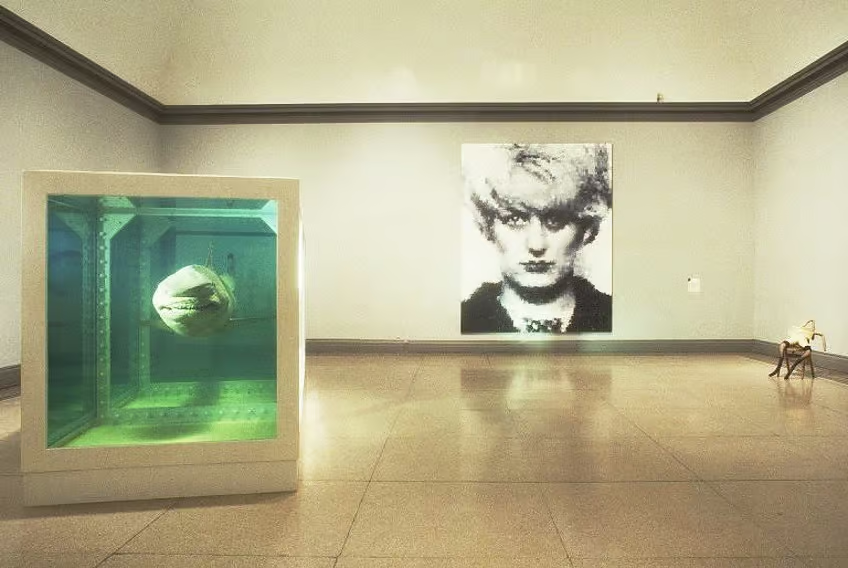
Image credit: Damien Hirst, The Physical Impossibility of Death in the Mind of Someone Living, 1991. WikiCommons.