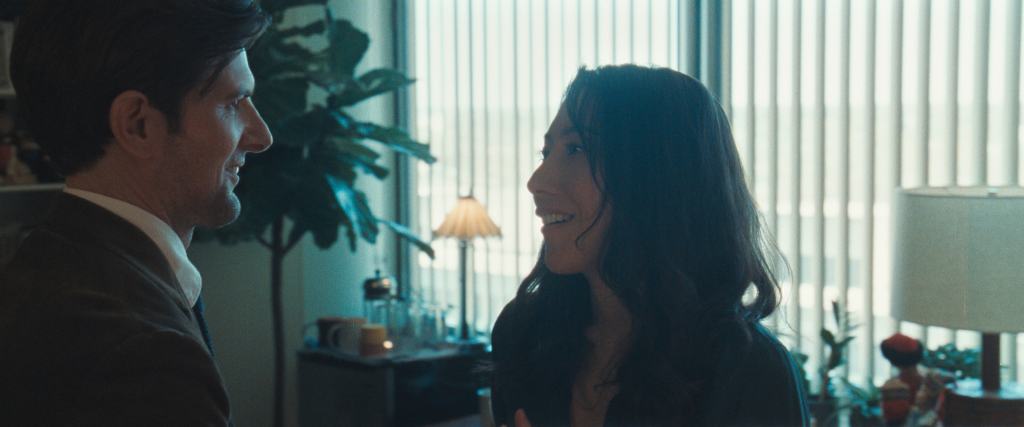
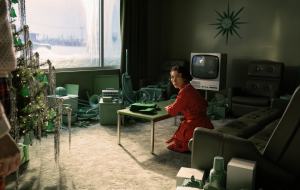
Dichen Lachman and Adam Scott in Severance, Season 2, Episode 7 (“Chikhai Bardo”), Streaming on AppleTV+.
In the top image, the pre-severed Scouts talk shop while grading papers; in the lower image, Gemma writes thank-you notes in an eternal Christmas scenario.
The AppleTV+ show Severance, which explores the lived reality of people who work at the pharma and tech giant Lumon, investigates what it means to deliberately separate and cultivate one part of a person’s consciousness – the part that works – from the rest, the part that lives away from the workplace. Certain employees at Lumon undergo the “severance” procedure, which separates their memories of their out-of-office lives (“outies”) from their work selves (“innies”) using a chip inserted into their brains, and which renders the “innies” simultaneously emotionally childlike and chillingly efficient office drones. With no recollection of their full names, much less the world outside the office, they exist in a permanent state of work, awakened and put to sleep as they enter and exit the Lumon elevators that trigger the severance chip’s effects.
Season Two, which just wrapped up, has revealed to us more about the uses and abuses that Gemma Scout (Dichen Lachman) has been put to since we first learned about her “innie” existence as Miss Casey, the Season One “Wellness Director” for severed employees. In that role, Gemma is forced to playact the therapist, leading “wellness sessions” that are doled out to innies who seem to be facing a crisis of self, temporary or otherwise – even those, like Mark S./Scout (Adam Scott), whose “outies” hope to spare them pain and grief of loss (in his case, the loss of Gemma, who he believes died in a car accident) by severing them from all knowledge of personal loss.
At the close of Season Two, amidst all the domestic, dental, and airborne tortures Gemma has endured – interspersed with monitored access to sanitized imprints of her beloved Russian novels – it becomes clear that Lumon’s targeting of the Scouts represents a larger culture war. In selecting the Scouts as a model couple to sever from themselves and each other, Lumon represents the desires and tactics of technocratic elites, who want to use medical systems and scientific knowledge to amass power and human capital, against humanities scholars – in this case, those working in history and literature. In selecting the Scouts as the model test case for a successful separation of a couple from their knowledge and each other, Lumon defines the severance procedure as an act that separates people from knowledge of the past and the meaning and nuances of language: the very things that give us context and precedent for analyzing collective and individual histories, and the ability to move thoughtfully toward the future.
The role of Miss Casey suggested that Season One Gemma was being used for wish fulfillment of the pseudoscientific kind: the construction of a therapeutic environment in which Miss Casey provides “innies” context for their lives –without having any context or history of her own. The deployment of “wellness” in a sterile, dystopian environment – specifically, the doling out of personal attributes and tendencies, divorced of chronology in a never-ending present tense (“you make people’s days better, just by being yourself”; “you love the sound of Radar”) – suggests that personality is active and predictable, but not based on learning or experience. Moreover, the rehearsal of these qualities and actions as vital and essential suggests that anyone can tell anyone else who they are – no deep work needed, just a little prompting. As Miss Casey, we might also see Gemma, an academic taken away from her work and forcefully placed in a caring profession, as being forced to perform a specific kind of psychological caretaking. Such caretaking is a task many professors (especially women and people from marginalized populations) are expected to provide students and colleagues, free of charge and without training.
But in Season Two, episodes 7 and 10, we learn more, including that Gemma has been given more than 20 “innie” personalities, each of which chips away at her core identity as a person who has trained long and hard to be an expert – a classroom leader and a teacher of others. In each of these scenarios – whether she is in a never-ending patch of turbulence, having her teeth drilled, or being forced to thank unseen “friends” for a series of mundane gifts – Gemma is rendered subject and subservient, instructed to act as a kind of servant-patient, rather than a teacher or student – a person who does not just parrot others, but learns and grows, and has ideas of their own that cannot be anticipated.
In Season Two, we see evidence that it is not just memory-based personal identity that has been Lumon’s target – indeed, the corporation has also been targeting the life of the mind. In episode seven, “Chikhai Bardo” (dir. Jessica Lee Gagne), we see a series of gorgeous flashbacks to Gemma’s life with Mark, one in which both are successful academics: Gemma specializes in Russian literature, while Mark teaches history. Their meet-cute, a campus blood drive, is, in addition to being their first interaction, a mutual interaction with Lumon. This suggests not only that Lumon has been surveilling the Scouts (and literally siphoning the life out of them) since they met, but that once they stepped into the medicalized side of Lumon, the corporation – and the Eagans, the dynasty that runs Lumon, atop it – took this as permission to strip them of their identities as subject matter experts. Since then, Lumon has kept the Scouts as test subjects in an alternate landscape of inquiry, one of medical experimentation without the ethical controls and humanistic interventions of a university system. Lumon views the Scouts’ transformation from humanities scholars – self-determining people who deal in words, concepts, feelings, and histories – to guinea pigs as the ideal human trajectory. Taking this erasure of expertise to its logical conclusion, the “Testing Floor” Gemma is trapped on might also be interpreted as an academic’s worst nightmare – a series of tests one is never prepared for, and based on rules outside one’s own chosen discipline, the body of knowledge one has chosen to enrich and contribute to.
Much of the commentary on Severance has remarked upon the forcefully fragmented nature of memory and identity, both in our own lives and the lives of the show’s severed employees (and, in one of the series’ more sinister turns, people who choose to offload the pain and doldrums of pregnancy to an “innie,” emerging as an “outie” once they have given birth). Much, too, has been written on the possibility that a new, composite person is being assembled to insert into Gemma’s body, or that that personality may be extracted whole cloth and deposited into another vessel. But there is a larger severance of knowledge as well. Witness Season Two, episode 10, in which Helly R. (or E., as she is Lumon heiress Helena Eagan’s “innie”), played by Britt Lower, remembers that the equator exists as a place, but doesn’t know if it’s a continent. If the Eagans are obsessed with their own psycho-spiritual hierarchy of tempers and (suppressed) appetites, Lumon is its own upside-down university – one in which humans serve inquiry, but inquiry does not serve humanity.
Works Cited:
Langmann, Brady. “Severance Season 2, Episode 7 Recap,” February 28, 2025, Esquire.com.
Murray, Noel. “‘Severance’ Season 2 Finale: Mark vs. Mark,” March 21, 2025 The New York Times.
Puckett-Pope, Lauren. “Severance Season 2, Episode 7 Recap: I’ll Be Seeing You,” February 28, 2025, Elle.com.
Quint, Jillian. “‘Severance’ Season 2 Episode 7: Did We Just Confirm Reddit’s Biggest Gemma Theory?” March 1, 2025, PureWow.
Rao, Tejal. “The Food on ‘Severance’ Is Its Own Chilling Character,” March 19, 2025, The New York Times.