In Leo Tolstoy’s (1828–1910) masterful novella, The Death of Ivan Ilyich, the lesser-known and often underappreciated character of Gerasim—a young, poor, uneducated peasant with the unenviable task of emptying Ivan’s chamber pot—serves as a subtle but powerful reminder of the moral imperative to be courageously veracious with those who wrestle with questions of meaning and purpose at the end of life. While the compassionate accompaniment of Gerasim has been noted in the health humanities literature [1], it is his role as an unwitting ethicist that aided me in caring for a patient in strikingly similar circumstances to the story’s eponymous main character.
I first met Larry on a cold and cloudy Monday in early March. Admitted to the hospital 68 days prior, the 56-year-old retired high school principal was experiencing acute clinical complications secondary to Amyotrophic Lateral Sclerosis (ALS), a progressive and fatal neurodegenerative disorder that affects nerve cells in the brain and spinal cord.
Larry immediately struck me as a deeply thoughtful and insightful man who, above all else, wanted to protect his devoted wife and two daughters from the pain they would eventually experience upon his death. The anticipatory grief that exuded from his family members, however, took the unfortunate yet common form of an unrealistic insistence that Larry “be resilient,” “keep trying,” “not give up,” and “fight and beat this.” Of course, neither Larry nor anyone else diagnosed with ALS could ever overcome it. The look on Larry’s face whenever he listened to his family’s unrealistic expectations of him was heartbreaking.
As a husband and father, I could appreciate Larry’s steely demeanor, his acquiescence to his family’s requests, and his willingness to put himself last in service of those he loved most. As a member of his healthcare team, however, I struggled to witness his perpetual exhaustion, chronic shortness of breath, unrelenting nausea, and profound depression at the slow but significant loss of his cognitive and physical abilities. Above all, I agonized to witness this dying man toil to find the ability to express how he really felt and what he really needed with those closest to him.
Over the course of his hospital stay, I had no less than thirty separate conversations with Larry—often early in the morning or late in the evening when his family was not present—during which I steadfastly but sensitively encouraged him to share with his family what he repeatedly expressed to me and his healthcare team in private: that he was tired, that he wanted to begin the transition to comfort-focused care, that he did not want to “keep fighting,” and that he wanted to face the reality of his death honestly rather than continuing to pretend that it could be avoided. Like Ivan Ilyich, Larry wanted “to weep … and [receive] some tenderness [instead of putting on] a solemn and serious face” (Tolstoy 203).
During one of our early conversations, I asked Larry what made it so difficult for him to tell his family how he really felt. “Because it would mean putting my needs above theirs; it would mean not letting them get what they still need out of me, which is the only thing left I can give them,” he softly replied. I assumed that Larry’s family, far from being health illiterate, needed tangible proof they, too, were “doing everything” for the person they loved most. For them, it meant “never giving up” on him, which in turn placed an unintentional and unrealistic burden on the one person least capable of bearing it. Whether Larry “gave up” or not was beside the point; ALS would soon strip away everything that provided Larry a sense of identity. Instead, what seemed to matter for both parties was fulfilling the narrative identity that was expected of, but never communicated between, them. Larry and his family undoubtedly aimed at the same target, but they remained unable to find a common language and method by which to arrive at it.
The tragic gridlock in end-of-life communication between Larry and his family is incomparably addressed in the interactions between Ivan Ilyich and his caretaker par excellence, Gerasim. While Gerasim performs numerous acts of kindness to Ivan in Chapter VI of the novella, his most meaningful service comes in the form of his transparent honesty to Ivan about his imminent death. In stark contrast to Ivan’s family and social circle, who persistently evade acknowledging his terminal condition, Gerasim confronts the reality head on. During one of his overnight vigils, Gerasim remarks, “‘We’ve all got to die one day. Why shouldn’t I give you a hand?’” (Tolstoy 203). This statement directly responds to the greatest source of Ivan’s psychological pain: “the lie, which was somehow maintained by them all, that he wasn’t dying, he was only ill, and all he had to do was keep calm and follow doctor’s orders and then something good would emerge. … On many occasions when [Ivan’s family] was acting out this farce in front of him, he was within a hair’s breadth of screaming at them, ‘Stop all this lying! You know and I know that I’m dying, so the least you can do is stop lying to me.’ But he never quite had the nerve to do it” (Tolstoy 202).
Gerasim’s candid acceptance of Ivan’s mortality underscores a profound recognition of their shared human vulnerability. In doing so, Gerasim embodies the platinum rule: the ethical ideal according to which one treats others as they wish to be treated (Chochinov 2022). His integrity and empathy enable Ivan to reciprocate with emotional openness, allowing him to express his suffering honestly—something he is not permitted to do with others. Tolstoy observes that this pervasive inauthenticity, both imposed by those around Ivan and internalized by Ivan himself, ”did most to poison [his] last days” (Tolstoy 203). It is Gerasim’s courageous veracity, then, that emerges as a striking moral counterpoint to the detachment and self-deception exhibited by Ivan’s family and associates.
Like Ivan, Larry was tortured most by the pattern of deception in which he was intertwined—by his family’s “unwillingness to acknowledge what they all knew and he knew; they wanted to lie to him about his terrible situation, and they wanted him—they were compelling him—to be a party to this lie” (Tolstoy 202). Following Gerasim’s example, Larry’s healthcare team and I refused to tell the polite lie that he could, and even was expected to, physically recover from his terminal disease. We recognized that Larry, like Ivan, felt that “no one [in his family] showed him any pity in the way that he wanted them to. There were some moments, after long periods of suffering, when what [he] wanted more than anything else—however embarrassed he would have been to admit it—was for someone [in his family] to take pity on him as if he were a sick child. He wanted to be kissed and cuddled and have a few tears shed over him. … [Only] Gerasim offered something close to this, which was why the relationship with Gerasim gave him comfort. Ivan Ilyich felt so comfortable with him that he didn’t feel like letting him go” (Tolstoy 203).
Larry succumbed to ALS 45 days after we first met. Despite my persistent rallying cry to voice his needs, Larry, like Ivan, never found the spirit to tell his family how he felt, nor did his family find the capacity to relent in their unrealistic expectations of him. Promising from the beginning to keep our conversations strictly confidential, I watched Larry die wishing that I could have advocated more on his behalf. While Larry’s life was certainly a blessing, his dying seemed like a curse. My hope is that Larry’s story can serve as a reminder—particularly to family members of terminally ill patients—of the moral responsibility each of us bears to speak truth to those we love—so that, unburdened, they might become free to speak theirs.
Works Cited
Charlton, Blake, and Abraham Verghese. “Caring for Ivan Ilyich.” Journal of General Internal Medicine, vol. 25, no. 1, 2010, pp. 93–95.
Chochinov, Harvey Max. “The Platinum Rule: A New Standard for Person-Centered Care.” Journal of Palliative Medicine, vol. 25, no. 6, 2022, pp. 854–856.
Tolstoy, Leo. The Death of Ivan Ilyich. Translated by Ronald Wilks. Penguin Classics, 2008.
Series Information
Notes from the Bedside: A Clinical Ethics and Health Humanities Case Series offers a first-person account of patient care issues that arise at the intersection of clinical ethics and health humanities.
Confidentiality Notice
Identifying information has been redacted and/or changed to ensure patient confidentiality. Verbal consent was obtained from the patient and/or family prior to the writing of this piece.
Featured Image
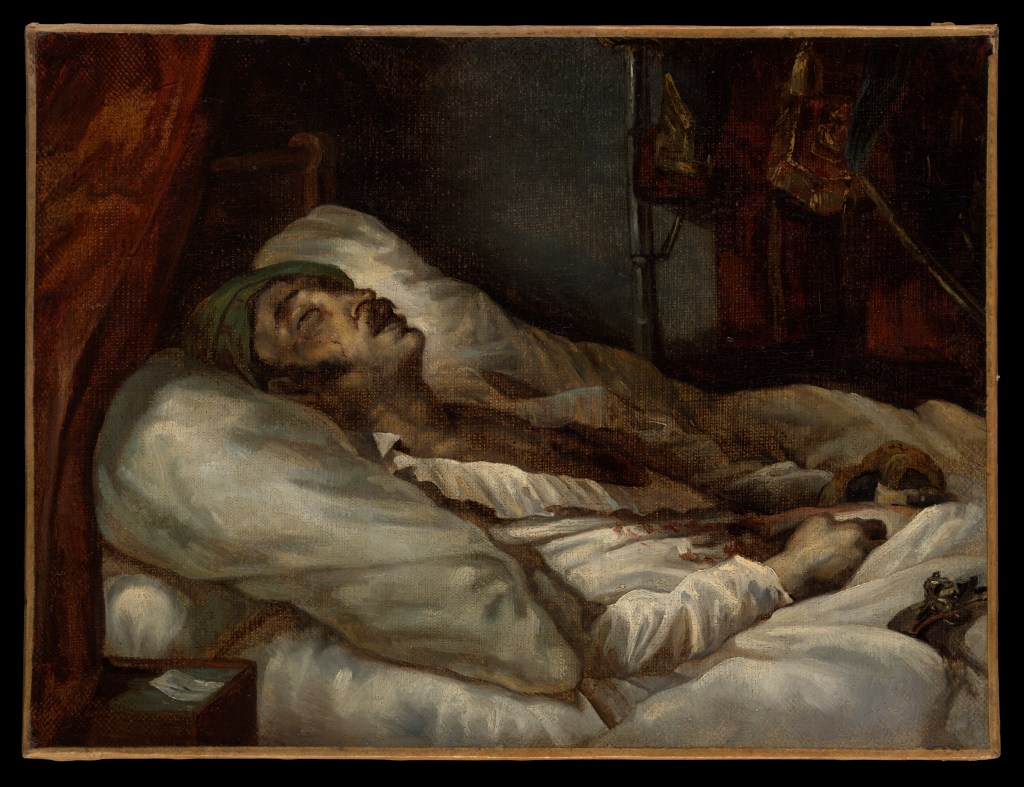
Credit: Théodore Gericault, “General Letellier on His Deathbed” (1818–20). The Met.
[1] See, e.g., Blake Charlton and Abraham Verghese, “Caring for Ivan Ilyich,” Journal of General Internal Medicine, vol. 25, no. 1, 2010, pp. 93–95.