To Have: Marriage as an Etiology of Disease
Entering matrimony can be a dauntingly momentous life decision to make. In Japan between the late 1910s and the 1930s, the significance of getting married at times went beyond uniting two individuals and manifested also through a drastic change in one party’s state of health. For the new wife, the wedding night could entail sharing not only her bed with a man behind closed doors but also the ramifications of his prior sexual history in the open.
Under the name Kimiko, for example, a woman disclosed her intimate struggle to the physician Okada Michikazu (1889–1980). Thanks to his previous tenure as a health columnist for the women’s magazine Onna no sekai (Women’s world, 1915–1921), Okada attracted a plethora of requests for guidance from women like Kimiko, whose specific concern was by no means singular. Not even a week had passed since she tied the knot, Kimiko became confronted with frequent and painful urination, which led her to suspect illness (Okada 1925, 173). She was neither wrong nor in the wrong. In his 1925 guidebook on “hygiene of the family,” Okada introduced Kimiko’s case, called hers a horrible “disease of marriage” (kekkonbyō), and framed the latter as a common result of the “sins” of the husband. Aside from recommending an immediate visit to the gynecologist, the male doctor also lamented the ubiquity of his female correspondent’s misfortune. “There are many cases where a pure young woman would fall sick upon catching her husband’s gonorrhea” (Okada 1925, ibid).
Although little is known about Kimiko beyond her encounter with the “disease of marriage,” it was remarkable, though by no coincidence, that her story as but one of countless ordinary women survived in print. The popular circulation of women’s magazines between the 1920s and 1930s furnished a space for sexual health communication that was simultaneously anonymous and public, where even female anger found a way to come out. Telling another familiar tale, a woman who went by the name Fusako identified her husband as the cause of her endometritis in a 1920 issue of Shufu no tomo (Housewife’s friend, 1917–2008), one of the most popular women’s magazines at the time. Writing from Osaka, Fusako recalled the onset of painful urination on the tenth day of wedded life. “Never in my dreams did I think of something like this would happen to me” (Fusako 1920, 45). Yet what happened, did, and was made worse by her husband’s initial denial of involvement. Before Fusako realized it was indeed her “husband’s bad,” her condition had already turned chronic.
Frank about her grudge, Fusako took her woe to Shufu no tomo and made it clear her husband was not the only one she blamed. Despite their daughter’s plead to conduct a “character inspection” on her betrothed, Fusako’s parents were reluctant to spend the money. Convinced that “money cannot buy health,” Fusako took matters into her own hands upon reading about the health advice printed in Shufu no tomo and eventually amassed the “courage” to receive clinical treatment (ibid., 45–46). At the time of her contribution to the women’s magazine, Fusako had already made a full recovery, though the return of her health was indeed bought with money. The infected wife’s fortnight hospital treatment, which involved hiring a personal attendant, came with a whooping price tag of 120 yen (ibid., 47), an expense not any Japanese family could readily afford. As reported in a 1920 guide on finding gainful employment, the monthly salary of an elementary school teacher only ranged between 20 and 45 yen in Tokyo (Tōkyō seikatsu kenkyūkai 1920, 205). What money did not buy Fusako was a husband who was chaste before marriage or one who was at least candid about his own sexual history.
The “disease of marriage” continued to feature in the health Q&A columns of women’s magazines well into the 1930s. Having served as a columnist, the physician Takeuchi Shigeyo (1881–1975), who was also known for her suffragism, penned an article in a 1938 issue of Shufu no tomo to address some of the most common yet confidential inquiries sent to her by anxious brides-to-be and concerned new wives. In the essay, Takeuchi urged a woman who speculated she was experiencing the symptoms of venereal diseases on the third day of her marriage not to jump to the worst conclusion just yet. “Experiencing pain during urination is not always the result of venereal diseases. The transition into married life constitutes an extremely drastic change to a young woman’s body, and her urethra too undergoes considerable stimulation, which can lead to urethritis upon the loss of virginity (hakasei nyōdōen)” (Takeuchi 1938, 413). Whether it be a sexually transmitted infection or not, the physical ordeal that young Japanese women had come to dread and associate with getting married had turned the latter into a clinically significant life event.
To Hold: Female Virginity for Male Consumption
That one did not hear as much, if at all, about the new husband’s shocking discovery of catching a “disease of marriage” from his wife was in itself meaningful. From Okada Michikazu to Takeuchi Shigeyo, the language used by Japanese physicians to describe the patient demographics of the “disease of marriage” spoke volumes about the double standard applied to female and male sexuality. Looming behind such phrases as “a pure young woman” and “an extremely drastic change” was the social expectation for female virginity to be held until the wedding night and for her husband’s consumption, along with the social reality that a considerable number of men had likely engaged in premarital sex—such as with a sex worker—to the extent of catching a sexually transmitted infection.
During the same decades of their circulation of narratives about the “disease of marriage,” women’s magazines also disseminated tearful testimonies from new wives whose virginity before marriage was suspected. The March 1937 issue of Fujin kurabu (Women’s club, 1920–1988), another mainstream women’s magazine of the interwar period, published two such stories submitted by one Teshigawara Yasuko and one Kawaminani Fusami. The former enjoyed a happy marriage until her husband mistook her rejection of a prodigal stepbrother’s request for more money in a letter as proof of her engagement in premarital sex. Having interpreted his wife’s protest in writing that her stepbrother had already robbed her of “the one irreplaceably important thing in my possession” as hard proof of her loss of virginity to another man, Yasuko’s husband went furious and remained emotionally distant even after his wife explained that the robbed item referred to Yasuko’s late mother’s hairpin (Kawaminani and Teshigawara 1937, 260–262). Despite defying her father’s wish by marrying for love, Fusami too suffered from her husband’s doubt. Failing to see through the nefarious plan of Fusami’s father to remarry his daughter in a deal for political gain, Fusami’s husband bought his father-in-law’s lies and accused Fusami of premarital fornication with a former politician’s son, who in reality harassed Fusami when the young woman worked as a domestic worker for the politician (ibid., 256–260).
Physicians helped perpetuate social beliefs regarding the significance of female chastity in women’s magazines as well. In an article for Fujin kurabu in 1937, the psychiatrist Shikiba Ryūzaburō (1898–1965) debunked telegony—the theory that children born to one man would also inherit the blood and manifest the traits of their mother’s previous sexual partners—as lacking scientific grounds. Despite his conviction that the loss of chastity itself would leave no physical stain on a woman’s body, Shikiba cautioned about the “psychological impact” of unchaste behaviors on women (Shikiba 1937, 328). Taking a more rigid stance in his essay for Fujin kurabu in 1938, the physician Fukui Masayori (1892–unknown) identified “virginal character” (shojo seikaku) as the “treasure of women” in an imagined dialogue between a mother and her daughter. In the fictional dialog, Fukui spoke through the mother against her coming-of-age daughter’s spending time alone with a male family friend to underscore the urgency to guard one’s “virginal character” before marriage. While Fukui was against using the integrity of the hymen to define female virginity, he nevertheless opined that sexual intercourse and contact with semen could change the composition of a woman’s blood and that the first and foremost thing any man could care about in selecting a wife was the woman’s “purity” (Fukui 1937, 436–437). In both male doctors’ writings, there was no question about the imperative for women to stay chaste both before and after marriage. The men’s disagreements resided primarily in if and how a woman’s lack of chastity could be medically detected and scientifically measured.
For the new wives who suffered the “disease of marriage” in quiet misery, though, the detection of their husbands’ unchastity before marriage came at a heavy cost on both their physical and mental wellbeing. Even as a medically vague diagnosis, the “disease of marriage” acted as a useful device of classification for ordinary Japanese women to find solace if not solidarity in one another’s confessions about the health risks brought about by marriage. For enabling their storytelling, women’s magazines functioned as a unique, though not unbiased, medium for the making and transmission of medical herstory.
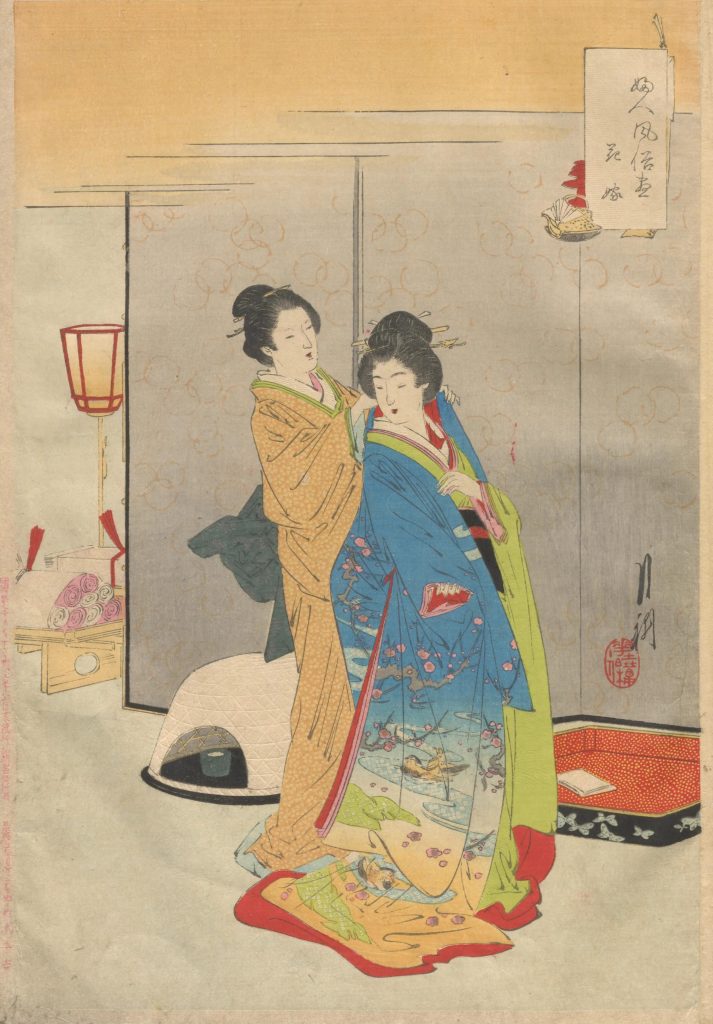
Featured Image
Ogata Gekkō 尾形月耕. “Hanayome 花嫁 [Bride].” In Fujin fūzokuzukushi 婦人風俗尽. Tokyo: Matsumoto Heikichi. 1898. https://dl.ndl.go.jp/pid/12150788/1/41.
Works Cited
Fukui Masayori 福井正憑. 1938. “Konki no musume to haha no eisei mondō 婚期の娘と母の衞生問答.” Fujin kurabu 婦人倶楽部 19 (6): 434–38.
Fusako 房子. 1920. “Naimakuen wo wazuka nishūkan no nyūin shujutsu de zenchi shita keiken 内膜炎を僅か二週間の入院手術で全治した経験.” Shufu no tomo 主婦の友 4 (6): 45–47.
Okada Michikazu 岡田道一 . 1925. Katei eisei mondō 家庭衛生問答. Naigai shuppan.
Shikiba Ryūzaburō 式場隆三郎. 1937. “Teisō wo ushinatta onna ni otoko no chi ha dō eikyō suru ka 貞操を失った女に男の血はどう影響するか.” Fujin kurabu 18 (11): 324–28.
Takeuchi Shigeyo 竹内茂代. 1938. “Niizuma no eisei himitsu sōdan 新妻の衛生秘密相談.” Shufu no tomo 22 (3): 412–15.
Teshigawara Yasuko 勅使河原保子, and Kawaminani Fusami 河南房美. 1937. “Kekkon mae no shojosei wo utagawarete naku wakaki hitozuma no shuki 結婚前の處女性を疑はれて泣く若き人妻の手記.” Fujin kurabu 18 (3): 256–62.
Tōkyō seikatsu kenkyūkai 東京生活研究会. 1920. Danjo shokugyō annai: Seikō hiketsu 男女職業案内 成功秘訣. Taiseisha.