Wandering in Tandem: or, How many people does it take to construct a self?
The metaphor of the road is writ large upon the discourse of everyday life — we speak of ‘life as a journey,’ the ‘path travelled’, the ‘passage of time,’ choices made at ‘the fork in the road,’ wandering ‘off the beaten path,’ hitting the road,’ and setting off on a ‘new course,’ or being thwarted by ‘detours’ and wrong turns.’ Addressing the confluence of time and space in the novel, philosopher and literary critic, Mikhail Bakhtin, claimed that “[t]he road is a particularly good place for random encounters” (“TCN” 243). The road is where the life projects and fate of the most distinct human lives come into relation with one another in unique and surprising ways. Bakhtin considered the road as emerging out of the confluence of time and space. But what of movement. If the serendipitous confluence of a ‘here’ and ‘now’ offers the opportunity for “[p]eople who are normally kept separate by social and spatial distance [to] accidentally meet; … [opportunity for] the most various fates [to] collide and interweave with one another,” there must be movement (“TCN” 243). Motility frees the actors / subjects from stasis, like one of Michelangelo’s subjects emerging from the marble block.
If we accept philosopher Thomas Nail’s proposition that movement is ontologically primary to the nature of all human experience, Bakhtin’s confluence of space and time (the chronotope) is no longer ontologically fundamental to, but rather an emergent feature of continuously fluctuating fields” (PM 21). The road thus becomes, in the fashion of Henri Lefebvre’s The Production of Space (1974), a product of the actors’ movement, rather than a site or place subsequently filled by actors. Motility initiates a biunal correspondence between the individual and the world, an ‘unconcealing,’ in the Heideggerean manner, which brings the world to attention at the same time as it awakens an embodied and enactive consciousness that is world-producing (BT 121 s.27).
Governed by chance, movement produces a correspondence of what Jennifer Livett (2021) calls “odd couples,” friendships that are “variously and even simultaneously reluctant, intimate, pugnacious, [and] productive.” Such odd friendship, David Halperin contends, “is the anomalous relation: it exists outside the more thoroughly codified social networks formed by kinship and sexual ties,” outside subjectification to social, cultural, and political ideology (75). The serendipitous meeting of odd couples on the road constitutes a “paradoxical combination of social importance and social marginality, [an] indeterminate status among the various forms of social relations” (Halperin 75). As such, it has the potential to circumvent normative expectations and inflexible positionality. Furthermore, it avoids the dissolution of distinct subjectivities in the formation of classifiable social groups (Halperin 75).
Serendipitous meetings open the self to the unpredictable, to an elastic extension of the ego beyond the periphery of self-security and containment, beyond dwelling at home in the comfort of sameness (Levinas TI 37, 43, 156). In “Strangers and Others,” Richard Kearney suggests that once we wander into the world and move beyond “the defence mechanisms [which protect] … us from alterity, … we either fall into psychotic breakdown or rise to a poetics of new images and an ethics of new ways of being with others” (19). “[O]ne of the best ways to de-alienate the other,” Kearney writes, “is to recognise (a) oneself as another and (b) the other as, at least, in part, another self (27). For Julia Kristeva, it is on the basis of coming to recognise that we are “foreigners to ourselves … [that] we can attempt to live with others” (SO 170). The question arises, how are we to avoid the danger of sublimating the other within a notion of the same?
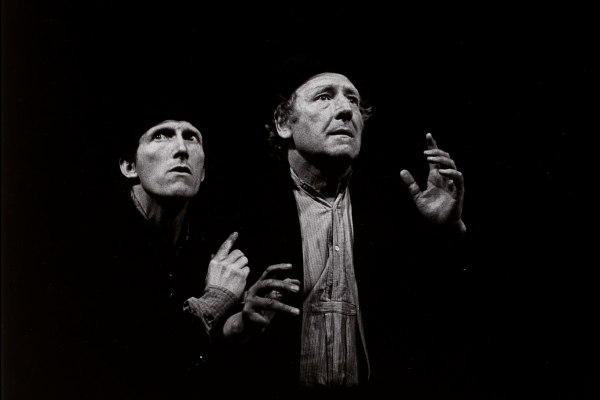
Samuel Beckett’s pseudocouple structure, the aporetically mis-aligned character pair, furnishes us with a narrative model for navigating a path between sameness and difference. Modelled on the comedic duo Laurel and Hardy, Beckett exemplified the structuret in Waiting for Godot (1954), in the form of the paradigmatic embodied pair, Vladimir and Estragon. Fredric Jameson best described Beckett’s pseudocouple structure as “a vaudevillesque situation of neurotic dependency in which two differentially maimed and underdeveloped subjectivities provisionally complete each other” (58). As an experiential, and embodied imaginary, the aporetic yet complementary pair engage in open-ended dialogue toward alternative ways of thinking and Being, thus providing a lens through which to explore human cognition and interpersonal interactions from a phenomenological perspective, such that personal subjectivities may be understood not as isolated computation, but as experiential, narrativised, and co-created.
If we can never make ourselves fully known to the world through words, if we can never understand what the other is thinking, how can we show up for one another in a truly ethical manner beyond that which is prescribed by social, cultural, political, and economic codes of behaviour? How might we traverse what Beckett described as the tympanic membrane between the inside and outside worlds of consciousness? One possible solution is to be found in the enactment of a participatory ethics, revealed via an ontology of movement that precedes the Levinasian call to a responsibility in the individual’s potential encounter with an Other. Harmonious conciliation for Beckett’s odd couples is found, not in showing up for the other, nor is it found between words and the world, but rather in the characters using words, as their commitment to a dialogue, in the Beckettian fashion of ‘going on,’ despite the absurd futility in doing so. As Brice Parain explains of Parmenides’ dialogue with Socrates in the Theaetus, Parmenides “knows too well that we do not always speak the truth. He can therefore only … [advise that one] speak regardless and … to go on reasoning as usual, assuming that words have a meaning and trying hard to find it (102).
The commitment to narrativising, giving a verbal account of one’s experiences, takes up its position in the intermedial space between self and world, between the end of action and the beginning of meaning. To go on with the story, as Beckett’s Vladimir and Estragon go on waiting, as Hamm and Clov go on dialogising (Endgame, 1958), as Winnie goes on speaking (Happy Days, 1961), demonstrates an absurd optimism and a commitment to endure and evolve. To try and fail, to “[t]ry again. Fail again. Fail better” (Beckett, NoHow On). Jameson situates the pseudocouple in broad historical terms, “as a structural device for preserving narrative,” for ‘going on’ with the story (58). Feeling alienated and uncomfortable in a rapidly changing world, the individual is, according to Jameson, obliged to get up from the couch, go out into the world, and “promenade in tandem” (58). For one never knows who they may meet out on the road, and what grand adventures this will lead to.
Works Cited
Bakhtin, Mikhail M. 1981. “Form of Time and the Chronotope in the Novel.” The Dialogic Imagination: Four Essays, Texas University Press, 2010 [1981].
Beckett, Samuel. Endgame. [1958]. Samuel Beckett: The Complete Dramatic Works. Faber and Faber, 2012 [1986].
—. Happy Days. [1961]. Samuel Beckett: The Complete Dramatic Works. Faber and Faber, 2012 [1986].
—. “Waiting for Godot.” [1954]. Samuel Beckett: The Complete Dramatic Works. Faber and Faber, 2012 [1986].
Halperin, D. M. Heroes and Their Pals. One Hundred Years of Homosexuality: And Other Essays on Greek Love. Routledge, 2012 [1990], pp. 75-88.
Heidegger, Martin. Being and Time. Revised ed., translated by Joan Stambaugh, State University of New York Press, 1996 [1953].
Jameson, Fredric. Fables of aggression: Wyndham Lewis, the modernist as fascist. Vol. 496. University of California Press, 1981.
Kearney, Richard. “Strangers and Others: From Deconstruction to Hermeneutics.” Critical Horizons, vol. 3, no. 1, 2002, pp. 7-36.
Kristeva, Julia. Strangers to Ourselves. Columbia University Press, 1991.
Lefebvre, Henri. The Production of Space. Translated by Donald Nicholson-Smith, Wiley–Blackwell, 1991 [French original, La Production de l’espace, 1974].
Levinas, Emmanuel. Totality and Infinity: An Essay on Exteriority. Martinus Nijhoff Publishers, 2007 [1969].
Livett, Jennifer. Odd Couples and Double Acts, or Strange but Not Always Queer: Some Male Pairs and the Modern/postmodern Subject, Australian Humanities Review, vol. 21, no. 2, 2021.
Parain, Brice. A Metaphysics of Language. Translated by Mary Mayer, Doubleday and Company, 1971
Rudova, Larissa. “Bergsonism in Russia: The Case of Bakhtin.” Neophilologus, vol. 80 ino. 2, 1996.