Amanda Cachia’s Hospital Aesthetics: Disability, Medicine, Activism was published by Manchester University Press last September. Cachia is a curator and art historian with a joint appointment as Professor of Practice in Museum Studies at the Herberger Institute for Design and the Arts at Arizona State University, where she is also Affiliate Faculty in Disability Studies.
In Hospital Aesthetics, she explores the artistic practices of several contemporary disabled artists, mainly from the Global North, and uses the term hospital aesthetics to illustrate how these artists aim to subvert the impact of the medical industrial complex on them through their art by mobilizing clinical settings or objects. The book also inspired a touring exhibition, Vital Signs: From Patient to Power, which will take place between 2027 and 2032 at a series of museums and galleries in the US.
With Amanda, we talked about disability activism at the core of her artistic and scholarly work, the significance of rethinking art history through medicine-oriented art, hierarchies not only in medical settings but also within the disability community, and more.
***
Merve Sen: At the core of this book is your story. So, I want to start with that. You are a curator, a crip curator with your own words, a disability activist, and a scholar. Could you tell us a little about yourself and what disability means to you as a person, a curator, and an art historian?
Amanda Cachia: That’s a great question to start with. For me, disability is a form of empowerment. As a young person, I had many insecurities and vulnerabilities, and I had to navigate the world by myself because I didn’t know any other disabled people. It felt like a very solitary and lonely time during my childhood and teenage years as I tried to come to terms with who I was and what made me different. When I entered the world of disability studies through my academic work, I suddenly gained a community: people who understood my experience and my desire to advocate. Having faced hardships as a disabled person, I was motivated to counteract them. I wanted to educate, inspire, and motivate others to embrace change and challenge the stigmatizing lens that we still often encounter today about disabled people. I’ve always been an artist, too. I loved creating art as a child, and at 18, I started volunteering at a gallery. I enjoyed it, but I never saw myself represented in museums. I rarely saw depictions of myself and my differences. From an early age, I believed that disabled people could create art, and I felt there shouldn’t be a fear of that. I encouraged museums to be more inclusive. Art is a powerful way to translate desire, language, and activism. Including disability in art made me feel more accepted in society. Professionally, it also gave me the motivation and energy to push for change and make a difference.
MS: When it comes to change, I also think about space. How should we consider the height, scale, and size of an art space? Do you think there has been a specific focus on how space relates to disability, say, in the last 20-30 years?
AC: I believe there is still plenty of room for improvement in the art world. You mentioned the last 20 or 30 years, but I would say the real shift has mainly happened in the past decade, especially in the last five years since the pandemic. Because of the pandemic, suddenly, the entire world became disabled, right? We all had to stay home and confront what it means to deal with a barrier every single day. I think this has made the art world a bit more… hospitable. It has become, I believe, more empathetic toward disability and disabled audiences, but there’s still a long way to go. I was recently on a panel at the Tyler School of Art and Architecture, where they discussed how it’s really important for museums to take responsibility for addressing disability in line with decolonization. The idea of decolonization is a responsibility museums need to embrace when considering Indigenous and Native audiences. They suggested that advocacy around access should be considered alongside decolonization. I also addressed this in my first book [The Agency of Acces]. And in Hospital Aesthetics, I argue that museums and hospitals could learn from each other to better serve disabled people.
MS: Thank you for sharing this evolving perspective, especially considering COVID. Since you’ve already mentioned the term, let’s go with it. In the book, you describe hospital aesthetics using a series of modern and contemporary artworks, mainly from the Global North. I could quote a description from the book, but I’m curious about flipping the idea. When you combine hospitals and aesthetics, or discuss them separately, many ideas come to mind. So, I’d like to ask: what is not considered hospital aesthetics?
My view of hospital aesthetics leans more toward radical activism, similar to protest art, highlighting the problems with hospitals and using this kind of aesthetics to give myself more voice and ownership.
AC: Hospital aesthetics isn’t about the interior design of hospital rooms. I clearly state in the introduction that the book isn’t about sandy beaches with palm trees and coconuts, even though excellent work is being done on that topic. For example, there’s a group called Hospital Rooms, a collective in the UK that visits hospital rooms and commissions well-known artists to create work that is more inspiring than typical scenery, like beaches with coconut trees. I understand that motivation, and studies show that being in a pleasant environment can make you feel better, which aids healing and serves as good therapy for patients. However, my view of hospital aesthetics leans more toward radical activism, similar to protest art, highlighting the problems with hospitals and using this kind of aesthetics to give myself more voice and ownership. In a hospital, we feel very vulnerable, right? We are patients, feeling disempowered, working within a long-established institution with deeply embedded power imbalances between patients and doctors. This division is rooted in society due to education, knowledge, resources, race, and class, which come into stark relief in the hospital space. That’s why COVID was so interesting. It revealed how the most vulnerable populations, those most at risk, are the ones dying.
MS: So true. Hospital aesthetics is a different term, but it complements your first book, which discusses access aesthetics. Why did you feel the need to change the vocabulary now?
AC: I see the two as different, but absolutely, they also complement each other. They differ because access aesthetics mainly focuses on the need for specific tools of access within the museum, as detailed in the book’s five chapters. Touch is one of them. Movement is another. Exhibition design is also crucial: how an exhibition is arranged to create a positive wayfinding experience for disabled people. I also discuss translation—alt text, captioning, image descriptions, and similar elements. Some artists incorporate these media into their art in very specific ways to suggest activism and critique institutions. However, hospital aesthetics specifically critiques the medical model of disability, which has actually been around much longer than access aesthetics. It’s older because disability art started in the 1980s during the disability rights movement. At that time, disabled artists started to critique that medical model, making it the oldest form of disability art. Of course, there were things before the disability rights movement, but from a political perspective centered on that era, disability art was confronting. I think it’s a powerful and contentious category because the medical model has affected many of my friends and me. The model is fundamental to disability studies, which is why the field exists. Both forms of activism and institutional critique—critique of hospitals versus museums—empower. What makes me happiest is that artists are leading this effort. It blows my mind because I’m so impressed by their advocacy and the strength of their work. It’s incredibly powerful and tangible. For me, it’s very impactful because the work is funny, witty, and playful at times, yet also confrontational, frustrating, and angry. It encapsulates so much passion. You called it a living archive in our earlier conversation. That’s why I want to document everything in a book: to reveal the recurring themes in their work and help establish disability art’s place in art history. It’s not yet fully recognized, and I want that to change.
MS: I would like to discuss this further. You are introducing fascinating art and artists. In much of this work, we see the artists reclaim medical terminology to regain their subjectivity. Both medical terminology and objects—such as charts, x-rays, and hospital gowns—are involved. What does this say about reconfiguring art and art history, especially when reading art history through the lens of medicine or medical history?
I, as an art historian, also live with a disability. That perspective hasn’t been widely represented before, and that’s what disabled people and disability bring to art—an entirely new, rich, complex, and generative world that hasn’t been fully acknowledged. Even in terms of art genres and movements, I see disability art as connected to surrealism, fluxes, and minimalism. Contemporary disabled artists aren’t working in a vacuum; they are also influenced by art history.
AC: I think that art history is beginning to engage more meaningfully with the medical humanities. Other scholars, like other art historians, are doing this work. They are trying to integrate art history with medicine and explore how medicine has influenced art history. For example, I’m currently working on a third book, Rehabilitating the Asylum, which looks at mental health. That topic has long been part of art history, especially in discussions of madness. The idea that madness has inspired what is called the artist’s genius is a recurring theme, and I think art history has always been fascinated by how art and psychosis influence each other. However, I also believe art history hasn’t done enough to center the identity of disabled individuals. Instead, it’s often romanticized and viewed through the lens of genius and other problematic tropes that haven’t been properly examined, partly because many art historians have distanced themselves from disability studies. This book aims to reframe our history to foster a more meaningful dialogue with disability studies and to connect more authentically with lived experiences. For example, I, as an art historian, also live with a disability. That perspective hasn’t been widely represented before, and that’s what disabled people and disability bring to art—an entirely new, rich, complex, and generative world that hasn’t been fully acknowledged. Even in terms of art genres and movements, I see disability art as connected to surrealism, fluxes, and minimalism. Contemporary disabled artists aren’t working in a vacuum; they are also influenced by art history. The two haven’t really been brought into conversation like this before. Have you ever read Tobin Sieber’s book? It is called Disability Aesthetics.
MS: I just noted it down here, actually, but I haven’t read it.
AC: Tobin is really the person who said that disability has always been present in art history; it’s just that no one has articulated it that way. Venus de Milo is one of the most famous statues in the world. Do we realize that she is disabled? Instead, everyone looks at her and says she is beautiful. But…her arms are missing. So why don’t we talk about that? It feels like inertia, fear, or reluctance. I’m not exactly sure what it is, but there just hasn’t been much interest. I was at another panel the other day where people said that what’s shown in galleries and museums, what’s displayed on walls, and what’s written about in art criticism and history actually reflects what people value. We value the stories we want to tell. Unfortunately, disability hasn’t been valued.

People haven’t bothered to explore that topic for whatever reason, even though there is excitement about the mad genius Vincent van Gogh chopping off his ear. But that’s pretty limited, right? There’s so much more that could be done. Of course, ableism plays a role. People with disabilities often don’t get a chance to show their work in museums. I remember when I was 18 or 20, I was in a job interview at a gallery for a curator position, and they asked, “Oh, how are you going to hang up the work on the walls?” I said, “…with a ladder?” Because I’m short-statured, they were concerned I wouldn’t reach. I said I’d use a ladder. They said okay, but I didn’t get the job. That’s straight-up ableism, right? Straight-up discrimination. That’s a big part of the conversation, too.
MS: Your book exactly critiques this: the mainstream ableist art culture. How do the artists you work with and write about challenge these norms? What do they find truly difficult to reconcile, both in the gallery space and in the medical environment?
AC: There are many issues, but I believe the main one is the assumption that the disabled body needs to be fixed. In Hospital Aesthetics, I refer to this as the ‘curative imperative,’ a term coined by my colleague, philosophy professor Joseph Stramondo. It reflects the medical world’s desire to fix disabled bodies because they are considered wrong, which aligns with the medical model of disability. Many artists I interviewed for the book expressed similar frustrations. They feel unheard by doctors, who often discriminate based on skin color, displaying medical racism. In the chapter on sensual aesthetics, there’s an assumption that I am asexual and lack sexuality, which is just one example among many. As I shared in the book, when I was pregnant with a child with a disability, doctors assumed I wouldn’t want to keep the baby. These assumptions are incredibly frustrating. Art becomes a way for these individuals to find their voice, especially since they often feel voiceless in hospital settings. That, I believe, is the core issue and what motivates their activism.
MS: There is a common theme here. However, you also recognize that these artists are not all the same. We see how Dominic Quagliozzi acknowledges his white privilege. How do you feel about these differences, and what do they contribute to the discussion?
AC: That’s a really good question. I think what it brings to the discussion is that not everyone is equal within the disability community. There are still hierarchies. As I mentioned, I have a very rare form of dwarfism, which is quite uncommon. So, when I attend conferences and conventions for little people, I’m considered an outsider. Even though I’m among others with a similar disability, most have achondroplasia, the most common form. But for some people, it’s an issue that I have a different type of this disability. I learned early on that ableism, racism, and sexism persist, even among our allies. I don’t know how else to say it. Even though Dominic and Carolyn (Lazard), whom I talk about in the same chapter, are both disabled, because they have different skin colors, they will still be treated differently. There are many layers to this. That’s what intersectionality is. Do people have multiple identities that influence how they’re treated? The answer is yes.
MS: Also, I’m thinking about technology and access. What does having access to medical technologies mean for an artist with a disability? In the book, you briefly mentioned the case in South Asia because you have a South Asian artist. Have you come across more examples like this? Or have you reflected more on how the lack of technology also inspires artwork? What might be some examples of that from other parts of the world?
AC: That’s a really good question. I haven’t thought about it much, to be honest. I’m trying to remember if I’ve encountered anything recent… Actually, it’s a recurring topic in my current research for my third book. I’ve been speaking with art studios worldwide that support artists with mental health challenges—such as schizophrenia, bipolar disorder, anxiety, or depression. The resources and support they offer vary by location. For example, I spoke with a studio in Havana, Cuba, which has limited resources and operates out of an apartment because that’s all they can afford. Their focus is on developing the artists’ skills and treating them as professionals despite limited means. On the other hand, I talked with a government-funded studio in Japan, which has abundant resources. From what I’ve seen, many of these studios, regardless of their resource levels, are equally talented. They’re driven by a genuine desire to create. It’s also clear that all these studios benefit artists by providing access to resources and materials in various forms. Of course, the Havana studio would love more government support and additional resources, but it remains highly effective at what it does. I hope that answers your question.
MS: That’s a compelling example. I was also aiming for something a bit more specific. For instance, in Jenna Grant’s Fixing Images, we follow the story of ultrasound technology in Cambodia. Early in the book, Grant shares an anecdote about how ultrasound was once seen as a supernatural intervention similar to shamanic practices. The medical material, or medical technology, becomes artistic material or artistic technology when the artist transforms it. I believe the cultural perspective also influences this. Bhavna Mehta’s art in your book is a great example of it. She combines x-ray and embroidery, and she discusses how embroidery is part of her culture. This brings us back to the medical script—referring to your exhibition, Script/Rescript—and raises the question: what does it mean to see medical material as a form of narrative?

AC: Although I come from the art side rather than the medical side, I’ve always had many X-rays of my body. I understand that these images are usually used by the medical community for a single purpose. Bhavna is an MFA student at the University of Houston, and she’s using X-rays for printing. If you’re saying it changes, I’m sure it’s completely transforming how the medium is used outside the hospital—no longer just for embroidery, but also in her printing, which involves multiple copies. I’m curious about what happens when the same X-ray is printed repeatedly and how the meaning might change over time.
MS: Having multiple X-rays over time and observing how your body changes—what does it mean to see that in a printed form? It’s fascinating. In the book, we see different media, such as videos, photography, and sculpture. Do you notice a tendency to work with specific materials or mediums, or is it really a mix? What are your thoughts on, especially, the material and medium?
AC: Yeah, I think it’s a big mix, and I really enjoy the fact that there is such a wide variety. I don’t see much painting, but I do through Riva Lehrer’s work, which I also opened the book with, her portrait of Alice Wong. Yeah, I don’t know, I think it’s a broad range of things, and I find that exciting and terrific. For example, Panteha Abareshi also does performance, video, and film, while Robert Andy Coombs works with photography. Lauryn Youden and Sharona Franklin, in the last chapter, make installations, sculptures, and a variety of other 3D objects, which are great. I also think it shows that disabled artists aren’t necessarily drawn to just one medium but are exposed to a wide variety, which is a good thing. It should all be accessible to them.

MS: In the book, you discuss the visual material extensively. We see that vision is the primary sense. What about other senses? Touch would definitely be the second in the book, but I also think about noise. Maybe even taste, thinking of Felix Gonzalez-Torres’ candies. What do you think?
AC: All of these artists are still primarily working with vision. One artist I mention in the book, Carmen Papalia, describes himself as a non-visual learner. He is more interested in breaking down the semiotics of the cane used by blind people. His work relates more to the other senses—sound, touch, movement, and so on. He had a very long, extended cane and tried to navigate space provocatively by swinging it in public and attempting to hit people. He said he was tired of the assumptions people make when they see someone with a cane. So, he’s most interested in exploring other senses and challenging sensory expectations. There are additional artists outside of that group I discuss more in my first book. Artists interested in sensory perception contribute to accessibility and aesthetics. As for the hospital, that could be a whole other book since hospitals involve many senses beyond sight. As you pointed out, it’s not just about visual experience. When I was in the hospital having my child, I could never sleep because it was so noisy. Now, as I talk to you and you bring this up, I realize I wish I had included more of that aspect in my work.

MS: You mention white noise through Carolyn Lazard’s Extended Stay, I believe. Building on that, I’m thinking of an MRI. Some people hate the noise, while others really like it. When you keep thinking about it, at first you feel alone, so you have to connect with something. Noise is one of the first things you can connect to. Then, when you start communicating with noise, you realize there was a nurse, and there are people in the other room—you’re not really that alone. It just makes you notice all those things you hadn’t seen before. But, yeah, it’s interesting that they mainly focus on vision, though there’s probably no clear answer to why.
AC: I would say that they are all probably engaging in a very sensory way, especially as they are in the process of making the work, which is a sensory process in itself. But I am now thinking more about how these objects are displayed. That comes down to the fact that, as a curator, I always advocate for objects to be touched. Also, I would say that 95% of the work I discuss in the book I have never experienced in person, so it’s hard to say exactly how it feels. Dominic introduces you to hospital gown work in the first chapter. Then he has the pieces on the canvas that you can open and close, which have a more sensory aspect through movement and touch.

He also works with smell, running workshops that use iodine. It’s used for bandages, and he actually uses iodine on water and paper. Iodine has that hospital smell, so there’s definitely a smell element there. I’m not sure about the sound aspect unless there’s an artist making videos, like Dominic, who has made many videos in hospitals. His work definitely reflects that sonic or audio element of hospital experiences as well. In the book, I talk about Bob Flanagan too. I wish I had seen his work in the 80s when he was creating his installations, like the one where he pretended to be in a hospital bed. Those works probably incorporated 100%, like the sounds, smells, and visual essence. And you already mentioned Felix Gonzalez-Torres.
MS: The iodine example is fascinating because of its role in the body, especially for the thyroid, which helps regulate the main thyroid hormone. Since we’re already discussing visualities, why did you choose Jess Darling’s Epistemologies for the cover?

AC: I love that work. I think it’s fabulous, and I love how Jesse has animated the medicine cabinet because that’s what it is. I really enjoy that it’s an object embodying a tension between restriction and freedom. It’s trying to escape and be free, but it still weighed down by the heaviness of medicine. The archive, which reflects colonization, ableism, racism, and sexism, adds another layer. But the legs make it feel so full of life—like it’s trying to break free while suggesting it has agency at the same time. That’s what the whole book is about, right? I just felt like it was perfect. Some people might see it as benign, but I don’t. I see it filled with life and energy. Also, it looks a bit odd, which helps it catch the eye.
MS: Absolutely.
AC: I’m glad you see it that way because the font and graphic design are pretty clever. I didn’t create it myself; the publishers did. They wanted to use a font that evokes hospitals. It resembles a hospital sign. I’m based here in the US, but they are in England, at Manchester University Press—that’s what hospital signage looks like in the UK. I thought, okay, that’s good because it helps me realize that even though it’s culturally specific, it still translates well. I don’t know, what do you think? Do you get that sense?
MS: I think, it feels… sterile?
AC: Yeah.
MS: I didn’t know the colors there; you feel there is something sterile about it, but then I’m seeing the image, and the sense of sterility kind of collapses. The verticality, too. The title appears first, but then your eyes are drawn to the image. It just fits the book.
AC: Have you ever come across the wheelchair symbol that some designers have basically changed? It’s called the Accessible Icon Project. This is how I see Jesse Darling’s book, because they aimed to animate the person in a wheelchair. I see some resemblance.
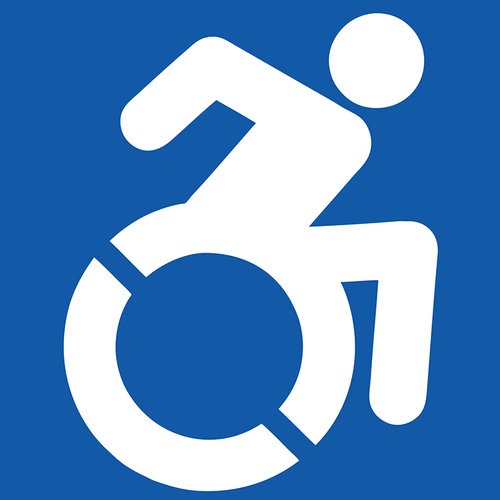
MS: Definitely, there is a similar gesture. As we wrap up, I would like to ask you about your upcoming project. You already mentioned your third book. What else is there brewing?
AC: I’m nearly finished with the mental health project. I’m about to start work on a fourth book, Disability Art: A Political History. I’ve already covered how the politics of disability emerged from the disability rights movement in the 80s, which itself grew out of the civil rights movement in the 70s, and that’s about it. The book is mainly a historical, thematic survey of disability art, structured into chapters where I explore performance, access, mental health, and the history of outsider art. I’m also focusing on progressive art studios in that context because I realize there’s no comprehensive history of disability art yet. I’m excited to start on it, especially since I have a fantastic publisher interested in partnering with me. Hopefully, it’ll be published within the next few years.