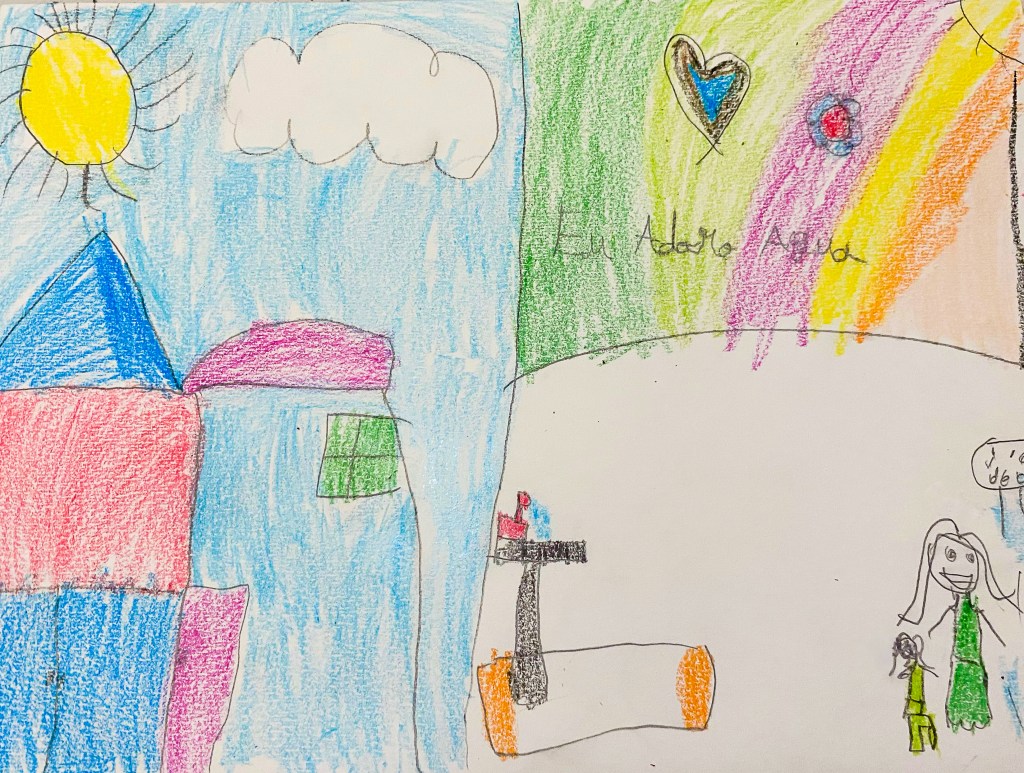
Children are everywhere in the conversation about water insecurity. They appear in statistics, policy briefs, and photographs meant to evoke a sense of urgency. We are constantly reminded that hundreds of children die each day from water-related disease (UNICEF, 2026), and that safe water is foundational to their health, education, and futures (Rhue et al. 2023). Yet remarkably, few have ever stopped to ask children directly; how do you understand, and are impacted by, the water you live with? This very question inspired my dissertation on children’s water insecurity, something many of our Synapsis readers might be familiar with, as I have regularly authored pieces about my research, as well as children’s right to safe and sufficient water (see Rhue, 2021; 2023). However, over the past three years of research, writing, and advocacy, I’ve come to realize more about working with children than just how they experience, and cope with inadequate water.
First, it is important to recognize that none of the work I have previously described, or will go on to, would have been possible without the children of Belém, Pará, Brazil, and their families, who graciously invited me in, and allowed me the opportunity to observe and document their everyday lives.
The city of Belém sits at the mouth of the Amazon River in the north of Brazil, surrounded not only by the bodies of water that form the Amazon Delta-Estuary, but crisscrossed by canals and waterways intended to divert excess water after heavy rains and flooding (Mansur et al. 2016). The children and families I worked with lived in various, often impoverished, neighborhoods of the city. Access to reliable and safe piped water varies by household and neighborhood to neighborhood (Mansur et al. 2018). Water could be interrupted for hours at a time, and even when it was available, it would often be contaminated with sediment, have a yellow discoloration, and/or smell, requiring families to run taps for up to 30-minutes so the water would clear (Rhue et al. 2025).
Planning around this intermittent supply was an inherent part of daily life, and could quickly complicate meals, washing clothes, getting ready for the day, going to school, cleaning, bathing, and staying cool after long hot days. Balancing all this and making time to meet with me was no small feat, and it often took many WhatsApp messages and days of coordination to set up a home visit. I could not be more appreciative for those opportunities, and although I am the one writing and publishing, the research and resulting impact I hope it will have, truly belongs to the children and their families, as it was their lived experiences that inform this groundbreaking work. Obrigado todos (thank you everyone).
Now, for the lessons learned.
Working with children required approaches that allowed them to express themselves in ways that felt natural and comfortable. One of the most effective activities we used involved something simple, crayons and small drawing booklets. We asked children to draw something they did with water every day, or something about water they thought was important. Drawing gave children time to think, something to focus on with their hands, and an opportunity to communicate visually as well as verbally. The images that appeared on the page often became starting points for conversation. A bucket next to a shower, a rainstorm over a house, a cup used for drinking; each drawing provided a way for children to explain how they understood the water around them.
Importantly, we did not take the drawings or the materials at the end of our interviews. Children kept everything we brought. When we returned to the households weeks later, it was common for children to eagerly show us pages filled with new drawings they had continued making on their own. In some cases, they would ask if we had more (we always did, just in case). While we had always hoped children would appreciate the drawing materials, it quickly became clear that the activity meant far more than we had anticipated. It was exciting for them to receive a small gift, something new, and it seemed to allow children a sense of ownership within the research process. As many households we visited were comprised of multiple children, we were also mindful that providing materials to one child could unintentionally make siblings jealous or feel excluded. Extra crayons and booklets helped ensure that brothers and sisters could informally participate, and settling their attention often allowed us to work with the focal child in relative calm.
That being said, it’s true what they say, working with children means working with the entire family.
Parents, siblings, and sometimes grandparents were often present, either observing, and sometimes, inserting themselves into the conversations. This could make it difficult to work strictly with the focal child, but thankfully, my colleague, Dra. Mariana (Mari) Inglez was conducting research with me and could help. While I or Mari spoke with one child or parent, the other could talk with another family member, help guide the drawing activity, or simply keep younger children entertained so that we could conduct the interviews. Interestingly, the presence of both Mari and me presented focal children with an unintended, but ultimately welcome, option. Sometimes one child would prefer to speak with Mari, sometimes with just me, and other times with the both of us. There didn’t seem to be a rhyme or reason as to who they felt more comfortable working with, but it allowed us to work with children who may have otherwise felt uncomfortable to do so.
Families were also very careful to emphasize something that is often lost in conversations about resource insecurity. Although they readily acknowledged the challenges of unreliable and poor-quality water, they did not reduce their situation to the consequences of poverty and resource insecurity.
Mothers spoke about water as something deeply important for children’s growth and development, and despite limitations, children themselves still found ways to enjoy water, to play with it, and to incorporate it into their everyday experiences of childhood. They created makeshift pools out of larger plastic containers when it was hot, children played with buckets and toys in the shower or while taking a bath, and where/when water wasn’t available at home, families would make opportunities for children to swim in pools, at the beach or interior rivers, something children looked forward to around extended feriados (holidays).
This distinction is incredibly important, as discussions of resource insecurity can easily slip into narratives that portray everyday life as uniformly negative (HWISE-RCN, 2022). The children and families I worked with reminded me that while insecurity presents real challenges, it does not erase the creativity, enjoyment, and complexity that shape daily life.
However, the most surprising lesson emerged not from fieldwork or working with the children themselves, but from reactions to the research itself.
Throughout my fieldwork and the resulting conversations at conferences and private events, I was often met with astonishment that I was working with children at all. I was told by other scholars, students, and professionals alike that; working with children was too difficult and that they wouldn’t understand my questions. I was even asked if children had the attention span for an interview. This baffled me. While few have asked children directly about water insecurity, there is a line of related research in food insecurity (see Fram et al. 2011; Bernal et al. 2012; Bernard et al. 2018) and a long history of conducting research on child wellbeing across disciplines (Pollard & Lee, 2003; Fernandes et al. 2012).
The assumption seemed to be that meaningful information about children’s lives could be obtained more easily (in terms of research permissions and practicality) from adults. This not only contradicts decades of precedent, but the children I worked with repeatedly demonstrated the opposite. Children were thoughtful and patient. They were just as capable of describing their experiences and perspectives as any adult; and compared to some of my previous work on water insecurity, perhaps more so.
Moving forward, it seems the challenge may not be advocating on behalf of children’s ability to participate in research or articulate their experiences but addressing a collective hesitation to engage with them.
However, for me, the most important lesson is this—children have far more to say than we often give them credit for. Their perspectives offer insight not only into a part of the human experience we so often are concerned for and prioritize but rarely acknowledge directly. I continue to hope that future researchers, policymakers, and advocates alike will make space for children’s voices on the issues that directly and indirectly affect their lives and cast aside notions which limit children’s advocacy and self-representation.
Acknowledgements
The research described here was supported by funding provided by the National Science Foundation (BCS-2215227) and the Ohio State University Office of International Affairs and its Global Gateways.
References
Ana Cláudia Mansur, Eduardo S. Brondízio, Suman Roy, Paulo Soares, and Alice Newton. “Adapting to Urban Challenge in the Amazon: Food Risk and Infrastructure in Belém, Brazil.” Regional Environmental Change 18 (2018).
Ana Cláudia Mansur, Eduardo S. Brondízio, Suman Roy, Samuel Hetrick, Nathan D. Vogt, and Alice Newton. “An Assessment of Urban Vulnerability in the Amazon Delta and Estuary: A Multi-Criterion Index of Flood Exposure, Socio-Economic Conditions, and Infrastructure.” Sustainable Science 11 (2016).
Elizabeth L. Pollard and Patricia D. Lee. “Child Well-Being: A Systematic Review of the Literature.” Social Indicators Research 61 (2003).
HWISE-RCN. “[HWISE-Now]: Water Insecurity and Child Health.” Video, October 28, 2022. YouTube.
José Bernal, Alexandra Edward, Edward A. Frongillo, Hilda Herrera, and Juan Rivera. “Children Live, Feel, and Respond to Experiences of Food Insecurity That Compromise Their Development and Weight Status in Peri-Urban Venezuela.” Journal of Nutrition 142, no. 7 (2012).
Luís Fernandes, António Mendes, and Aurora A. C. Teixeira. “A Review Essay on the Measurement of Child Well-Being.” Social Indicators Research 106 (2012).
Melissa S. Fram, Edward A. Frongillo, Stephanie J. Jones, Rachel C. Williams, Meghan P. Burke, Kimberly P. DeLoach, and Christine E. Blake. “Children Are Aware of Food Insecurity and Take Responsibility for Managing Food Resources.” Journal of Nutrition 141, no. 6 (2011).
Robert Bernard, Rebecca Hammarlund, Matthew Boquet, Tolulope Ojewole, Daniel Kirby, Joseph Grizzaffi, and Patricia McMahon. “Parent and Child Reports of Food Insecurity and Mental Health: Divergent Perspectives.” Ochsner Journal18, no. 4 (2018).
Steven J. Rhue. “Acknowledged but Unheard: The Absence of Children’s Voices in Water Insecurity.” Synapsis: A Health Humanities Journal (2021).
Steven J. Rhue. “What Did It All Mean? The United Nations First Conference on Water in Over Fifty Years.” Synapsis: A Health Humanities Journal (2023).
Steven J. Rhue, Barbara A. Piperata, and Ulisses Lopes. “Coping With Water Insecurity Despite Access and Abundance in the Urban Amazon.” Journal of Water, Sanitation and Hygiene for Development (2025).
Steven J. Rhue, Gonzalo Torrico, Chiamaka Amuzie, Sarah M. Collins, Adrien Lemaitre, Chelsea L. Workman, Amanda Y. Rosinger, Adam L. Pearson, Barbara A. Piperata, Amber Wutich, Alexandra Brewis, and Justin Stoler. “The Effects of Household Water Insecurity on Child Health and Well-Being.” WIRES Water (2023): e1666.
United Nations Children’s Fund (UNICEF). Water, Sanitation and Hygiene (WASH): Safe Water and Good Hygiene Keep Children Alive. 2026.