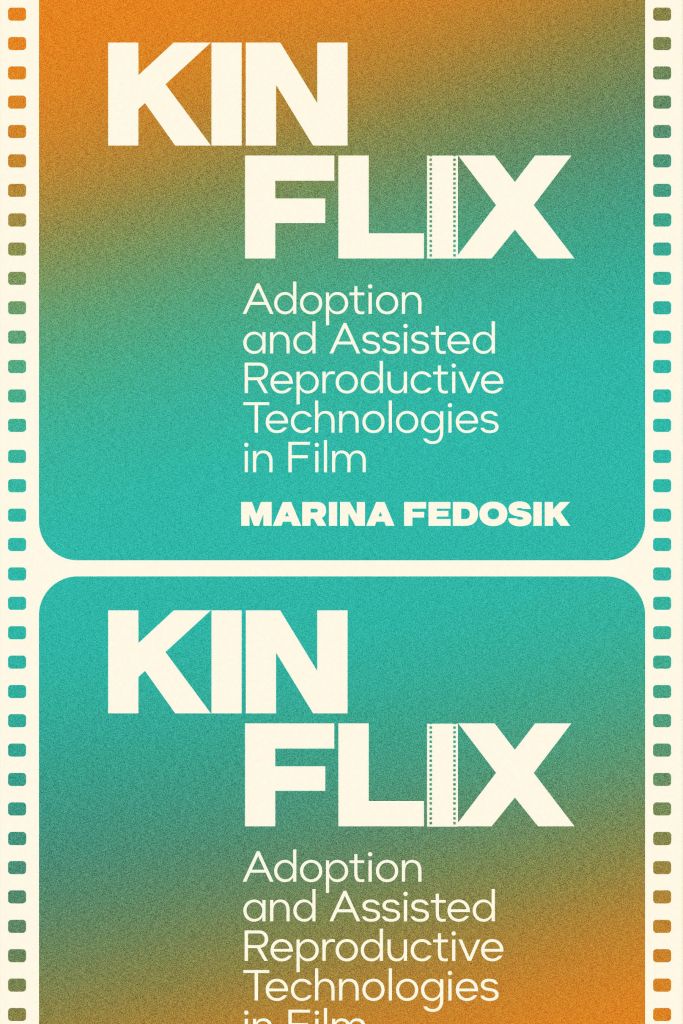
Marina Fedosik’s Kinflix examines the “tug of war” over the meaning of characters that trouble assumptions of heterocoital reproduction through the medium of film, which reflects social norms and generates them in its portrayal of non-normative family making. The book is organized by genre: horror, drama, comedy, science fiction. Fedosik argues that, despite transcending the normative scripts of heterocoital reproduction through portrayals of nontraditional modes of family making such as adoption and assisted reproductive technologies (ARTs), popular genre fiction is most concerned with reinforcing the norms of heterocoital reproduction (17). Still, despite the limits of meaning-making within genre conventions, film creates possibilities for new cultural understandings of these so-called alternative modes of family continuity. Each chapter of Kinflix presents examples of adoption followed by ART to highlight how these presentations converge and separate across genres.
First, Fedosik explores how non-normative family structures play out in the melodramatic battle between good and evil. Adoption is examined through Losing Isaiah (1995) and Mother and Child (2010), both of which give primacy to the biogenetic bond over adoption. The ending of Mother and Child, for example, portrays the child at the center of an adoption battle between adoptive and biological mothers as healing the bond of the two mothers through emphasis on the biological ties of mothering to remedy the disruption caused by a non-normative parent-child relationship. Fedosik finds that portrayals of ART also affirm heterocoital primacy: in The Kids are All Right (2010) ARTs are used to normalize the same-sex parent family through heterocoital kinship. In Private Life (2018), adoption similarly makes ARTs seem more natural because the child retains a genetic link to its parents.
The horror genre reinforces social norms through the return-to-normalcy convention employed after the portrayal of a horror event. The adopted child genre of horror follows the well-explored evil child genre: the young child, still unformed, can be shaped into a full human to assure reproductive futurity or could become wild. Fedosik tells this story through the classic adoption horror film The Bad Seed (1956). An adopted child’s evil is traced to its genetic origins, as is the failure of the child to be socialized into heterocoital culture. ART horror, seen through films like Splice (2009), portrays ARTs as a threat to heterocoital paradigm through the creation of an evil child–animal hybrid.
Comedy, according to Fedosik “test[s] the limits of the heterocoital structure” by dealing with the mismatch between expected social norms and reality in a playful manner. Fedosik includes two examples that highlight how adoption is naturalized through the taking on of so-called genetic traits. The Jerk (1979), the white protagonist Navin, adopted by a Black family, for much of his life exhibits traits that make him stand out from the Black culture in which he was raised. By the end of the film, he intuits some elements of that culture, highlighting the importance of a shared nature. In Flirting With Disaster (1996) , the film’s adopted protagonist reinvents himself each time he meets a potential birth family, before reuniting for good with his adopted family. In both of these films the protagonists reunite with adoptive families after having reconfigured kinship through heterocoital (genetic) understandings. The ART comedies Delivery Man (2013) and Junior (1994) play with genetic paternity through sperm donation and male pregnancy, respectively, to initially stretch the meanings of fatherhood and motherhood, before renaturalizing both.
Science fiction film also plays with reproductive futurities, but in a way that helps viewers make sense of rapid technological change they experience. A.I. Artificial Intelligence follows the story of a robot boy adopted into a human family who is not marked as human enough because he does not share genetic origins with his parents. In Blade Runner (1982) and Blade Runner 2049 (2017), human-like beings are deemed non-human until a biological origin can be identified.
In each of Fedosik’s examples, non-normative family structures are naturalized through heternormative tropes. Some emerging ARTs such as pluripotent stem cells, could take our society past that. If it is decentered, we could “learn the importance of heterocoital logic to the patriarchy.”
References
Marina Fedosik, Kinflix: Adoption and Reproductive Technologies in Film (Columbus: Ohio State University Press, 2025).