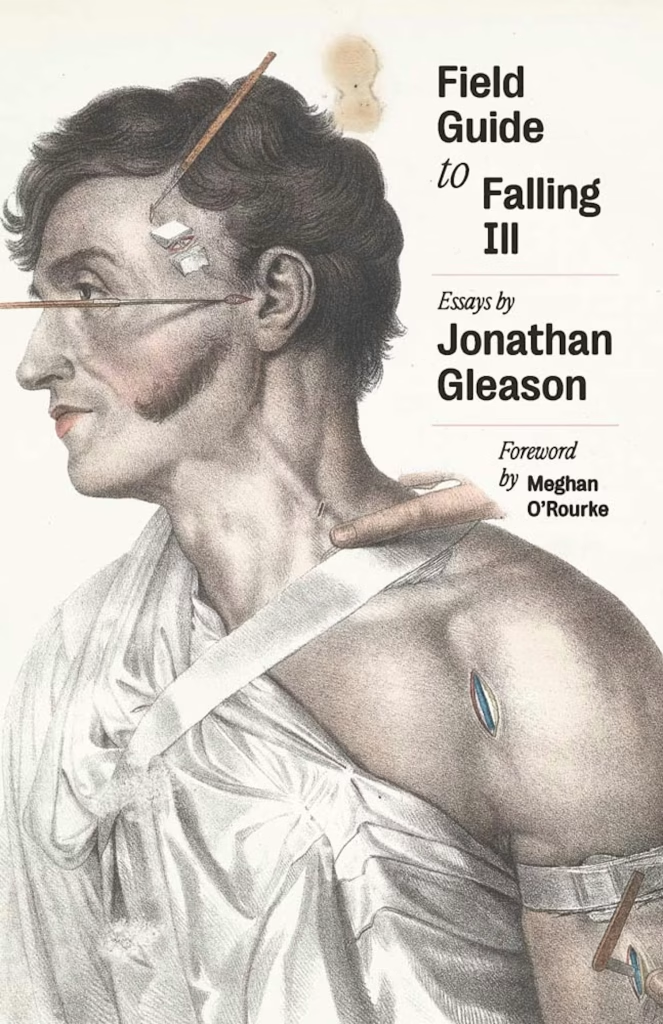
Medical interpreters occupy a contradictory position: present at a patient’s most vulnerable moments, they are expected to remain invisible, rendering one language into another without leaving a trace of themselves in the exchange. In Field Guide to Falling Ill (Yale UP, 2026), Jonathan Gleason takes that role as both literal subject and critical methodology. Across ten essays, he approaches the cultures of western biomedicine with the precision of a trained ethnographer, using first-hand experience as a gateway for social and cultural analysis. The result is a collection of essays that takes on HIV stigma, police violence, mental illness, and the medical neglect of prisoners, among other subjects, without losing sight of the grounded human experiences that make these problems legible.
Gleason worked as a medical interpreter at a clinic for low-income patients during graduate school and now teaches creative writing at the University of Chicago. Throughout the collection, he uses personal experience as a gateway to examine broader social and medical problems. In “Exit Wounds,” for instance, he opens with his own account of witnessing a gunman being shot and killed by police on a Megabus while traveling from Ohio to Chicago. Moving between that experience and his subsequent flashbacks, he uses the essay to examine the disproportionate killing of people living with mental illness by law enforcement. As a gay man writing about healthcare, the body, and sexuality, Gleason follows in a tradition of feminist and queer writing that has long understood personal experience as a starting point for social and cultural criticism. This impulse is visible to varying degrees in other recent American essay collections, such as Leslie Jamison’s The Empathy Exams (2014) and Joseph Osmundson’s Virology (2022). For all these writers, personal experience serves as a critical instrument for social and cultural analysis, particularly when it comes to health.
Several of the essays grapple with what it means to come of age as a gay man in the shadow of the AIDS crisis. “Blood in the Water,” for instance, is structured as a series of letters written to Gaetan Dugas, the gay Canadian flight attendant, who was infamously remembered as the “Patient Zero” of the AIDS epidemic. In And the Band Played On (1987), journalist Randy Shilts famously cast Dugas as a hedonistic villain alleged to have knowingly and recklessly spread the virus to the men he slept with. Gleason, however, approaches Dugas with empathy, for instance, speculating how easy it was for doctors to tell Dugas to be abstinent as if it “was as simple as turning off a tap” (31). In Gleason’s hands, the archive doesn’t just provide evidence of the queer past. Instead, it allows him to establish a sense of intimacy and solidarity with Dugas across time, which is all the more important as the AIDS crisis foreclosed intergenerational knowledge transfer.
In “A Difficult Man,” Gleason again turns to the archive to forge a connection to the queer past, this time by listening to conversations recorded by the AIDS activist Michael Callen and Dr. Joseph Sonnabend. This unlikely pair, along with activist Richard Berkowitz, would publish the 1983 pamphlet How to Have Sex in an Epidemic: One Approach, which laid the groundwork for the development of what we now call “safer sex.” While Gleason’s aim is to use the conversations to tell the larger history of early AIDS treatments, such as AZT, and critique the greed of the pharmaceutical industry, I found his descriptions of his encounter with the archival materials to be the most compelling parts of the essay. “At the beginning of tape 147, Callen acknowledges that ‘some poor queen is going to have to transcribe these,’ and I paused my transcription with an eerie sense of history speaking to me” (103). The uncanny feeling of being interpellated in the archive is a moment to which many queer historians can relate.
Gleason trades in the archive for interviews in the final essay “No Harm,” which examines the case and trial of Dr. William Husel, a physician in Ohio, who was charged with 14 counts of murder relating to the deaths of his terminally ill patients. Headlines like this one tend to invite snap judgments –Husel was either a murderer or a merciful angel of death—before the facts of the case are even considered. Gleason assumes as much. But after sitting through the trial and interviewing medical providers and bioethics experts, Gleason finds himself less tethered to binary thinking. Instead, he concludes, “By proxy these stories tell us the world is coherent, that we are in control of ourselves, ultimately and fully” (214). The rest of the essays, however, betray the fact that health and embodiment rarely conform to the orderly narratives that patients and healthcare providers crave.
Field Guide to Falling Ill would be a welcome addition to the undergraduate or graduate health humanities classroom. The accessibility of the writing makes the essays excellent for pairing with other scholarship. The essay on Dugas, for instance, could be taught alongside Priscilla Wald’s chapter on Patient Zero in Contagious (2008). While the book includes a preface written by the writer Meghan O’Rourke that describes the major themes, I do wish Gleason had included his own introduction that better explained how the essays relate to and build on one another. Ultimately, Gleason’s book will help healthcare providers, scholars, and students explorewhat it means when our bodies, as O’Rourke writes, “collide with the impersonal machinery of corporatized biomedicine and the sociocultural narratives that shape it” (xi).
Works Cited:
Gleason, Jonathan. Field Guide to Falling Ill. Yale University Press, 2026.
Jamison, Leslie. The Empathy Exams. Graywolf Press, 2014.
Osmundson, Joseph. Virology: Essays for the Living, the Dead, and All the Small Things in Between. W.W. Norton & Company, 2022.
Shilts, Randy. And the Band Played On: Politics, People, and the AIDS Epidemic. St. Martin’s Press, 1987.
Wald, Priscilla. Contagious: Cultures, Carriers, and the Outbreak Narrative. Duke University Press, 2008.