Plant Knowledge in the Shadow of War
Whereas others saw death in the carnage of World War I, Kusaka Masaichi saw life, albeit from the safety of Tokyo a continent away. In his capacity as director of the Greater Japan Society for the Promotion of Medicinal Plant Cultivation (Dai-Nippon yakusō saibai shōreikai), Kusaka convinced the House of Representatives of the value of plant life through a petition submitted to the regular session of the Imperial Diet held between December 1917 and March 1918. Given that the “manufacturing of the majority of pharmaceuticals uses medicinal plants as raw materials” and that the “turmoil of war in Europe has stopped pharmaceutical imports,” Kusaka called for government promotion of domestic medicinal plant cultivation as a side business for Japanese farmers (Yakusō saibai hojo shōrei no ken 1918).
More of Kusaka’s vision about who could share in the responsibility of achieving Japan’s medical autarky in the shadow of war would come to light. Later the same year, the popular women’s magazine Shufu no tomo (Housewife’s companion) published his article on the benefits of cultivating saffron crocus, the source plant of the crude drug saffron, as a side business. In an effort to appeal to the magazine’s female target audience, Kusaka framed growing medicinal plants also as a refined undertaking that had come in vogue among members of the polite society. According to him, the households of “Marquis Tokugawa, Count Yamada, and Viscount Torii” had all begun to grow medicinal herbs in their gardens in light of the “Great War of Europe” (Kusaka 1918, 95). Having explained the technical side of growing saffron crocus at home, Kusaka further discussed how the average woman could easily prepare a saffron tea as a “women’s medicine” for her own consumption (Kusaka 1918, 98). Insofar as Japanese society of the early twentieth century regarded the domestic sphere as a feminine space, housewives were expected to play a critical role in his vision of Japan’s pathway towards pharmaceutical self-sufficiency.
To the effect of facilitating the realization of Kusaka’s vision, popular women’s magazines continued to publish on the home cultivation of medicinal plants in the decades to come, and with many contributions sourced intentionally and directly from their female readers no less. In the October 1926 issue of Shufu no tomo, the instructions submitted by a woman named Kuroda Misao on growing saffron crocus was chosen to headline a group of articles on the “experience of running a side business that needs no capital” (Kuroda 1926, 76). In 1926, the third year of her endeavor, Kuroda was already making a net profit of over 450 yen , whereas the average elementary school teacher in her home prefecture Hyogo was only paid a little more than 800 yen in 1923 (Monbushō futsū gakumukyoku 1926, 6–7). In another example, the magazine’s gardening column of the July 1936 issue featured a Tokyo resident named Kurihara Suzuko, who not only relocated medicinal plants from the wild to grow in her herb garden, but also personally and systematically processed their roots, branches, leaves, and/or flowers for her family’s use in times of need. The latter operation also included the dehydration of freshly harvested saffron, the so-called “king of drugs for women’s illnesses,” using a home-made wooden grid over a low flame (Kurihara 1936, 244). Be it accumulated through the productive labor of an entrepreneurial wife or the reproductive labor of a caring mother, practical knowledge on the home cultivation of medicinal plants traveled broadly during the interwar period thanks to the mass circulation of women’s magazines like Shufu no tomo.
Before long, ordinary women’s plant knowledge would acquire new significance as a valuable asset on the home front of Japan’s own great war. As the Second Sino-Japanese War dragged on into another year, Shufu no tomo featured a forum in its May 1940 issue on readers’ “experiences” of the therapeutic properties of yomogi, a native plant with a much longer domestic history than the introduced cultivars of saffron crocus. Without any explicit reference to the war, the magazine’s editors described yomogi as a medicinal herb with “surprising efficacy,” a wild plant easily accessible across Japan, and “what one wants to utilize during a time of drug shortage” (Kurihara et al. 1940, 222).
As imperial Japan’s military campaign escalated, wartime shortage came further to the foreground of the home front for human and plant life alike. On the theme of “home economics under the rationing regime,” the July 1941 issue of Shufu no tomo printed an eight-page introduction to a total of sixty home remedies prepared exclusively with medicinal plants (Shufu no tomo 1941, 237–244). In the magazine’s February 1942 issue on “life during the decisive battle of the Greater East Asian War,” yomogi made a return in a collection of readers’ tips on how to navigate air raids and supply shortages as a handy remedy for stomach aches (Tabata 1942, 208). To the extent that World War II had disrupted the everyday life of ordinary Japanese women, it also reshaped the meaning of medicinal plants from a housewife’s refined side project in peacetime to one of her few yet practical options for healthcare in the shadow of war.
Rooting for a Multi-life History of Gender and Medicine
Beyond offering a snapshot of the deteriorating living condition on imperial Japan’s home front, the aforementioned stories of entanglement between plant and human life have also led me to examine the history of gender and medicine through a “multi-life” approach. To be sure, the intersecting scholarship of post-humanism, multispecies ethnography, and environmental humanities has long been contributing to a rethinking of history that challenges an anthropocentric point of view. What I think of as a “multi-life” approach stands in no contradiction to the insights of existing literature. Instead, I intend for it to draw attention to the epistemic possibilities arising from intentionally involving the nonhuman not only as passive research subjects but also as active research collaborators in better understanding the past. Specifically, I mean to do so both by physically exploring the contact between multiple life forms and by analyzing our intertwined historical experiences of the multiple realities lived in a single lifetime as a result of natural and man-made disasters alike.
To give a concrete example, little did I know that the plants featured in women’s magazines between the 1920s and 1940s would play a direct role in helping me appreciate ordinary Japanese women’s epistemic authority in the domain of medicine. While I have regarded the “experiences” shared by the female readers of Shufu no tomo on growing medicinal plants as “practical knowledge,” such a designation is historically never a given. To the extent that narratives of such experiences in women’s magazines invited great public interest in medicinal plants in imperial Japan, they also blurred the boundary between folk healing and kanpō—the adaptation of classical Chinese medicine in Japan—over the use of materia medica. At a time when the legitimacy of their craft already faced criticism for not complying with the standard for knowledge observed in Western scientific medicine, some kanpō physicians became distressed by the layperson’s use of medicinal plants. The renowned kanpō physician Kimura Chōkyū, for instance, expressed his concern in 1934 that women’s magazines had been actively “publishing stories about folk healing as of recent,” a trend that had led the public to replace doctor’s visits with home remedies. In response, Kimura advocated against the conflation of the layperson’s use of “grass roots and tree barks” and a kanpō expert’s use of medicinal plants and doubled down by denying folk healing the status of “medicine” proper (Kimura 1934, 96–99).
And what criteria for knowledge does his objection leave a historian of medicine and gender with? Do I take his words and reduce the self-help tips shared in women’s magazines about how to grow, forage, or process plants for medical use as no more than the laywoman’s tinkering? And if not, what means do I have to suggest otherwise? Luckily for me, the medicinal plant garden at Tohoku University, my home institution, came to rescue. On a sunny day in November 2025, I watched a technician relocate one saffron crocus from the garden’s saffron field to a clay pot and started my own journey of growing the medicinal plant. It did not take long for me to realize that following textual instructions alone was insufficient in this seemingly mundane quest. Despite the detailed descriptions provided in his 1918 article for Shufu no tomo, not even Kusaka Masaichi mentioned what a healthy saffron crocus plant should look like between the months November and May, the period between which the plant’s crimson pistil “saffron” and the corms used for future propagation are respectively collected.
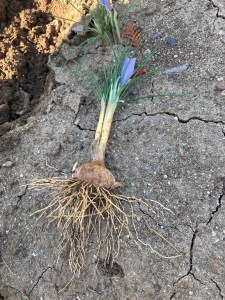
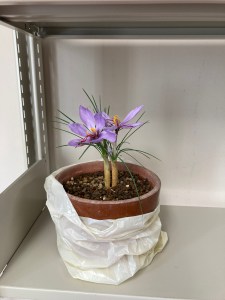
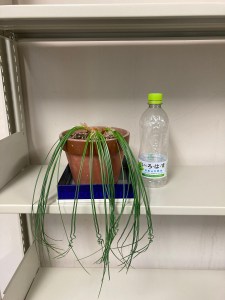
From left to right: how my attempt to care for saffron crocus has progressed from November 2025 to March 2026.
Ultimately, it took paying additional visits to the medicinal plant gardens of both Tohoku University (in northeast Japan) and the Naito Museum of Pharmaceutical Science and Industry (in central Japan) for me to find reassurance that I was, in fact, not destroying university property by my lack of a green thumb. As it happens, during the winter months when the plant is in no active service to any human interest and, as a likely result, routinely unrepresented in cultivation guides, even the healthiest saffron crocus plant can look alarmingly droopy, a piece of practical knowledge that requires lived experience of growing the plant to grasp.
But my ignorance as a present-day historian of medicine and gender did not end there. Despite the solid amount of time that I have spent searching for and looking at their photos online, I struggled and continue to struggle with identifying the yomogi growing in and out of Tohoku University’s medicinal plant garden. Most of my similar-aged colleagues confess that they have no confidence in recognizing the plant in the wild, either, even as traditional confections flavored with yomogi continue to be sold at the average supermarket across Japan. Has the shortage of drug become such a distant memory in Japanese society that the practical knowledge about its native medicinal plant life can no longer be taken for granted?
And this is the question that I would like to keep exploring in the years to come, and hopefully not alone. To learn more about or join in this inquiry, please reach out to the Center for Integrated Japanese Studies at Tohoku University, where we have only recently embarked on a multidisciplinary collaborative project on multispecies (and multi-life) humanities: https://cijs.oii.tohoku.ac.jp/en/research/collaborative_research_projects/010_multispecies/
Featured Image
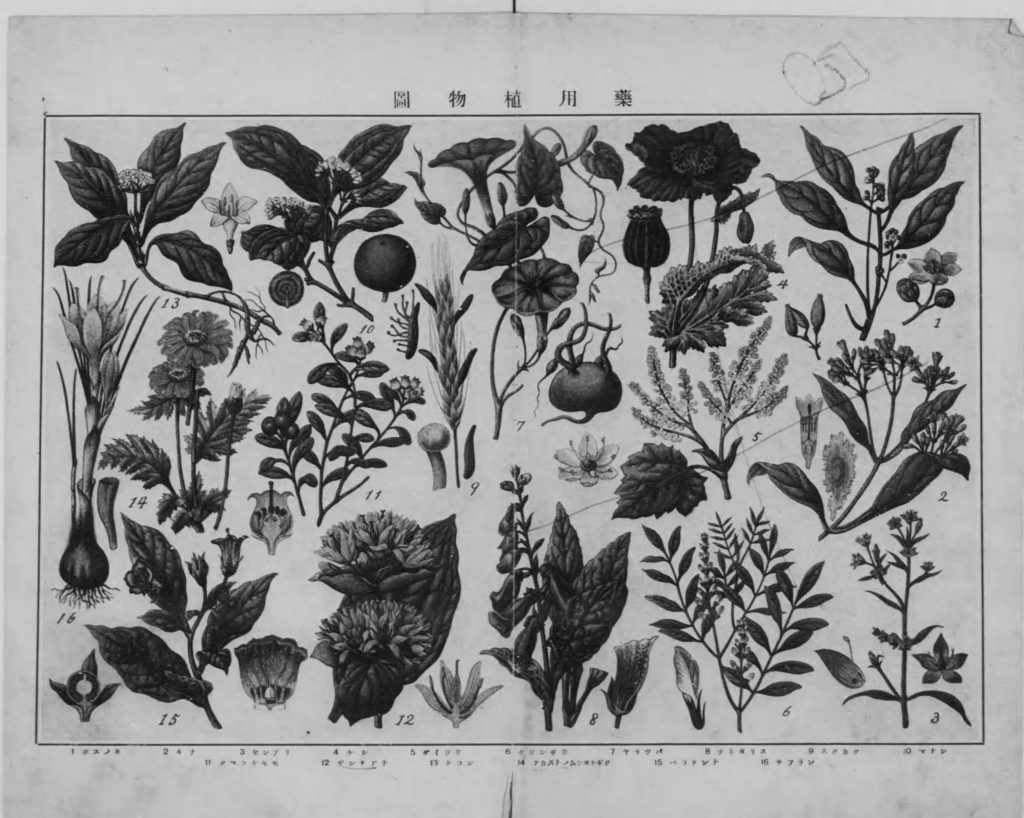
Murakoshi Michio 村越三千男. “Yakuyō shokubutsu zu 薬用植物図 [Illustration of medicinal plants].” In Dai shokubutsu zukan 大植物図鑑. Tokyo: Dai shokubutsu zukan kankōkai. 1925. https://dl.ndl.go.jp/pid/2387662/1/6.
Reference
Kimura Chōkyū 木村長久. 1934. “Minkan’yaku to kanpō 民間薬と漢方.” Kanpō to kanyaku 1 (4): 96–99.
Kurihara Kōzō 栗原広三, Shioda Jigen 塩田慈眼, Narita Gyokujun 成田玉純, Ōga Uta 大賀うた, Yamazaki Shinko 山崎しん子, and Chimura Yoshie 千村芳枝. 1940. “Yomogi de byōki wo naoshita jikkenshū よもぎで病気を治した実験集.” Shufu no tomo 24 (5): 222–223.
Kurihara Suzuko 栗原寿々子. 1936. “Katei yakusōen no tsukurikata 家庭薬草園の作り方.” Shufu no tomo 20 (7): 242–245.
Kuroda Misao 黒田みさを. 1926. “Jūgo-en no tanekyū de sannenme ni ha yonhyakuen yo no shūeki aru yakuyō safuran saibaihō 十五円の種球で三年目には四百円余の収益ある薬用サフラン栽培法.” Shufu no tomo 10 (10).
Kusaka Masaichi 日下真佐市. 1918. “Fukugyō toshite yūrina yakusō no saibai 副業として有利な薬草の栽培.” Shufu no tomo 2 (7): 95–96.
Monbushō futsū gakumukyoku 文部省普通学務局. 1926. Chihō gakkō shokuin taigū chōsa 地方学校職員待遇調査. Monbushō futsū gakumukyoku.
Tabata Toyo 田畑とよ. 1942. “Yomogi no kairobai よもぎの懐炉灰.” Shufu no tomo 26 (2): 208.
“Yakusō no katei ryōhō rokujūshu 薬草の家庭療法六十種.” 1941. Shufu no tomo 25 (7): 237–244.
“Yakusō saibai hojo shōrei no ken 薬草栽培補助奨励ノ件 [Regarding the subsidy and encouragement of medicinal plant cultivation],” seigan 00059100-03708, National Archives of Japan Digital Collection, https://www.digital.archives.go.jp/item/en/3717218