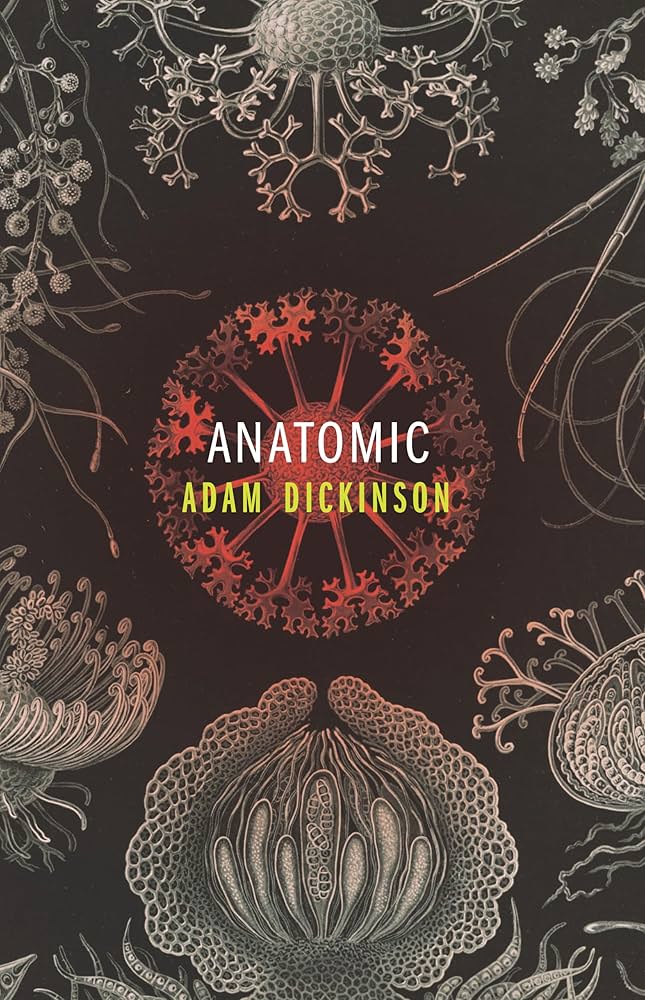
In a project that saw him labeled “a wild doctor and a Romantic scientist,” Canadian critic and poet Adam Dickinson set out in 2018 to discover what exposure to various compounds, environments, and habits had precipitated in his cellular makeup. Ordering a barrage of testing of his own blood, urine, cheek swabs, and feces, he went looking for the writing on the (intestinal) wall, so to speak. What he found fascinated and horrified him. Dioxins, phthalates, unusual pathogens, brominated flame retardants, excess gut bacteria resulting from high sugar and fat intake, mercury, and a host of other chemicals, microbes, and contaminants comprised the distinct signature of his flesh.
Transforming his test results into a poetic rumination on the risks of contact in our era of heightened toxicity, Anatomic is Dickinson’s anxious attempt to let his insides dictate the historical and personal story of globalization’s vulnerabilities. In line with what environmental scholar Stacy Alaimo calls “trans-corporeal” thinking, Anatomic “underlines the extent to which the substance of the human is ultimately inseparable from ‘the environment,’” always enmeshed in and changed by our more-than-human world (Alaimo 8).
The many poems in Dickinson’s alarming collection range from prose protest about the spread of poison from nuclear power to minimalist evocation of swapped germs via the tender holding of a loved one’s hand. Imbued with both scientific and affective language, this text is equally reverent toward and fearful of the “survivalist militia” of microbes and pollutants campaigning against their author’s anatomy. Dickinson describes, “A body / is a crowd / getting out / of bed… with its / chemicals / it can never / be lonely” (Dickson, Anatomic 107). As he charts how innumerable acts and creatures share in the very fabric of his being, Anatomic grapples with the self’s permeability, at once a critique of pesticides and an ode to exchanged kisses.
Critically, Dickinson’s curious interrogation of the collectivity of our supposedly individual biochemistry yields an altogether original model of embodied writing. For one, Anatomic represents an experimental take on formal scientific research, transmuting private lab results into public meditation. But Dickinson’s project is not merely about “relaying human experience from the inside out” as “an alternative or adjunct to conventional report writing” (Anderson 83). Beyond using poetry to appropriate and manipulate scientific texts, this collection incorporates the materiality of toxins and the multi-species nature of human presence into its very paradigm of authorship. Embodied writing, in other words, includes not only an acknowledgment of a writer’s physicality; rather, it asserts a kind of biosemiotics by which chemicals directly meddle with our messages.
“Hormones have their own poetics… Their task is the prosody of metabolism,” Dickinson writes in a poem outlining the “unprecedented potency” of phthalates found in all manner of plastic consumer products (Dickinson, Anatomic 76). Here, he suggests that rhythm, stress, and intonation become the creative terrain of petrochemicals. “This book of glands and hormones make up the endocrine system, an enduring evolutionary adaptation that has changed little in millions of years,” he notes before detailing the many ways phthlates adversely affect our reproductive functions. He demonstrates how the material text of our bodies is being overwritten by contaminants. Elsewhere, Dickinson also remarks: “PCBs constitute a form of writing in the Anthropocene, a recursive script where industrial innovations find their way back into the metabolic messaging systems of the biological bodies that have created them.” “Pollutants,” he adds, “collect like comments sections” in the channels of our flesh (31).
Indeed, Anatomic reimagines “the writing subject as membranous, as a cyborg ontology,” “defamiliariz[ing a] subjective emphasis on the body” to focalize writing instead as a mode of constant exchange happening at microscopic and global levels (Dickinson, “Pataphysics” 18). As the poet converts the secrets of his skin into language, so too do chemical compounds compose the flesh. “When I put food / in my mouth, / I am taking dictation,” he writes (Dickinson, Anatomic 116). The body drafts his story as he drafts its.
Much like this 2018 poetry collection, disability studies thinkers are also attuned to the ways in which we “transform constantly in response to our surroundings and register history on our bodies” (Garland-Thomson 524). Contending with differing degrees of threat, our health and abilities remain ever susceptible to material influence; the built world—with its smog and its pharmaceuticals and its lead pipes—defines our existence. “There are no safe levels of any of the chemicals I was tested for,” Dickinson claims (Dickinson, Anatomic 70). After all, “What’s a safe level? What’s an adverse effect? Industry welcomes the imposition of guidelines because this would give them permission to pollute people up to a line with impunity” (70).
In tandem with scholars who observe and critique the mutuality of disabling structures and environmental damage, then, Adam Dickinson’s Anatomic launches an experimental version of Alaimo’s trans-corporeal ethics with a disability lens. “Looking inside my body has done something to my body,” the poet writes (124). Seeing the outside etched upon his inside, Dickinson’s anxiety spikes, his weight fluctuates, and his cough deepens. Personhood polluted, he cannot unknow the crowded systems of himself, and he cannot unsee how such “systems are so harmful to the living world” more broadly (Alaimo 18). As a model of embodied writing grounded in disability frameworks that understand the world and the self to be reciprocal, Anatomic thus assures us that poetry might offer “resistance to the colossal science project that the industrialized world is currently performing on the bodies of its citizens without consent” (Dickinson, “Pataphysics” 14).
Works Cited:
Alaimo, Stacy. Bodily Natures: Science, Environment, and the Material Self, Indiana UP, 2010.
Anderson, Rosemarie. “Embodied Writing and Reflections on Embodiment,” Journal of Transpersonal Psychology, vol. 33, no. 2, 2001, p. 83-98.
Dickinson, Adam. Anatomic. Coach House Books, 2018.
—. “Pataphysics and Postmodern Ecocriticism: A Prospectus,” The Oxford Handbook of Ecocriticism, August 2014.
Garland-Thomson, Rosemarie. “Disability and Representation,” PMLA, vol. 120, no. 2, March 2005, p. 522-527.