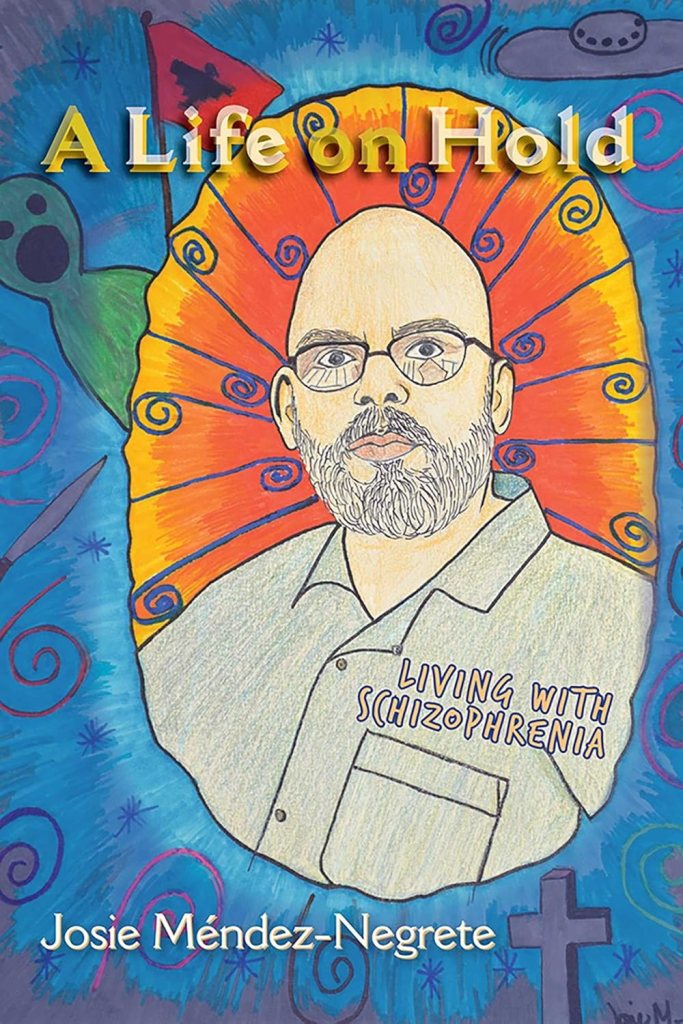
Within the field of the health humanities, there has been a propensity to claim that medical expertise and lived experience equally contribute to our understanding of symptoms and the etiology of illness. Family memoirs, written by a parent or relative who is living with someone who has been diagnosed with an illness, offer a different form of relational – and, in certain cases, intercultural – experiential knowledge. Their epistemic value lies in their depictions of the complex relational dynamics between patients, caregivers, and relatives. A Life on Hold: Living with Schizophrenia (2015) by Josie Méndez-Negrete, Mexican American professor emerita at the University of Texas at San Antonio, suitably illustrates this point. In her family memoir, Méndez-Negrete explores her son Tito’s experience of living with schizophrenia. By opting for multilayered narration, oscillating between her own voice and Tito’s (with dialogue markers), Méndez-Negrete includes the patient’s and caregiver’s perspectives on a level playing field, while reconsidering the role of the latter in helping the former cope with symptoms of hallucination, delusion, and depression.
The result is a collaborative process of meaning-making that simultaneously unearths and illuminates the intersubjective and intercultural dimensions of schizophrenia. This example proposes an “idiographic” understanding of – as opposed to a “nomothetic” and universalized approach to – schizophrenia that holds potential for complicating our medical and cultural understanding of this still misunderstood and highly stigmatized illness (Ballesteros 16–18; Granger and Naudin). In doing so, family memoirs like Méndez-Negrete’s can contribute to the development of idiographic approaches in psychiatric care, namely approaches based on idiosyncratic lived experiences from various socio-economic and cultural contexts.
In the introduction to her book, Méndez-Negrete explains that she does not follow the typical linear narrative of memoir. Instead, she explores her son’s schizophrenia “through memories and recollections of the life he had before schizophrenia,” which allows her to dive into how Tito’s illness and symptoms affected his sense of self (xvi). By including references to articles by sociologists and medical professionals along with her son’s and her voices, Méndez-Negrete challenges biomedical approaches in psychiatry, calling for new alternatives that would not rely strictly on institutionalization and medication (xvii).
Méndez-Negrete manages to represent the violence of illness and stigmatization by truly embodying it. In other words, Tito’s schizophrenia does not only affect her and her family; it is also their schizophrenia. As a mother, Méndez-Negrete lives her son’s illness as what he himself describes as her “permanent nightmare” since he is constantly “living in [her] subconscious” (164). In her epilogue, Méndez-Negrete suggests that it is her own experience of inhabiting a “multiplicity of subjective spaces,” of being “a survivor of incest and domestic violence, a girl/woman in a patriarchal world,” and an American of Mexican origin, which led her to incarnate her son’s schizophrenia (260). However, Méndez-Negrete is aware that she cannot, like psychiatrists, fully understand schizophrenia. Her memoir is, rather, about the importance of materializing the presence of both illness and caregivers. “I have never met anyone,” Méndez-Negrete writes, “who longs to have his relatives around as much as my son does” (199). In his self-reflexive stories, Tito constantly reassesses the value of family, as the chapter “Friends and Family Kept Me Afloat” demonstrates (194). In doing so, he bridges the gap between the reality of psychosis, which causes his pain and suffering, and his family, which provides him with the strength to cope.
More importantly, Méndez-Negrete introduces another voice to the narration, that of stories and cuentos. The author does not only reconnect her son to his past through Tito’s stories, but also integrates her own practice of storytelling into this process. For example, Méndez-Negrete evokes the story of Titotzín, which she made up to teach her son about honesty and truth. The truth of Titotzín, as Tito revisits this story in the chapter “Reality Is Imagined,” becomes the reality of violence and stigma itself. The process of retelling this story to his mother becomes therapeutic, a way of narrating and materializing his affective experience of mental distress and stigmatization, of communicating it and giving it meaning. Tito explains himself that “sometimes stories are the only thing that can soothe the pain” when “medicine is not enough,” and they “keep [him] anchored to something” (74). These stories, however, acquire meaning and fulfill their therapeutic role only in an interaction with a listener. Narratives need the act of “witnessing,” as Arthur Frank calls it, of acknowledging the suffering of the other and the knowledge this suffering carries (207). Méndez-Negrete, in this case, is the “receptive audience,” she says, who “will be there to listen,” and her presence suffices as involvement.
It is precisely through this relationship as well as in the clash between Mexican traditions and storytelling and Western society and psychiatry that relational knowledge about schizophrenia in A Life on Hold is produced. Méndez-Negrete claims to be often amazed at the insights that her son offers: “He impressed me with the knowledge he ha[s] amassed about schizophrenia,” she writes, and admits that “his insights [are] uncanny and unexpected” (15). Still, these insights emerge in dialogue with his mother, which is made possible by intersubjective witnessing and conveyed through multilayered narration.
Knowledge about complex mental illnesses such as schizophrenia is shaped not only by psychiatric expertise, but also by multiple lived experiences, which can be found in various forms such as literary texts, blog posts, podcasts, and webzines. A family memoir like Méndez-Negrete’s, for its part, fully belongs to this ecology of meaning: it emphasizes that families living with mental distress are not only carrying the burden of their loved one’s suffering but embodying it, thus capturing the psychological, social, cultural, and affective dimensions of illness experience. In doing so, they make mental illness and stigma legible, potentially contributing to the destigmatization and empowerment of those living with it.
Works Cited
Ballesteros, Virginia. “Objectivity, Standardization, and Epistemic Injustice in Psychiatry.” Synthese, vol. 205, no. 172, Apr. 2025, pp. 1–23.
Frank, Arthur W. The Wounded Storyteller: Body, Illness & Ethics. The University of Chicago Press, 2013.
Granger, Bernard, and Jean Naudin. Idées reçues sur la schizophrénie. Le Cavalier Bleu, 2022.
Méndez-Negrete, Josie. A Life on Hold: Living with Schizophrenia. University of New Mexico Press, 2015.