


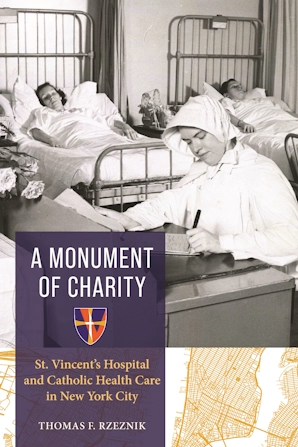
In A Monument of Charity: St. Vincent’s Hospital and Catholic Health Care in New York City (New York University Press, 2026), Professor Thomas F. Rzeznik offers a comprehensive look into the daily operations of the long-standing, titular hospital. Through this process, Rzeznik celebrates some of the more influential women among the ranks of the Sisters of Charity, who not only founded the institution but also safeguarded its core principles from mounting external pressures. Across the book’s seven chapters, Rzeznik accompanies the reader on a chronological journey through the history of St. Vincent’s, and outlines the methods it used to offer relief to its Greenwich Village community in periods of staunch sectarianism, bitter economic crisis, and various public health emergencies.
As a foremost scholar of American Catholicism, the pages of this monograph are truly imbibed with Rzeznik’s expertise, which shines through from the start of the first chapter. In “Humble Beginnings, 1849-1869”, he outlines how, and why, on November 1st, 1849, Sisters Mary Angela Hughes, Mary Ulrica O’Reilly, Mary Xavier Mehegan, and Mary Agnes Hancock took up a tenancy on a townhouse on East Thirteenth Street. Founded in response to a recent resurgence of cholera ravaging the city with disproportionate effects on its poorest and most vulnerable, the call to which the Sisters answered not only lays out the foundational principles of the Sisters of Charity, the order to which they belonged, but also the gap in New York City’s care landscape that desperately needed filling. Finding that there were no hospitals in the city which provided indiscriminate care to Catholics, from its inception, St. Vincent’s was exceptional in its commitment to admit “‘persons of all denominations’ without distinction” (11). The unusually charitable nature of this voluntary hospital is, throughout this chapter, only highlighted by countless examples of how the Sisters were “‘ever willing to admit the sick poor, and to give them their time and kindest attention gratis'” often at great personal cost and sacrifice for them, as well as the overall strength of St. Vincent’s itself (12).
The chapters that follow continue this pattern, outlining the ways the Sisters of Charity at the helm of St. Vincent’s were made to respond to the rising stress facing the institution, as well as the call of modernity which wholly reshaped the nature of hospitals and medical care. In “The Hospital Marketplace, 1870-1905”, Rzeznik outlines St. Vincent’s first forays into establishing its School of Nursing, the first of many programs to which it would play host to over the next 118 years. Establishing itself as a center of unparalleled care and education was, according to Rzeznik’s research, fundamental in legitimizing St Vincent’s and the quality of Catholic healthcare across the country. This desire to demarcate itself for its’ incredible commitment to quality is only further highlighted in “Community Institution, 1906-1938”, when the American College of Surgeons included St. Vincent’s among its first-ever list of institutions to meet their regulatory standards published in 1921 (89). Critically, Rzeznik notes that one third of these institutions were Catholic, highlighting the widespread recognition of the quality of care offered, and the quest for excellence championed by the small-but-mighty fleet of Sisters and nurses at St. Vincent’s.
As the shape and size of the contemporary American medical system began to cement itself, Rzeznik sympathetically outlines the growing pains experienced by St. Vincent’s and those responsible for its administration. The voluntary system through which it was operated was fundamentally at odds with the methods which necessarily needed to ensure its fiscal solvency, and its continued mission. As aptly written in “Postwar Expansion, 1939-1959”, “Since [insurance] reimbursement rates were determined by reported costs, […] the hospital needed to put a price tag on its charity, in terms of both the amount of free care it provided and the voluntary contributions of the Sisters, even though that seemed to go against the spirit of the institution” (132-3). The increasing demand to quantify the devotion characteristic of the Sisters’ work in service of the poor proved challenging to an administration which was reticent to attribute such figures to their invaluable work. This tension, combined with the never-ending requirement for the hospital’s expansion, and demands placed on Medical Centers of its caliber made St. Vincent’s stand out as a “‘well-maintained anachronism'”, juggling its pre-civil war mission with contemporary demands made of cutting-edge research institutions (179).
In the wake of the difficulties experienced at St. Vincent’s in the 1960s and 1970s, “Resurgence, 1980-2000” outlines how the hospital regained its strength after a prolonged period of uncertainty marred with wage freezes, austerity measures, and quests for unionization. This period of renewed stability allowed St. Vincent’s to, once again, reassert its commitment to serving the vulnerable. Its location at the heart of the Greenwich Village placed St. Vincent’s at the front lines of the AIDS crisis: it was among the first hospitals in the country to offer critical care for those infected and education about the disease to the wider public, despite its Catholic affiliations and the judgement frequently placed on the HIV-positive in the early stages of the epidemic. It proved to be a similarly critical bedrock for the community on September 11th, 2001, when it quickly moved to establish a special command center and six overflow emergency rooms as soon as it heard of the impact on the first of the towers. Unfortunately, the blow of the attack was felt long after the events on 9/11. Community and city-wide reticence to travel to the area meant that St. Vincent’s was hemorrhaging patients despite the quality of care it offered. In spite of extensive efforts to breathe life back into St. Vincent’s, it formally filed for closure on April 30th, 2010. While this announcement prompted resistance from the community it had served for over 150 years, Rzeznik points out that, “To some, St. Vincent’s was simply the ‘victim of its own generosity'” (244).
Despite the thorough nature of Rzeznik’s research, and the quality of prose employed to memorialize St. Vincent’s and its champions, there were moments where it felt as though a main character had failed to make a notable appearance. Sectarianism, and its changing forms throughout the period of 1849 to 2010, is often absent from the tale Rzeznik is recounting. Similarly, there were instances wherein offering additional context, such as when discussing costs associated with managing a hospital in the nineteenth century, or supplementary comparative information would have only strengthened Rzeznik’s argument about the exceptional character of St Vincent’s. Ultimately, A Monument of Charity offers a moving case study of the ever-evolving tug-of-war between religion, modernity, gender, and medicine fought over the course the hospital’s 161 years in operation, and offers a wonderful tribute to the Sisters of Charity who continuously and selflessly devoted themselves to caring for the poor, the ill, and the vulnerable of New York City.
Works Cited
Rzeznik, Thomas F.. A Monument of Charity: St. Vincent’s Hospital and Catholic Health Care in New York City. New York University Press. 2026.