On 7 January 1949, Mukō Hideo of the National Agricultural Experimental Station in Nishigahara, Tokyo, was summoned to the office of the Public Health & Welfare Section (PH&W) of the Supreme Commander of Allied Powers (SCAP) in Occupied Japan. The PH&W was worried about the impact of Salmonella typhimurium and Salmonella enteritidis on human health. Both kinds of Salmonella were varieties of bacteria that had been in use as popular rodenticides since the late nineteenth century. The PH&W suspected that Salmonella cultures were dangerous for humans and could cause intestinal diseases and instructed the Japanese to switch to chemical rodenticides like alpha napthyl thiourea (ANTU), developed at Johns Hopkins Hospital, during the course of the war to kill rats and enable the U.S. Army to safely advance in war zones. (Keiner 2025) Japan had used Salmonella in its fields to control rats and rodents and protect food stocks since 1901. (Mukō 1960) Bacterial-bait rodenticides and chemical rodenticides represented different generations of rodenticides and were borne of varied social realities and contexts. For the Japanese, bacterial baiting represented an established and trusted method of dealing with rats. However, the Americans believed that bacterial rodenticides were dangerous to humans and promoted chemical rodenticides as the new technological innovation of American science. Displeased with orders from the Allied Occupation, Muko and his colleagues argued that the Americans would be solely responsible if there was any damage to food resources and if people had to go without food. (GHQ SCAP 1949) The war had constrained food resources and the Occupation was still fighting epidemics and rebuilding public health with the support of Japanese health and sanitation officials. Given these circumstances, there was no scope or margin for error in how rat populations were controlled. They were singularly responsible for destroying grains and spreading tsutsugamushi disease, which made rats a huge public health challenge. (Aldous and Suzuki 2012)
The use of bacterial baits, i.e., using micro-organisms to infect other harmful species without disturbing or causing collateral harm to other species, was first suggested by Louis Pasteur. (Wodzicki 1973) Consequently, during the last decades of the nineteenth century, pathogens were developed to control rodent populations. In 1892, Friedrich Loeffler developed a culture that induced typhoid in rodents called Salmonella typhimurium. This was followed by the culturing of Salmonella enteritidis var. dansyz by Jean Dansyz. This became popular as the Dansyz Rat Killer in the earlier part of the twentieth century. Concurrent wars and famine in Europe had provided the necessary preconditions for finding a solution to the rat problem. (Wodzicki 1973) In Japan, Salmonella based rodenticides had been in use since 1901 to reduce rat populations that had caused immense damage to food crops and food stocks. When the Occupation ordered the immediate termination of the use of Salmonella cultures, it was not without fear and apprehension based on the effectiveness of Salmonella on rats and the harm it was causing to humans who prepared and handled the bait. By the 1920s, serious doubts were cast upon the effects of bacterial agents and the harm they caused to humans. Lt. Colonel W.D. Tigertt of the 406th Medical General Laboratory argued that the Salmonella cultures submitted to the laboratory by the Japanese were not able to provide sufficient samples for analysis. (GHQ SCAP 1949) However, he cited recent research by F. Kaufmann, manager at the State Serum Institute in Copenhagen, as a conclusive proof that Salmonella can cause outbreaks of gastrointestinal infections in humans and might not be as effective at killing rats once they developed tolerance to it. As per the sources of the Occupation, it was feared by the authorities of the PH&W that improper baiting techniques could lead to an outbreak of intestinal diseases in Japan’s villages. (GHQ SCAP 1949) The Occupation, thus, came down heavily on the practice of bacterial baiting to prevent a potential outbreak of intestinal infections in Japan. This heavy handedness of the PH&W Section was not appreciated by the Japanese scientists and they went on to describe that the technique had worked perfectly for the last fifty or so years. Salmonella cultures were distributed upon request to all prefectures within Japan from the National Agricultural Experiments Station Lab at Nishigahara. The prefectural labs performed further sub-culturing and distributed Salmonella samples in bottles to towns and villages for 5 to 20 yen per bottle. This culture was then poured over and mixed with any kind of flour and then distributed to the farmers who collected the baits and used them to kill rats in their fields. (GHQ SCAP 1949) A long-standing technique was not equal to a safe method and the Occupation felt that there was no established or scientific backing for the claims made by the Japanese scientists. As per the records of the PH&W,
“Regarding pathogenicity for man, the Ministry of Agriculture representatives were extremely vague. In fact, throughout the conference they kept referring to a publication dated 1928 to find answers to questions put to them. They stated that the cultures would not produce diarrhea in man, only slight fever…” (GHQ SCAP 1949)
The actions and response of the American Occupation in Japan can be contextualized within the contemporaneous socio-scientific responses to rodents and notions of health, sanitation and filth. As the Second World War dragged on, food became scarce and it became necessary to explore efficient methods of rodent extermination for both civilian and military needs. The war explicitly and implicitly led to the development of new insecticides and rodenticides such as DDT and ANTU, respectively. ANTU did for rats what DDT did for insects, becoming part and parcel of U.S. troop movement and sanitation projects as it moved through the arenas of war. ANTU was more lethal and was tasteless and odorless to rats while being safe for humans unless ingested. Disciplines like entomology and ecology studied population and invasive species to understand how rodenticides could be applied and used effectively. (Kelty 2023) The development and use of rodenticides, particularly those against rats during the Second World War, is indicative of how scientific disciplines like entomology and ecology were used for war needs and to expend a kind of violence against rats that was very similar in vocabulary to settler colonialism, race violence, and imperialism. (Kelty 2023) Thus, the new prescriptive rodenticide introduced by the U.S. Occupation, ANTU, was an extension of a perfected practice of scientific violence that was dispensed in the name of civilization.
References
Aldous, Christopher, and Akihito Suzuki. Reforming Public Health in Occupied Japan, 1945-52: Alien Prescriptions? Routledge Studies in the Modern History of Asia 73. Routledge, 2012.
GHQ SCAP. “Bacterial Baiting of Field Rodents.” 1949. PHW04540. Modern Japanese Political History Room, National Diet Library.
Keiner, Christine. “Wartime Rat Control, Rodent Ecology, and the Rise and Fall of Chemical Rodenticides.” Endeavour 29, no. 3 (2005): 119–25. https://doi.org/10.1016/j.endeavour.2005.07.004.
Kelty, Christopher M. “The Ecological Origins and Consequences of the Rodent Bait Station: From WWII Britain to Contemporary California.” Medical Anthropology 42, no. 4 (2023): 397–414. https://doi.org/10.1080/01459740.2023.2213390.
Mukō, Hideo 向秀夫. “No nezumi chibusu-kin no omoide” 野鼠チブス菌の思い出 [Memories of Field-Rodent Typhimurium Bacteria]. Shokubutsu Bōeki 植物防疫 14, no. 1 (1960): 31–32.
Wodzicki, Kazimierz. “Prospects for Biological Control of Rodent Populations.” Bulletin of the World Health Organization 48, no. 4 (1973): 461–67. https://iris.who.int/handle/10665/263726.
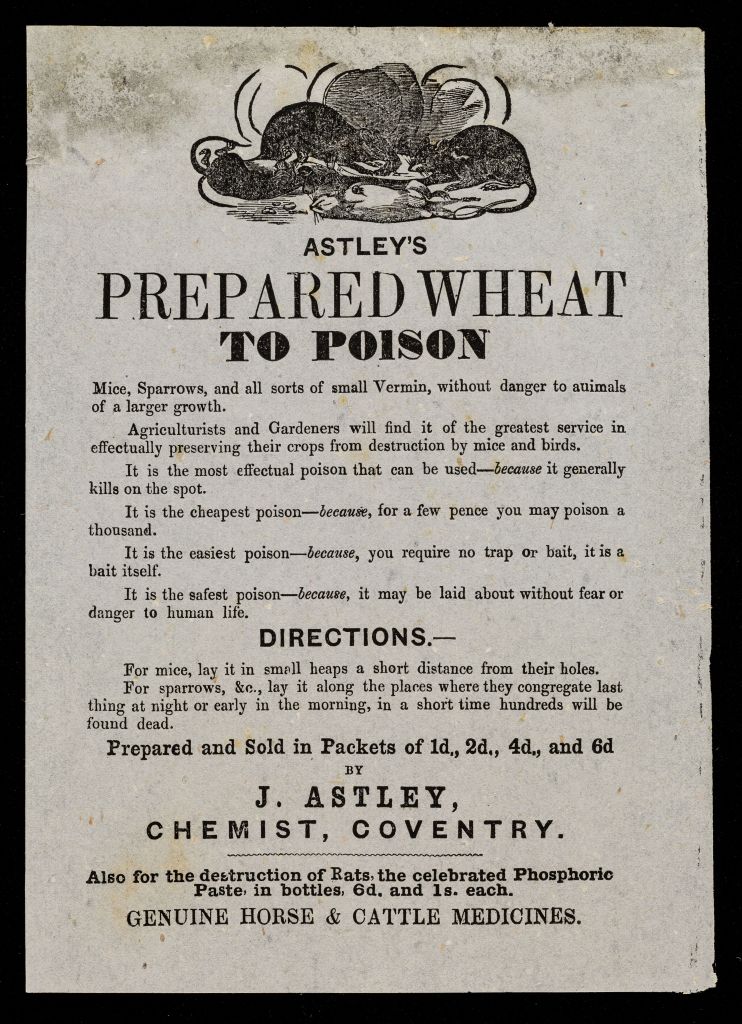
Image Credits: Astley’s prepared wheat: to poison mice, sparrows, and all sorts of small vermin, without danger to animals of a larger growth… / J. Astley. Public Domain Mark. Source: Wellcome Collection. https://wellcomecollection.org/works/e6wd8eup