Access Denied: Health and Justice Under Siege
Authors: Khosro Kalbasi Isfahani and Tiffany D. Creegan Miller
Khosro Kalbasi Isfahani is an Iranian journalist, activist, and researcher. Currently, Isfahani writes for BBC Monitoring, the Atlantic Council, and ARTICLE 19, focusing especially on health and human rights violations. His work includes articles on Iran’s violence against protestors, persecution of ethnic, religious, and LGBTQ+ minorities, response to COVID-19, and other health crises, like medicine shortages and the lack of medical care for minority groups. Isfahani, who identifies as queer and non-binary (he/they), has focused most recently on LGBTQ+ issues in Iran. In the past and under different pen names, they created materials for young LGBTQ+ adults on health, gender, and sexual orientation, and they were involved in suicide prevention work for the LGBTQ+ communities. Despite the obstacles, Khosro is one of the main voices highlighting human rights issues in Iran.
Content Warning: This article contains details some readers may find distressing.
“Security forces are tailing me. Help! Please! They are killing everyone”: these were the last words of a 23-year-old medical student who participated in the recent uprising in Iran. Shortly after writing these words on Instagram, Aylar Haghi was arrested, severely beaten, and purportedly shot in the back of the head. Her body was dumped in a pit.
In addition to Aylar, from the ranks of healthcare professionals, at least three doctors and one dentist were killed during the Woman, Life, Freedom uprising that was triggered by the killing of Jina Mahsa Amini in police custody on 16 September 2022. Jina, a 22-year-old woman from Iran’s Kurdish ethnic minority, was arrested for allegedly wearing the mandatory headscarf “improperly.”
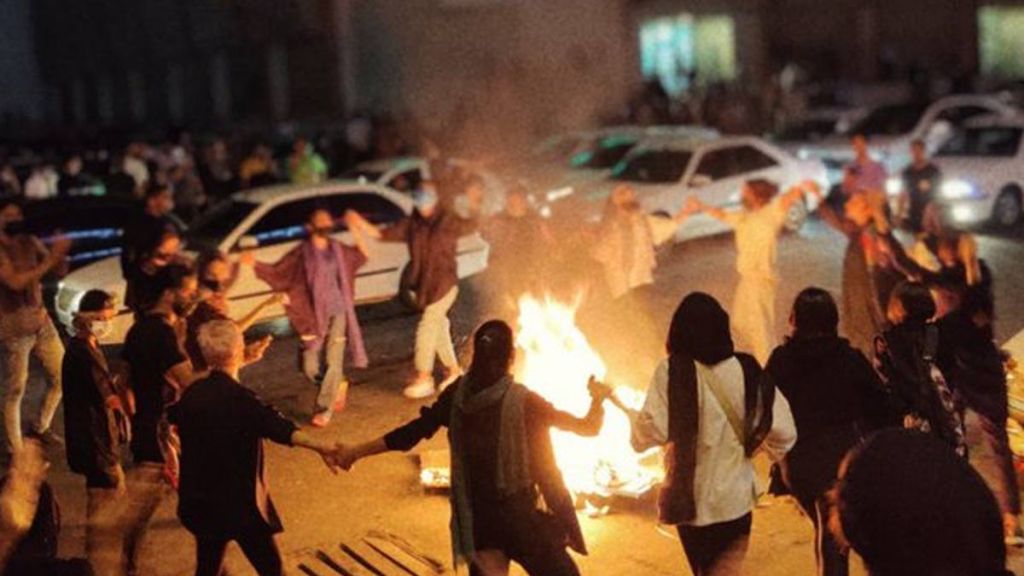
In response to the uprising, the Islamic Republic unleashed brute force against unarmed protesters, killing at least 522 people, including 71 children, US-based Human Rights Activists News Agency (HRANA) reported in December 2023. The actual number is estimated to be significantly higher.
On top of street killings, the regime used a wide array of brutal tactics to quell the protests and prevent the flow of information in and out of Iran at all costs. Security forces shot at the faces and genitals of female protesters, arrested at least 22,000 people, tortured the detainees—including children as young as 12, aired coerced “confessions” of detained protesters on state TV, and arbitrarily executed at least seven people in relation to their role in protests.
And the health sector did not remain unaffected by the brutality of the Islamic Republic. During protest days, security forces clad in full black riot gear made a habit of raiding hospitals and arresting injured protesters. Whenever they faced resistance from doctors, they resorted to violence. In one case, security forces arrested a female doctor dragging her on the ground and out of a hospital.
All these happened in blatant violation of international human rights law protecting the work of the medical community during protests. To add insult to injury, the regime went a step further and co-opted ambulances to infiltrate demonstrations and detain protesters.
Despite all this repression, Iranian doctors, risking their lives and freedom, have been determined to deliver aid to the injured. Doctors filled up backpacks with first aid kits and medicine and traveled to areas most affected by state violence, including those populated by the Kurdish and Baluch ethnic minorities. Some of them were arrested and now face bogus charges of “crimes against national security.”
These atrocities are by no means the Islamic Republic’s first assaults on healthcare providers, during the regime’s four-decade rule over Iran. The clerical establishment has a long history of persecuting doctors and nurses providing lifesaving care to women seeking abortions and LGBTQ persons seeking gender-affirming care. The regime has recently gone as far as introducing legislation that raises the prospect of the death penalty for abortion.
Sadly, such barbaric rules, infringing on the right to bodily autonomy, are not too unfamiliar to women and the queer community in the global north, whether it is the belligerent assaults on access to gender affirming care in the United States and the United Kingdom or the push for restricting access to abortion in the US.
Health and justice are under siege around the globe. The similarities between these repressive actions and rules are stark reminders that we shall not struggle in isolation, wary of man-made borders superimposed on our universal suffering. We should never forget that it is one land, one blood, one global struggle. And we must unite for this fight.
Khosro Kalbasi Isfahani, 2023 Oak Fellow
2023 Oak Human Rights Fellow
Khosro Kalbasi Isfahani has been a voice among the ranks of journalists and human rights defenders who have dedicated their lives to document such atrocities in Iran and around the world. In recognition of this crucial work, Isfahani has been named as the 2023 Oak Human Rights Fellow in residence for the fall at Colby College
The Oak Institute for Human Rights, established in 1997, annually brings a prominent human rights activist to campus. While in residence, Oak Fellows have an opportunity to reflect, recuperate, and engage the Colby community about their work.
As this year’s Oak Fellow, Isfahani is an Iranian journalist, activist and researcher. Currently, Isfahani writes for BBC Monitoring, the Atlantic Council, and ARTICLE 19, focusing especially on health and human rights violations. His work includes articles on Iran’s violence against protestors, persecution of ethnic, religious, and LGBTQ+ minorities, response to COVID-19, and other health crises, like medicine shortages and the lack of medical care for minority groups.
Isfahani, who identifies as queer and non-binary (he/they), has focused most recently on LGBTQ+ issues in Iran. In the past and under different pen names, they created materials for young LGBTQ+ adults on health, gender, and sexual orientation, and they were involved in suicide prevention work for the LGBTQ+ communities. Despite the obstacles, Khosro is one of the main voices highlighting human rights issues in Iran.
Reflecting on this year’s Oak theme, “health and human rights,” we consider our health to be our most basic and essential asset regardless of our age, gender identity, race, sexuality, socio-economic or ethnic background. The right to the highest attainable standard of physical and mental health is a fundamental part of our human rights, and these convictions were codified in the 1946 Constitution of the World Health Organization (WHO), whose preamble defines health as “a state of complete physical, mental, and social well-being and not merely the absence of disease or infirmity.” The preamble also states that “the enjoyment of the highest attainable standard of health is one of the fundamental rights of every human being without distinction of race, religion, political belief, economic or social condition.”
More attention has been paid to these rights in recent years. Ever-changing climate and environmental factors, pandemics, global and domestic violence, politicization of health-related issues, migration, access to safe drinking water and adequate sanitation; safe food; adequate nutrition and housing; healthy working and environmental conditions; health-related education and information; and gender equality.
Thinking about the connections between the international contexts “over there” and the national contexts that are happening “right here,” at Oak we are looking forward to programming connecting the global and the local.
There are threads that connect international human rights concerns like the ones Isfahani works on with the ones right here at home in central Maine.
Tiffany D. Creegan Miller, Director, Oak Institute for Human Rights
Works Cited
Amidi, Feranak. “Iran protests: Jailed activist Sepideh Qolian describes brutality in letter.” BBC News, 11 January 2023, https://www.bbc.com/news/world-middle-east-64225902.
Assemi, Fareen. “Victims of Iran protests; Aylar Haghi saw Woman, Life, Freedom movement as Citizen Revolution.” BBC Persian, 7 September 2023, https://www.bbc.com/persian/articles/cp619x2342po.
“Amnesty International Condemns Anti-Trans Youth Bill in US House.” Amnesty International, 20 April 2023, https://www.amnestyusa.org/press-releases/amnesty-international-condemns-anti-trans-youth-bill-in-us-house/.
BBC 100 Women, Disinformation, Monitoring, BBC Persian and Visual Journalism teams. “Iran protests: BBC identifies many more people killed in demonstrations after Mahsa Amini’s death.” BBC News, 6 December 2022, https://www.bbc.com/news/world-middle-east-63836921.
Colby College, https://www.colby.edu/, Accessed 30 September 2023.
“A Comprehensive Report of the First 82 days of Nationwide Protests in Iran.” Human Rights Activists News Agency (HRANA), 8 December 2022, https://www.en-hrana.org/a-comprehensive-report-of-the-first-82-days-of-nationwide-protests-in-iran/.
Curtis, Abigail. “Iranian Activist Will Serve as Next Oak Human Rights Fellow.” ColbyNews, 20 June 2023, https://news.colby.edu/story/iranian-activist-at-oak-institute-for-human-rights/.
Esfandiari, Golnaz and Elahe Ravanshad. “‘It’s My Decision’: Iran’s New Population Law Blasted For Restricting Access To Contraceptives, Abortions.” RadioFreeEurope/Radio Liberty (RFE/RL), 18 November 2021, https://www.rferl.org/a/iran-abortions-sterilizations-contraceptives/31568161.html.
Gambrell, Jon. “Iran announces pardoning of more than 22,000 arrested during protests.” PBS NewsHour, 13 March 2023, https://www.pbs.org/newshour/world/iran-announces-pardoning-of-more-than-22000-arrested-during-protests.
Ghanbarpour, Sina. “Anniversary of Iran protests: The ordeal of the healthcare professionals.” BBC Persian, 13 September 2023, https://www.bbc.com/persian/articles/crg0pwd43jno.
“A Hospital Manager’s Account of the ‘Curious Mental and Emotional State’ of Security Officers Suppressing Protests.” Radio Farda (Persian service of RFE/RL), 21 November 2022, https://www.radiofarda.com/a/gorgan-hospital/32141126.html.
“Iran: One year after uprising international community must combat impunity for brutal crackdown.” Amnesty International, 13 September 2023, https://www.amnesty.org/en/latest/news/2023/09/iran-one-year-after-uprising-international-community-must-combat-impunity-for-brutal-crackdown/.
“Iran: Child detainees subjected to flogging, electric shocks and sexual violence in brutal protest crackdown.” Amnesty International, 16 March 2023, https://www.amnesty.org/en/latest/news/2023/03/iran-child-detainees-subjected-to-flogging-electric-shocks-and-sexual-violence-in-brutal-protest-crackdown/.
“Iran protester: ‘We could hear the beatings and screams in jail’” BBC News, 9 November 2022, https://www.bbc.com/news/world-middle-east-63559971.
“Iran Protests 2022: Women Protester Eyes Intentionally and Systematically Targeted.” Iran Human Rights (IHRNGO), 22 September 2023, https://iranhr.net/en/articles/6205/.
Isfahani, Khosro Kalbasi. “Manifestations en Iran : Comment votre téléphone peut vous conduire en prison.” BBC Monitoring, 1 February 2023, https://www.bbc.com/afrique/monde-64451663.
Isfahani, Sayeh. “‘Women, life, liberty’: Iran’s future is female.” Atlantic Council, 26 September 2022, https://www.atlanticcouncil.org/blogs/iransource/women-life-liberty-irans-future-is-female/.
Oak Institute for Human Rights, https://oakinstitute.colby.edu/, Accessed 30 September 2023.
Parent, Deepa and Ghoncheh Habibiazad. “Iranian forces shooting at faces and genitals of female protesters, medics say.” The Guardian, 8 December 2022, https://www.theguardian.com/global-development/2022/dec/08/iranian-forces-shooting-at-faces-and-genitals-of-female-protesters-medics-say.
—. “‘They used our hijabs to gag us’: Iran protesters tell of rapes, beatings and torture by police.” The Guardian, 6 February 2023, https://www.theguardian.com/global-development/2023/feb/06/iran-protesters-police-rapes-beatings-and-torture.
“Respecting and protecting health care in armed conflicts and in situations not covered by international humanitarian law – Factsheet.” ICRC (International Committee of the Red Cross), 21 May 2021, https://www.icrc.org/en/document/respecting-and-protecting-health-care-armed-conflicts-and-situations-not-covered.
RFE/RL’s Radio Farda. “Family Says Iranian Student Killed By Police Bullet, Rejecting Official Claim That She Died In A Fall.” RadioFreeEurope/Radio Liberty (RFE/RL), 18 Nov. 2022, https://www.rferl.org/a/iranian-protester-haghi-killed-police-bullet-fall-pressure/32137124.html.
“Stop the Roll Back on Abortion Rights in the USA.” Amnesty International, Accessed 2 October 2023, https://www.amnesty.org/en/petition/stop-the-roll-back-on-aborton-rights-in-the-usa/.
Tabrizy, Nilo and Ishaan Jhaveri. “How Iran’s Security Forces Use Ambulances to Suppress Protests.” The New York Times, 23 November 2022, https://www.nytimes.com/2022/11/23/world/middleeast/iran-protesters-detained-ambulance.html.
“UK: UN view on trans rights is ‘much-needed common sense.’” Amnesty International UK, 11 May 2023, https://www.amnesty.org.uk/press-releases/uk-un-view-trans-rights-much-needed-common-sense.
United Nations. “Iran death penalty threat for abortion unlawful: UN rights experts.” UN News, 16 November 2021, https://news.un.org/en/story/2021/11/1105922.