Our best machines are made of sunshine; they are all light and clean because they are nothing but signals, electromagnetic waves, a section of the spectrum…Their engineers are sun-worshipers mediating a new scientific revolution associated with the night dream of post-industrial society.
–Donna Haraway, “A Manifesto for Cyborgs”
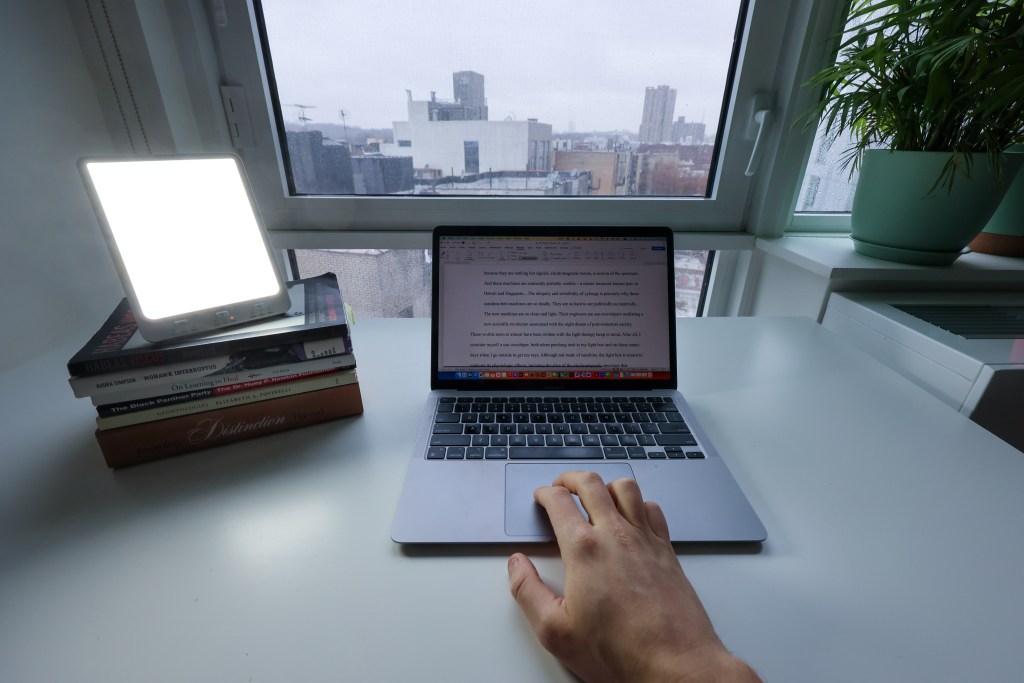
I frequent a park near my apartment that has a beautiful lake. I love to walk along the water and watch the wildlife, especially the turtles. They perch on rocks and bask in the sun’s rays. Their heads reach towards the sky, as if the sun’s warmth will touch them more if they are a few inches closer to it. I describe their leisurely sunbathing as turtling. I feel a kinship with them because I turtle too, or at least that’s what I call it when I use my light therapy lamp, a device that mimics the brightness of the sun and staves off seasonal depression. I perch it on a stack of books on my desk and bask in its rays for up to ninety minutes a day as I work on my laptop in the mornings. Using the light lamp not only wakes me up, but miraculously, it helps me escape what seemed, before I started using the device, like an inevitable dip in my mood that accompanied shortening days and colder weather. In fact, last semester, instead of a debilitating late fall depression, I had perhaps my most productive semester yet, writing over ninety pages in final papers, presenting at a conference, and working a part-time job during my first semester of graduate school. The light therapy lamp—my form of turtling—not only fends off winter blues, but it propels me through some of my most creative and productive times. In contrast to the turtles whose turtling I interpret as laziness and leisure, my turtling increases my capacity for work and productivity.
In this essay, I want to explore how light therapy functions as a prosthetic device and how it is entangled with capitalist demands for productivity, especially in the contexts of the neoliberal university and workplace, from first-person narrative and feminist science studies perspectives. Anthropologist Lochlann Jain describes how in American capitalist society, “prosthesis, defined as ‘that which supplies the deficiency’…can include the creation of deficiency and the antidote to the deficient body” (33). Taking this insight as a starting point for my essay, I ask: How does the light therapy lamp function as a prosthetic, and what kinds of cyborg bodies, to use Donna Haraway’s formulation, does it produce? How does light therapy capacitate certain disabled bodies but not others, and what forms of privilege are necessary to access light therapy’s potential benefits? Finally, how can the increased energy that this prosthetic device enables be co-opted by neoliberal demands of productivity?
Prosthetics and the Pineal Gland
Much has been written about the politics of prosthetics in feminist science studies. Famously in “A Manifesto for Cyborgs,” Donna Haraway thinks of the cyborg—an organism-machine hybrid—as a figure of potentially liberatory politics in late capitalism. However, she also acknowledges that this political potential is at least ambivalent and that the cyborg can be co-opted by capitalism and other oppressive structures. In this vein, I want to understand how the light therapy lamp might entrench neoliberal norms around productivity and reinstate my body as an able one—perhaps even more than able or hyper-able. I reference Haraway in the epigraph because she uses the metaphors of light and sunshine throughout the manifesto to define the machines with which humans hybridize to form cyborgs:
Modern machines are quintessentially microelectronic devices: they are everywhere and they are invisible. Our best machines are made of sunshine; they are all light and clean because they are nothing but signals, electromagnetic waves, a section of the spectrum. And these machines are eminently portable, mobile—a matter immense human pain in Detroit and Singapore…The ubiquity and invisibility of cyborgs is precisely why these sunshine-belt machines are so deadly. They are as hard to see politically as materially…The new machines are so clean and light. Their engineers are sun-worshipers mediating a new scientific revolution associated with the night dream of post-industrial society. (Haraway 70-71)
These words seem to almost have been written with the light therapy lamp in mind. After all, I consider myself a sun-worshiper, both when perching next to my light box and on those sunny days when I go outside to get my rays. Although not made of sunshine, the light box is meant to replicate its physiologic effects, imitating the slice of the electromagnetic spectrum that modulates sleep-wake cycles. My light box is battery-powered and eminently portable on my frequent commutes to school and work. It not only travels with me, but my daily use of it fuses us. I am a cyborg, a hybrid of human and sunshine machine.
In describing the operators of modern machines as “sun-worshipers,” Haraway is arguing against a reverence for the promise of technology in solving worldly problems. She also cautions that cyborgs can become invisible and their political and material effects obscured. We can see such concealment of prosthetic politics in how biomedicine, as well as corporations that sell light therapy lamps like Lumie, posit light therapy as a technological solution for the problem of seasonal depression. Lumie advertises: “Bright light therapy offers an easy-to-use natural solution to seasonal mood changes. Exposure to bright light can help alleviate the symptoms associated with winter blues…[It] works by mimicking natural sunlight” (emphasis mine). Here, Lumie implicitly contrasts light therapy as a natural solution with antidepressants, an unnatural one. They rely on the story that biomedicine tells about how light therapy works neurochemically to make their argument about light therapy’s supposed naturalness. The biomedical story that they tell goes something like this: Light therapy modulates mood by regulating the circadian rhythm, usually regulated by sunlight, which starts when bright light hits retinal cells that contain a light-sensitive pigment. These retinal cells connect directly to a part of the hypothalamus (a gland in the brain) that is widely understood to regulate the body’s biological clock. When light stimulates this part of the hypothalamus, it inhibits the pineal gland, which is a gland responsible for sleep-wake cycles and the release of melatonin (Shirani and St. Louis 155-6). Because melatonin and serotonin share a chemical precursor, decreased melatonin also increases the availability of serotonin when the pineal gland is inhibited. In other words, bright light inhibits the pineal gland, decreases melatonin release, and increases levels of serotonin, which results in improved mood and increased alertness, energy, and focus. Thus, while Lumie thinks of the light lamp as “natural,” I argue that it functions as a pineal prosthetic.
According to this biomedical story, light therapy supplies the body deficient in “Vitamin L,” which is how Lumie refers to sunlight in marketing materials, reinforcing their rhetoric of naturalness. Yet, this so-called natural solution is actually a technological one that doctors and corporations offer to the “deficient” brain, mobilizing the prosthetic trope that Jain describes. When Lumie describes light therapy as a natural solution, they attempt to make invisible the light therapy lamp as a cyborg, as a pineal prosthetic. Such a rhetorical move, as Haraway argues, makes cyborgs difficult to see “politically and materially.” Sunshine machines, for Haraway, hide the political work that they enact. As a sun-worshiper, I aim to uncover their politics.
(Photo)Pharmaceuticals and the Politics of Productivity
Following Haraway, I contend that light therapy lamps as sunshine machines conceal the politics of productivity, particularly in how they are portrayed as supplying the “deficiency” that neoliberal productivity culture produces and demands. The link between productivity and light therapy has become clear to me both in advertisements for light lamps and through several personal experiences. Lumie, for example, in their online marketing materials, says that bright light therapy can be “a game-changer” because it “boosts energy, alertness, and performance.” Light therapy is entangled in the politics of productivity because it is portrayed as supplying deficiency, but the definition of deficiency and the borders between able and disabled bodies become blurred in neoliberal capitalism.
In contrast to how Lumie portrays light therapy as a “natural” solution, a psychiatrist once told me that doing light therapy was, in her experience, the equivalent of starting Wellbutrin (bupropion), a common antidepressant that activates the nervous system. In saying that light therapy would have a similar effect to Wellbutrin, she suggests the former as a sort of (photo)pharmaceutical. This conversation came up in the context of optimizing my antidepressant regimen, as I was dipping into depression and having trouble focusing at work, a public health job that was demanding both cognitively and physically. Light therapy, this (photo)pharmaceutical, she suggested, would probably help my mood and productivity. When I brought up that it was hard for me to get up early enough to do the light therapy before work, she suggested I do it at my desk. She was helping me optimize my (photo)pharmaceutical regimen, troubleshooting my difficulties making time for light therapy. In being offered the choice between Wellbutrin and light therapy, I was being hailed into the role of the neoliberal patient who, as anthropologist Emily Martin describes, is “now obliged to take responsibility for picking and choosing (so it seems at least) among these precision instruments, to optimize their capacities and flexibility [and] adapt their brains and minds to the changing environment” (“Pharmaceutical” 280). Light therapy as a (photo)pharmaceutical could help me adapt to the rainy weather and to my demanding workplace, better fulfilling my role as a public health worker.
The demands of productivity in the neoliberal university are also intertwined with light therapy’s function in supplying the ever-expanding category of “deficiency.” A medical school friend that I used to study with frequently used a light therapy lamp, but she did not report suffering from seasonal depression. Instead, she used it in the winter when she was “missing the sun.” She used it in the late afternoons when sleepiness would slow her studying, saying that a few minutes in front of the lamp would prolong a study session whose returns were otherwise diminishing. The light therapy lamp enhanced her ability to meet the undoubtedly daunting requirements of the preclinical medical school curriculum, in addition to her many extra-curricular activities. In a way, her pineal prosthetic helped her exceed normative ability, but the light box can also be thought of as supplying a “deficiency” that was linked to her positionality as a student in a demanding professional program. Critical disabilities studies scholar and queer theorist Jasbir Puar argues, “In neoliberal, biomedical, and biotechnological terms, the body is always debilitated in relation to its ever-expanding potentiality” (13). The studying of a medical trainee or work of an attending physician is never done. The physician’s body is expected to meet ever-expanding demands of productivity in a profit-driven healthcare system because, as Puar argues, “all bodies are being evaluated in relation to their success or failure in terms of health, wealth, [and] progressive productivity…There is no such thing as an ‘adequately abled’ body anymore” (15). Within this paradigm, what could have otherwise been understood as a prosthetic that helped my friend increase her capacity for work, light therapy can be more accurately described as supplying a “deficiency” in the medical trainee. The medical student at the neoliberal university is encouraged to score highly, excel in clinical rotation, and lead several extracurriculars to be able to market themself to residency programs and to succeed later as a physician in a profit-driven healthcare system that demands ever-expanding productivity from its workers.
A final example of the entanglement between light therapy and productivity occurred when I was writing final papers last semester in a coworking space frequented by writers and creatives. I brought my light therapy lamp. Before I turned it on, I checked in with the two people who were working around me to make sure it wouldn’t bother them. One asked that I angle it away, which I did, and the other said enthusiastically, “No problem.” She further inquired (and I paraphrase hereafter), “Is that a light for seasonal affective…what’s it called?” I confirmed, and she asked me if it helps. I told her that it wakes me up, helps my depression, and maintains my energy. She replied, “That’s brilliant! I don’t really get sad, but my energy and creativity dip on cloudy days. I just feel dull and can’t get sh*t done. Maybe I should get one.” This interaction evokes Emily Martin’s work on manic depression, where she writes how manic personalities—artists and CEOs being paradigmatic examples—are often portrayed as “brilliant” and their manic energy as key to their creativity and business success. In this way, the “notion of creativity conforms: it conforms to the demands of productivity as measured by the market” (“Bipolar” 243). My tablemate at the coworking space understands her potential use of light therapy as a salve for stunted creativity (feeling “dull”) and diminishing productivity (“can’t get sh*t done”). Light therapy is implicated in the politics of productivity because it is perceived as spurring creativity, a resource of the neoliberal worker so valued by markets and capital.
The potential benefits of light therapy, then, become desirable in the context of demands for never-ending creativity and ever-expanding productivity at work and school. Indeed, Jain writes “The organization of human affairs based on the belief of ever-increasing production and consumption can only result in…the creation of bodies that are considered never whole enough [which] is compensated for by the promise of the prosthetic” (Jain 45). The bodies of workers and students alike come to be seen as deficient because no amount of productivity or creativity will meet the demands of the capitalist market or neoliberal university. The promise of the prosthetic, such as the light therapy lamp, compensates for the deficiency produced by these labor and learning conditions. Relying on light therapy to meet these demands obscures the problems of the neoliberal productivity culture that produces them. As a result of these dynamics, prosthetics can thus be both wounding and enabling (Jain 49). Martin’s work, for instance, describes how the euphoria, creativity, and productivity of mania for people diagnosed with bipolar disorder can lead to terrible crashes into suicidal depression (“Bipolar 267-8). By a corollary logic, the productivity that light therapy enables (or is perceived to enable) could lead to more and more productivity until you just can’t anymore, or what we call “burnout.” Light therapy, thus, can both enable and obfuscate the harms of neoliberal productivity culture. While the material and political effects of the sunshine machine can become invisible, its benefits are also not available to everyone.
Disability and the Privilege of Capacitation
In her critical approach to disability, Puar queries: “Which debilitated bodies can be reinvigorated for neoliberalism, available and valuable enough for rehabilitation, and which cannot be?” (13). This question is key to understanding the politics of privilege in light therapy. The light box is not just a sunshine machine but also what Puar calls a “machine of capacity,” a technology of power that makes some disabled bodies—but not others—available for rehabilitation (13). This uneven process of capacitation falls along the axis of race, class, and gender, among others, such that many gendered and racialized bodies are always already seen as debilitated, deficient, and not valuable enough for rehabilitation. In other words, light therapy can make whole those bodies–particularly, white, white-collar, and male bodies–who are already seen as potentially whole or near wholeness. Lumie’s website, is symptomatic of this dynamic. It shows almost exclusively white models soaking up the rays from their light lamps, their white bodies being viewed as valuable enough to benefit from light therapy. I, too, as a white person assigned male at birth and being trained in an esteemed and high-earning profession, represent a body that is generally marked for rehabilitation, perhaps explaining why my psychiatrist spent the time troubleshooting my use of this capacitation machine. She knew that I wanted to be a doctor and that I would need to figure out how to maintain productivity to be successful in such a demanding field. She was aware that I was employed, had insurance, and could likely afford the device (which can cost anywhere from thirty to well over one hundred dollars). She also recognized that I worked in an office and that I might have the privilege of sitting at a desk for prolonged periods. Time, money, and a body deemed valuable enough for rehabilitation are privileges required to experience light therapy’s potential benefits, and so is privacy.
While I use my light box at work and in public spaces, not everyone may feel as comfortable. Using light therapy, therefore, also requires the privilege of privacy. Using a light box will, for most, betrays to those around them that they suffer from a mental illness or disability. Many may not want to disclose this perceived “deficiency” to family, coworkers, or especially supervisors for fear of not meeting the expectations of able-bodiedness endemic to productivity culture and the neoliberal workplace. In fact, I worry about if and how I will be able to use my pineal prosthetic during my training as a physician, especially during clinical rotations in medical school and during residency. Will I be able to get up even earlier than, say, my surgery rotation will require to turtle for a while in front of my light box? If I find it too difficult to wake up at such an ungodly hour, could I use it on the wards, perhaps as I’m putting in orders or writing patient notes on a computer? Would I need disability accommodations through my institution to be able to use my light lamp in this way? Would the bright light bother coworkers or negatively affect patients? By using the light box, would I be disclosing a disability of which my attending and supervising physicians might take note? Could this information potentially influence their evaluations of me or recommendations for residency and beyond? What would the risk of not using the light or not using it for insufficient time be not only for my health but also for my care of patients? What interests would the institution have in supporting me in taking this step for my well-being?
I hope my reflections in this essay have raised questions about the politics of prosthetics and productivity. In using my light box daily, I consider myself somewhat of a light therapy evangelist (at least one of my friends has adopted the practice, for example). However, this doesn’t mean I think of this sunshine machine as politically neutral or good. Light therapy does significantly improve my depression, but it also enables me to meet the ever-increasing demands of the neoliberal university where productivity is paramount and of medical training where one must have superhuman stamina to succeed. My pineal prosthetic is a capacitation machine, for which I feel both immense gratitude and profound suspicion.
References
Haraway, Donna. “A Manifesto for Cyborgs: Science, Technology, and Socialist Feminism in the 1980s.” Socialist Review, vol. 80, pp. 65-108.
Lumie. “Bright Light Therapy Can Be a Game-Changer,” 2024, https://www.lumie.com/en-us/bright-light-therapy. Accessed 25 Jan. 2024.
Jain, Lochlann. “The Prosthetic Imagination: Enabling and Disabling the Prosthesis Trope.” Science, Technology, and Human Values, vol. 24, no. 1, 1999, pp. 31-54.
Martin, Emily. Bipolar Expeditions: Mania and Depression in American Culture. Princeton University Press, 2007.
Martin, Emily. “The Pharmaceutical Person.” BioSocietes, vol. 1, no. 3, 2006, pp. 273-287.
Puar, Jasbir. The Right to Maim: Debility, Capacity, Disability. Duke University Press, 2017.
Shirani, Afshin and Erik K. St. Louis. “Illuminating Rationale and Uses for Light Therapy.” Journal of Clinical Sleep Medicine, vol. 5, no. 2, 2009, pp. 155-163.