“You’ll often come across as crazy,
since female writers are crazy,
while their male colleagues are merely
alcoholic geniuses.”
Chloé Delaume[1]
“Genius has two natures:
flame in a man’s head,
heat in a woman’s heart […].
Woe betide women
who excel in literature or arts!
They chose the wrong kind of genius.”
Alphonse de Lamartine[2]
October 17, 2024. A public reading of my latest collection of poems, Permettez-moi de palpiter [Allow Me to Pulsate][3]. An open discussion with the audience. A member just asked about my sense of being in the world. I replied that I feel very porous to it; as if I were not “worldtight,” or had no edges. Suddenly, in a eureka moment, an elderly man speaks up: “You have Cotard’s Syndrome. You must have. All the symptoms you describe match up.” As a reflex in the context of this social event (and because the bookstore owner whispers to me: “He’s a psychiatrist”), I politely reply: “Well thanks, I’ll go and do some research”.
At the time, I didn’t perceive the symbolic violence of this publicly stated diagnosis. It was only after the reading, when several people came up to me outraged, that I realized this man’s attitude was inappropriate. Out of curiosity, I did a quick Internet search to find out what Cotard’s syndrome was. Not to mention that it has nothing to do with what I expressed that night (“Cotard’s syndrome […] is a rare mental disorder in which the affected person holds the delusional belief that they are dead, do not exist, are putrefying, or have lost their blood or internal organs”[4]), I find out that this “disease” was observed and described in 1880 by neurologist Jules Cotard (1840-1889), a colleague of Jean-Martin Charcot (1825-1893) at the Salpêtrière hospital.
Much like hysteria, a condition we now know Charcot “invented” at the time[5], this other disease has no scientific basis. In fact, it is neither mentioned in the Diagnostic and Statistical Manual of Mental Disorders (DSM), nor in the latest edition of the International Classification of Diseases (ICD) produced by the World Health Organization. So really, it was just about one man publicly dumping a non-existent mental illness diagnosis on a woman. Actually, it was more than that. It was about a psychiatrist pathologizing a female poet. This anecdote – whose significance is, in fact, more than anecdotal – gives me the opportunity to revisit a centuries-old tradition in patriarchal discourse of pathologizing female poets.
***
19th century Europe was marked by a clear division between sexes. Anatomical discourse, largely monopolized by male scientists[6], shaped the representation of two distinct bodies – female and male –, each bearing a different responsibility in the act of sexual reproduction[7]. According to this binary division, men and women found themselves responsible for respecting the behavioral standards associated with their sex. Yet these standards were not neutral.
Pointing out that medical discourse has been one of the most powerful channels of sexist ideology in Western culture, Barbara Ehrenreich and Deirdre English explain, in their 1973 study Complaints & Disorders: The Sexual Politics of Sickness, how 19th century medicine shaped a conception of the female complexion as fragile, almost debilitated[8]. In France, this categorization was particularly well integrated into collective representations. For instance, a medical essay dating back to the late 18th century already “established a correlation between dampness and softness of the female organs, including brain tissue, and mental inferiority[9].” Adrianna M. Paliyenko, who unearthed this document, comments that this reasoning is rooted in the ancient “Hippocratic theory of humors, according to which phlegm dominates the female nervous system[10].” It was to be considered relevant for millennia.
Thus, the 19th century woman was deemed to be a precious and frail creature, enslaved by her heightened sensitivity, and “predisposed to quick sensations rather than lengthy reasoning[11]”. If she did not fit this description, she was bound to be suspect.
“In a society that not only perceived women as childlike, irrational, and sexually unstable but also rendered them legally powerless and economically marginal, it is not surprising that they should have formed the greater part of the residual categories of deviance from which doctors drew a lucrative practice and the asylums much of their population.[12]”
And female poets may be the most suspect of all.
***
In her pioneering work Women and Madness (1972), Phyllis Chesler demonstrated how, in Western patriarchal culture, a woman who wishes to be considered sane must integrate the behavioral norms of her sex, since men are the ones to draw the line between the sane and the insane[13]. Therefore, what 19th century society regarded as madness was in fact the simple rejection of gender stereotypes[14]. And female writers did not fit these stereotypes. Worse: their mere existence undermined them.
As Barbara Ehrenreich and Deirdre English point out, the Western medical discourse (which had no interest in deviating from its binary division of gender roles) built itself on the argument that too much brain activity could be dangerous for women’s health. It could drain their vital energy, stored in the uterus[15]. The well-being of the reproductive system (which was the core and purpose of the female body) was simply not conducive with the development of an intellectual activity. In this context, writing poetry could not be seen as a harmless pastime.
Paradoxically, the 19th century medical discourse defines women as creatures of emotion. Their biological complexion naturally predisposes them to feel the world in an intensified way, a “too much” way. But that does not mean they should write about it. As French Romantic poet Alphonse de Lamartine wrote of his mother, in 1857:
“All her poetry was in her heart; for that’s where all women’s poetry should be. […] Sensitivity is a revelation, art is a profession; they must leave it to men, those workers of life; for their art is to feel, and their poetry is to love.[16]”
But if women do insist on writing poetry (instead of being content with feeling poetic), it will never be a true work of the mind. Indeed, our late 18th century essay stated that the immanent “poetic furor” that animates some women should not be mistaken for the transcendent “divine breath” of true artistic inspiration[17]. In that regard, Adrianna M. Paliyenko reminds us how the early French Romantics were the first to draw a line between male poetic brain-based inspiration, and female poetic heart-based inspiration[18].
So, while “madness and literary creativity might be intrinsically linked” within Western culture, since Plato’s Phaedrus and his idea of “the Madness of the Muses” inspiring the poet[19], this reasoning did not apply to women, whose creative madness was downgraded to pathological craziness. Adrianna M. Paliyenko reveals how this double standard allowed 19th male poets to erase female poets (such as Anaïs Ségalas, Malvina Blanchecotte, Louisa Siefert…) from the literary canon, reducing women’s poetry to the mere expression of a “sigh” (Charles Baudelaire) or a “cry” (Barbey d’Aurevilly) – both images purposely depicting it as an outpouring of emotion, rather than intellectual work[20].
***
Until the beginning of the 20th century, medical discourse was to remain central in the association of women’s creative aspirations with pathology[21]. After the Two World Wars, this rhetoric resurfaced to be challenged in the wake of two major publications: Simone de Beauvoir’s Le Deuxième Sexe [The Second Sex] in 1949, and Michel Foucault’s Histoire de la folie [History of Madness] in 1961. But Suzanne Dow indicates that “it was not until the post-1968 explosion of women’s writing and feminist literary criticism that the question of woman was to be widely taken up, and only then in very different ways[22].” This context gave rise to groundbreaking works such as Phyllis Chesler’s, Barbara Ehrenreich and Deirdre English’s, or Shoshana Felman’s[23], that challenged – with limited impact, as they only circulated in academic circles – the idea of an intrinsic relationship between poetry, craziness and womanhood.
What about the pathologization of female poets in our contemporary world? If the anecdote I shared at the beginning of this article is anything to go by, it would appear that, although less widespread, it remains persistent. And it would appear that we, women poets, still have a lot to do to unravel a narrative established by centuries of misogynistic discourse. To that extent, French illustrator Diglee (Maureen Wingrove) recently published Je serai le feu [I Will Be Fire], a long-awaited anthology of women’s poetry, enriched with magnificent drawings. This work is indeed a landmark, in that it unearths a body of literature that had been stifled, forgotten or simply denied by centuries of male domination. Regrettably, in an effort to order her anthology, Diglee comes to classify women in the manner of a medical nosography (“The Predatory”, “The Eccentric”, “The Rebel”). Driven by the desire to honor their sororal similarities, she paradoxically perpetuates male fantasies – and notably the pathologization of female poets, with her denomination “The Melancholic,” straight out of a 19th century medical essay[24]. This category includes, among others, Marceline Desbordes-Valmore, Anna Akhmatova, or Ingeborg Bachmann. Women who, through poetry, attempted to transcend their suffering from “loving too much, feeling too much”[25]. Of course, it is invaluable to discover the little-known (or unknown) work of these female poets. But isn’t reading their poetry through the “too much” prism an unconscious way to reproduce an old sexist rhetoric?
Every time we get the chance, we should state that our poetry is work. Of course, this work comes from the heart. Both women and men have a heart. And no matter how vibrant, passionate, and sometimes inspired by “the Madness of the Muses”, this work is the fruit of intellectual conception and technical construction. If a male psychiatrist ever diagnoses you in the middle of a public reading, this is what I suggest you say.
[1] Chloé Delaume, in Collectif, Lettres aux jeunes poétesses [Letters to Young Female Poets], Montreuil, L’Arche, 2021, coll. « Des écrits pour la parole », p. 17.
[2] Alphonse de Lamartine, cited by Adrianna M. Paliyenko, Envie de génie. La contribution des femmes à l’histoire de la poésie française (XIXe siècle) [Genius Envy: Women Shaping French Poetry History, 1801-1900] , Rouen, PURH, [2016] 2020, p. 45. Traduit de l’américain par Nicole G. Albert. I translated Lamartine into English.
[3] Pauline Picot, Permettez-moi de palpiter [Allow Me to Pulsate], Rennes, Vroum, 2024.
[4] « Syndrome de Cotard », Wikipédia, dernière modification faite le 25 septembre 2024, en ligne, URL : https://fr.wikipedia.org/wiki/Syndrome_de_Cotard.
[5] Georges Didi-Huberman, Invention de l’hystérie : Charcot et l’Iconographie photographique de la Salpêtrière [Invention of Hysteria. Charcot and the Photographic Iconography of the Salpêtrière], Paris, Macula, 1982. For a more recent work demonstrating how hysteria was a medical fiction, I would recommend listening to a podcast created by Pauline Chanu, « Les fantômes de l’hystérie. Histoire d’une parole confisquée » [« The ghosts of hysteria. History of a confiscated speach », LSD – La Série Documentaire, France Culture, mars 2023. En ligne, URL : https://www.radiofrance.fr/franceculture/podcasts/serie‑les‑fantomes‑de‑l‑hysterie‑histoire‑d‑une‑parole‑confisquee.
[6] Barbara Ehrenreich et Deirdre English, Fragiles ou contagieuses. Le pouvoir médical et le corps des femmes [Complaints & Disorders: The Sexual Politics of Sickness], Paris, Éditions Cambourakis, [1973] 2016, coll. “Sorcières”, p. 13. Traduit de l’américain par Marie Valera.
[7] Stéphanie Haerdle, Fontaines : histoire de l’éjaculation féminine de la Chine ancienne à nos jours [Squirters: History of Female Ejaculation From Ancient China to the Present Day], Montréal, Lux Éditeur, 2021.
[8] Barbara Ehrenreich et Deirdre English, Fragiles ou contagieuses. Le pouvoir médical et le corps des femmes, op. cit., p. 9-10.
[9] Adrianna M. Paliyenko, Envie de génie. La contribution des femmes à l’histoire de la poésie française (XIXe siècle), op. cit., p. 18.
[10] Id.
[11] Id.
[12] Elaine Showalter, The Female Malady: Women, Madness and English Culture, 1830 – 1980, London, Virago, 1987, p. 73.
[13] Phyllis Chesler, Les Femmes et la Folie [Women and Madness], Paris, Payot, [1972] 1975, p. 78. Traduit de l’américain par Jean-Pierre Cottereau.
[14] Ibid., p. 66.
[15] Barbara Ehrenreich et Deirdre English, Fragiles ou contagieuses. Le pouvoir médical et le corps des femmes, op. cit., p. 39-40.
[16] Alphonse de Lamartine, cited by Adrianna M. Paliyenko, Envie de génie. La contribution des femmes à l’histoire de la poésie française (XIXe siècle), op. cit., p. 45. I translated Lamartine into English.
[17] Adrianna M. Paliyenko, Envie de génie. La contribution des femmes à l’histoire de la poésie française (XIXe siècle), op. cit., p. 18.
[18] Ibid., p. 9-10.
[19] Suzanne Dow, Madness in Twentieth-Century French Women’s Writing, Lausanne, Peter Lang, 2009, p. 4.
[20] Adrianna M. Paliyenko, Envie de génie. La contribution des femmes à l’histoire de la poésie française (XIXe siècle), op. cit., p. 18.
[21] Id., p. 46.
[22] Suzanne Dow, Madness in Twentieth-Century French Women’s Writing, op. cit., p. 2.
[23] Shoshana Felman, La folie et la chose littéraire [Writing and Madness], Nanterre, Presses Universitaires de Paris Nanterre, [1978] 2021.
[24] Diglee (Maureen Wingrove) et Clémentine Beauvais, Je serai le feu [I Will Be Fire], Roubaix, La Ville brûle, 2021, p. 85.
[25] Id., p. 84.
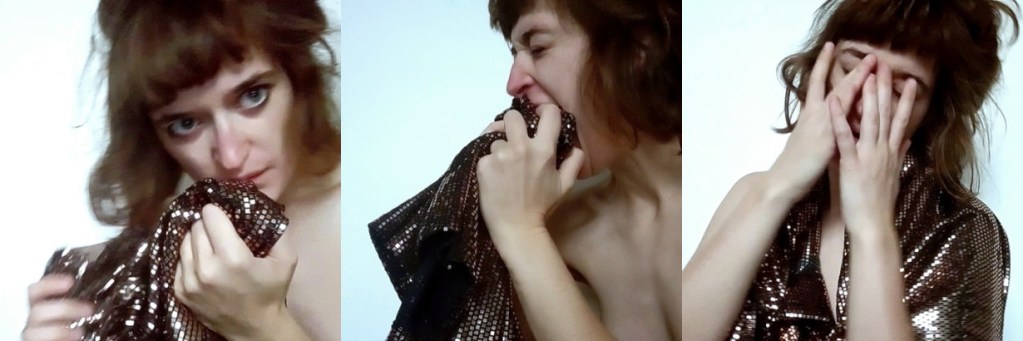
Featured Image ©Pauline Picot : Fig. 1, Fig. 2, Fig. 3: Crazy female poet fiddling with the dress she was wearing at a public reading on October 17th, 2024, during which an audience member diagnosed her with Cotard’s Syndrome.