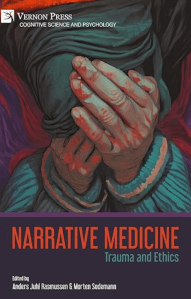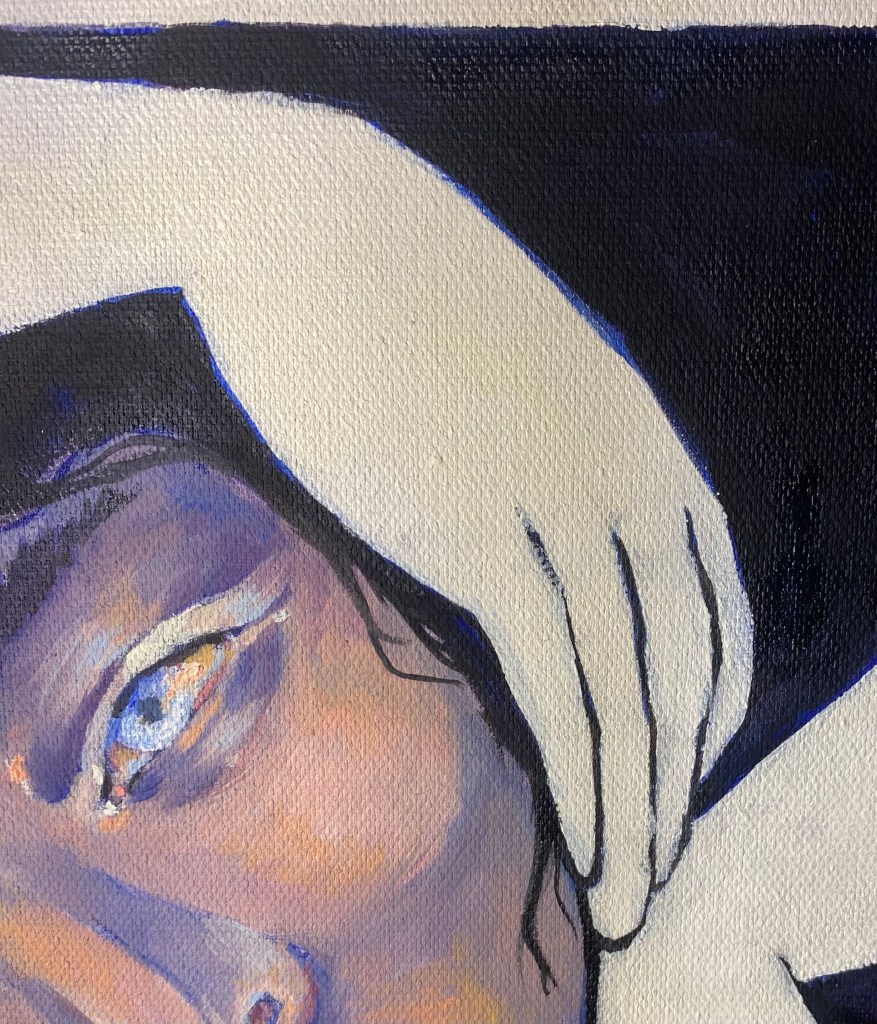
Image: “L’appel du Vide,” by Danielle Wilfand (oil painting).
It’s a long story. You sit in front of me, the neurology resident, face half obscured by the computer, fingers poised on the keyboard. You don’t look up. I can see the gears in your head whirring, piecing together how best to boil down my fragmented story into a digestible presentation you will give to the attending after you leave the room. I haven’t quite figured out how to do that either, even though I lived through it. Even though I’ve had three years to make sense of what happened. You only have the length of a standard new patient appointment – 20 minutes.
I wonder what you read in my chart. How the various specialists I saw during the initial episode and in the years that followed have attempted to spin the tale. Did they start at the beginning?
When my vision started to blur that August, then disappeared altogether at the edges. I first noticed it when I was sitting in the lecture hall during my first block of medical school. Suddenly, I couldn’t read the text on the massive screen even though I was sitting in the front row.
Or was it with the strange neurological symptoms that followed? How a few weeks later my left foot began to feel like it had fallen asleep, then never woke up again. The sensation progressed to broader weakness, and one morning I found I couldn’t flex my left ankle upwards at all. That was the first time I went to a neurologist. I was a woman in my early twenties. Vitamin D deficient. It should’ve been a slam dunk. The archetypal MS story. But the MRIs were spotless. So they changed their tune. It was a functional neurological disorder they said. Then when that didn’t fit, it was just in my head entirely. I don’t blame them. I too went to medical school, learned how to take histories, how to parse out individual symptoms, piece them together, sort them into neat categories until something takes shape. A disease. A syndrome. Anything. I wouldn’t believe me either.
I tried to follow their advice, ignore my symptoms. Pretend they did not exist. But the weakness only got worse, spreading to my left arm and hand. I didn’t know what was real, what I felt and what I did not. Was my arm really weak, did I really feel electric jolts between my toes? Or was I just imagining it? Each symptom murky, so that I couldn’t delineate where the illness stopped and the healthy parts of me began. It was like a ghost. There one moment, but slipping through my grasp the next.
Eventually, my tests were abnormal, though nonspecifically so. Not diagnostic of any one condition but just a general indicator that something was indeed wrong. My symptoms resolved with some prednisone and the passage of time. A nonspecific treatment for a phantom disease. For three years, I searched for answers, stayed up all night reading through research articles, seeking out specialist after specialist. And that’s how we got to where we are now, with you sitting in front of me.
In Arthur Frank’s Wounded Storyteller, he describes three types of illness narrative: restitution, chaos, and quest(1). These narratives aren’t just told by those who are ill, but forms how we understand illness as a whole. These are the narratives we use to develop the language of medicine, how we categorize illness, how we describe it, and how we treat it.
The restitution narrative is the story of illness, treatment, cure (1). It is the preferred storytelling unit of modern medicine. In which disease fits neatly into a predetermined category, with a known course, a known treatment. In which someone gets sick, is given a diagnosis, given a proper treatment, then “triumphs” over their disease (1). Quest narratives are the internalized narrative, the story of the sufferer who reflects on their experience of illness and what it has taught them (1). This too has a place in medicine, as the “patient’s perspective.”
Chaos is the antithesis of medicine, how we learn it in medical school. It is unexplainable, illogical. The collective we – medical providers, patients, society as a whole – don’t seem to like chaos narratives. The reasons are multifaceted and probably buried deeper inside of us than we would like to venture. In her paper Claiming chaos narrative, emerging from silence, Donelly, a professor of English and medical humanities at the University of Colorado,suggests that much of our discomfort in the chaos narrative stems from its divergence from the conventions of Western storytelling: “Stories are sequences with a beginning that introduces character and setting, a middle that includes complicating action and climax (in illness narratives the development of the disease and the progress through it), and a dénouement which is a resolution that resolves ambiguities and questions and conclusion.”(2) We as an audience are not accustomed to interacting with chaos narratives, so we don’t know what to do when we are faced with one.
To have an undiagnosed illness is to exist forever in the chaos narrative. It is to be without a beginning or a resolution. A TV show that has been canceled, never settling the cliffhanger in the last season finale. But it is more than that. Within the medical field itself, this lack of audience acceptance can manifest as epistemic injustice, the de-legitimization of the patient’s testimony. An example of this is how medicine interacts with patients who have fibromyalgia, a condition with an etiology and pathophysiology that remains not well understood (3). Research has shown that patients’ illness experiences with fibromyalgia are often discounted by medical professionals, more so than “high prestige” diseases such as cancer or heart disease (3). Some of this disbelief has been attributed to the conflict between patient testimony and medicine is rooted in the ways evidence-based practice, the basis for modern medicine, can erode other types of clinical knowledge, such as patient testimony (3). Considering that Fibromyalgia is a condition recognized by a majority of providers within the medical field, the sense of de-legitimization must be even more intense for illnesses without a name.
This tension between illness experience and evidence-based medicine highlights a truth innate to many of us in the medical field–we want to know the answer. We want to understand the why and the how of illness, and what we can do to fix it. But sometimes we don’t know, and to placate our discomfort we dismiss what we cannot mold into the models we have learned over our years of training.
How should healthcare providers – really, all of us – become more comfortable with chaos? One solution that has been meaningful to me has been the practice of narrative medicine, both as a patient and as a provider. The practice of narrative medicine was introduced by Rita Charon, who holds a doctorate in medicine and English literature. It harnesses the tools of literary analysis, including the examination of tone, structure, point of view, to better understand the many meanings imbued in the medical stories our patients tell us (4, 5). This creates a way to honor patients’ expertise in their own experience within modern medical practice. Writing my story and engaging with others’ stories has allowed me to create meaning out of a messy, discombobulating time, which for so long had seemed meaningless.
So I answer your questions, repeat my story again, but to new ears and perhaps with better words. You leave and close the door behind you. Maybe you will be the one to diagnose me. Maybe my story will have stirred a long forgotten memory of some rare disease you learned about in medical school and any second you’ll barge back in with the answer I have sought for so long. Or maybe not. Either way, I have found my nook of peace in the unknown.
Citations
- Frank, Arthur W. The wounded storyteller: Body, illness & ethics. University of Chicago Press, 2013.
- Donnelly, Colleen. “Claiming chaos narrative, emerging from silence.” Disability & Society 39.1 (2024): 1-15.
- Heggen, Kristin Margrethe, and Henrik Berg. “Epistemic injustice in the age of evidence-based practice: The case of fibromyalgia.” Humanities and Social Sciences Communications 8.1 (2021): 1-6.
- Charon, Rita. “Rita Charon,“Narrative Medicine: A Model for Empathy, Reflection, Profession, and Trust” The Journal of the American Medical Association 286 (2001), 1897-1902.” Humanitas: Readings in the Development of the Medical Humanities (2015): 207.
- DasGupta, Sayantani, and Rita Charon. “Personal illness narratives: using reflective writing to teach empathy.” Academic Medicine 79.4 (2004): 351-356.