And now there is a hole
Outside and inside
And we are in it, and it is us
Looks like we’re going to live there
From now on [1]
June 24, 2022. Public inauguration of the LBO, a contemporary art center located in the nursing home “Les Blés d’Or” in Chambéry, France. Canapés; distinguished guests making their way among the residents with a glass of sparkling wine; handshakes. Then, during a round table discussion, one of the residents speaks up: “My question is for the artists. Why are you doing this? Why would you come here?” A few of them are there, among the audience. Silence. Finally, one of them answers, uncertainly: “Well, I like making people happy, I guess?” Annoyed silence. That answer is not enough. I hear myself adding: “We all visit places of vulnerability at some point in our lives, whether it’s to take someone there or to go there ourselves. And we should do everything to make the dividing line between these institutions and society more permeable. Art is one of the ways.” I would then become an artist in residence there, from May 2024 until January 2025.
*
I am a writer, a performance artist, and a PhD graduate. For several years now, I have been invited to places that sociologist Erving Goffman grouped under the term “total institutions.” [2] “Part residential community, part formal organization,” they are defined by their “encompassing […] character,” in that “all aspects of life are conducted in the same place and under the same authority.” Including “homes for the aged” and “mental hospitals” (but also army barracks, ships, or boarding schools), “total institutions” function as a coerced “retreat from the world,” “symbolized by the barrier to social intercourse with the outside and to departure,” and where individuals experience forced “batch living.” [3] For my part, I have been giving talks, conducting writing workshops and performing in nursing homes, psychiatric clinics, and prisons. Something in an artist instinctively resonates with these places; it may just be the symbolic connection with the figure of the outcast, that dates back to the Platonic fantasy of banishing poets from the Ideal State. [4] However, the artist has complete freedom of movement to enter and leave those institutions. Neither fully belonging nor completely ostracized, they constitute a hybrid figure of visitor.
In this article, I would like to propose a format that is halfway between a reflective essay on “total institutions” from the perspective of a visiting artist, and a practical guide for future guest artists in those institutions. But first, I would like to point out—as Goffman himself does—that I will consider these institutions together, regardless of moral issues, on account of their many “common characteristics.” [5] They are all places of confinement—and it is noteworthy that the words “jail” and “jailers” are brandished by residents of nursing homes [6] and patients in psychiatric clinics [7] as a metaphor for their constrained lives. They are places of “last resort”: [8] ending up there, on the margins of society, is considered a failure of the functional individual. They are places “that crystallize fears, and are associated with a very negative image,” [9] because they can lead to dehumanization (through restrictions, promiscuity, routine and depersonalization). And above all, they are places “where people’s vulnerabilities converge.” [10] All the quotes I am using, which initially applied to a specific institution (nursing home, prison, psychiatric clinic) will therefore be applicable to all three.
*
Often located on the outskirts of cities (the geographical margin being the corollary of the social margin), the purpose of “total institutions” is to physically distance individuals from the world; to hide those who deviate from the norm, whose dysfunctions we want to ignore. People whose existence we’d rather forget, because they show us a distorted image of ourselves. And within these places, this original divide is reproduced; diffracted almost to infinity:
“[…] interactions between entrance and exit, between interior and exterior, occur around various thresholds, and are tightly regulated […] through an effective combination of physical barriers (locks, doors, guardrails) and face-to-face control (professionals circulating throughout the facility; a receptionist on duty during opening hours).” [11]
In this context, the visiting artist finds themselves in a position that they anticipate to be irritating, since they can move freely through all these spaces, escorted by a representative of the institution who removes those barriers for them, right up to the exit one. Every time I go to the psychiatric clinic, I have the acute feeling that I can leave; that, in fact, I will move on while this place remains standing still. There is always a tear in my heart at this thought, which it would obviously be indecent to mention.
Moreover, the residents did not necessarily have a say in inviting the artist in question. Julien Daillère, the LBO’s second artistic curator from 2024 to 2026, did warn me about this before I started my residency: “You need to be aware that you are coming into their living space; their home. You are imposing yourself on them, and they have no way to escape your artistic proposal.” This choice of words made a strong impression on me, revealing how art could bring additional constraints to an already restrictive environment. In fact, one of the residents at the nursing home told me about an abstract painting hanging just outside her room, saying she hated it because it reminded her of a concentration camp. My response was to propose a project that would take the residents outside, in a symbolic sense. I asked a few of them to tell me about a place they had lost; a place they no longer had access to. I asked them what mission I could carry out for them; how I could be their eyes and hands to celebrate the loss of that place on their behalf. That was the start of “Pleureuse, l’émissaire des lieux perdus” [The Mourner, Emissary of Lost Places].
*
“Total institutions” bring together people who have been knocked out of the fast-paced world, offering them “no possibility of structuring their time and space” [12] and presenting instead an obvious “clash of temporalities” [13] between them and their handling staff. Therefore, they paradoxically find themselves experience both the “dull ache caused by the feeling of time stretching indefinitely” [14], and a certain restlessness caused by the “constraints of institutional schedules (mealtimes, walks, showers, visits, etc.).” [15] In short, the temporality of the institution combines “motionless time” [16] with imposed haste. Furthermore, one must not overlook the “tensions between different time frames” [17] among the residents themselves, who do not arrive and leave (or die) at the same time, which creates a continuous turnover within the stillness. And of course, there is each individual’s perception of the present (often altered by their psychological vulnerability) and, deeper within, the countless layers of their past selves.
Whether leading a two-hour writing workshop or staying for a week-long residency, the artist must adapt to the rigidity of institutional temporality. First, that means not reacting to the staff making them feel the incongruity of a non-essential activity, that requires a “useless” break in a context largely marked by the urgency of various needs. Then, it means adjusting to frequent interruptions (unplanned appointments or treatments, sudden fatigue or emotional distress) which disrupt the supposed sanctity of a shared artistic experience. In March last year, at the Roanne Detention Center, I was having a fascinating conversation with an inmate when the prison guard called her to the visiting room, cutting it abruptly short. One way to navigate these delicate situations is to be mindful of this fragile attunement. As an artist, the only time I can offer to the residents is my own. And my time is the present; the moment I commit to share with them. Nothing exists before or after, neither for me nor for them. Nothing has to. That is why I often plan one-off activities, to protect myself (and other members of the group) from any additional discomfort caused by the expected discontinuity of the moment we are trying to create.
*
As a visitor of these “total institutions,” the artist must more broadly consider the question of their appropriate posture. While art can be a place of self-revelation, a certain reserve seems called for in this particular context. One should not come to these places to expose one’s private life or, worse still, to force already vulnerable people to do so, thereby deliberately imposing them a mechanism of unwanted catharsis. Personally, my own mental health issues always make me doubt my ability to handle these interventions, as I am not always sure that I myself am within the norm; that I am so clearly on the other side. Therefore, I have had to develop strategies in order to preserve both myself and the interaction I am trying to establish with people. For instance, during my intervention at the Lironde psychiatric clinic (near Montpellier) last November, I was offered the possibility of lunch on site. As someone who suffers from an eating disorder, I am unable to eat surrounded by vulnerable people, so I politely declined and explained my situation. During my residency at the LBO, the curator offered me a place to sleep at the nursing home. But I felt I needed to sleep outside, if only to absorb all the emotions of the day and make myself more available for the next one. It took me several years to learn how to deal with those kinds of situations. So, to follow up and conclude this reflection, here is a series of subjective (and friendly) notes that I address to myself—and to the artists who would be preparing to intervene in these institutions.
Do not adopt a messiah complex (“my art will save them”) and believe yourself to be more important than you are. Do not think you are irreplaceable: the institution will continue to function; everything will run just fine without you. Do not make yourself emotionally indispensable to people: try to maintain a healthy distance, knowing that you are only a temporary visitor. As unfamiliar and inspiring they may be, do not steal people’s lives to turn them into art, for they entrust them to you. Do not be naive: keep in mind that we are (also) here to keep people busy; to distract them from their monotonous routine—do not ignore this opportunistic aspect, or you may feel betrayed. Cherish the delicate nature of what you are trying to build with the residents: each time, it will be a tiny victory over adversity. Be a simple visitor: someone who brings food and drinks, even if only in the form of words. And above all, do not think you are immune to those places. One day, you might find yourself going there.
[1] Pauline Picot, « BRACE BRACE », Recours au poème, 29 avril 2023.
[2] Erving Goffman, Asylums. Essays on the social situation of mental patients and other inmates, Garden City, New York, Anchor Books/Doubleday, 1961.
[3] Ibid., p. 3-12.
[4] Platon, La République [The Republic], Paris, GF Flammarion, [c. 375 BC], 2002, books III and X.
[5] Erving Goffman, Asylums. Essays on the social situation of mental patients and other inmates, op. cit., p. 5.
[6] Damien Vanneste, Cédric Routier, Agnès d’Arripe, « Vivre en EHPAD : l’épreuve de la limite, entre transitions spatiales et singularités sous contrainte » [“Living in a Nursing Home: An Experience of the Limit, Between Spatial Transitions and Singularities Under Constraint”], Revue française des affaires sociales, n° 4, 2016, p. 261.
[7] Maxime Floriat, « De l’attente en psychiatrie » [“About Waiting in Psychiatric Care”], Éthique. La vie en question, 2018, p. 3.
[8] Michael Saraga, « Le temps (dé)compté de l’hôpital psychiatrique aujourd’hui » [“The (Countdown) Clock Is Ticking for Psychiatric Hospitals”], L’Information psychiatrique, n° 101, 2025, p. 538.
[9] Ibid., p. 540.
[10] Damien Vanneste, Cédric Routier, Agnès d’Arripe, « Vivre en EHPAD : l’épreuve de la limite », art. cit., p. 262.
[11] Ibid., p. 260.
[12] Maxime Floriat, « De l’attente en psychiatrie », art. cit., p. 2.
[13] Ibid., p. 3.
[14] Ibid., p. 1.
[15] Gwenola Ricordeau, « “Faire son temps’’ et “attendre’’ : Temporalités carcérales et temps vécu dedans et dehors » [“Doing Time” and “Waiting”: Carceral Rhythms and the Experience of Time Inside and Outside Prison”, Criminologie, n° 52, 2019, p. 62.
[16] Maxime Floriat, « De l’attente en psychiatrie », art. cit., p. 4.
[17] Gwenola Ricordeau, « “Faire son temps’’ et “attendre’’ », art. cit., p. 58.
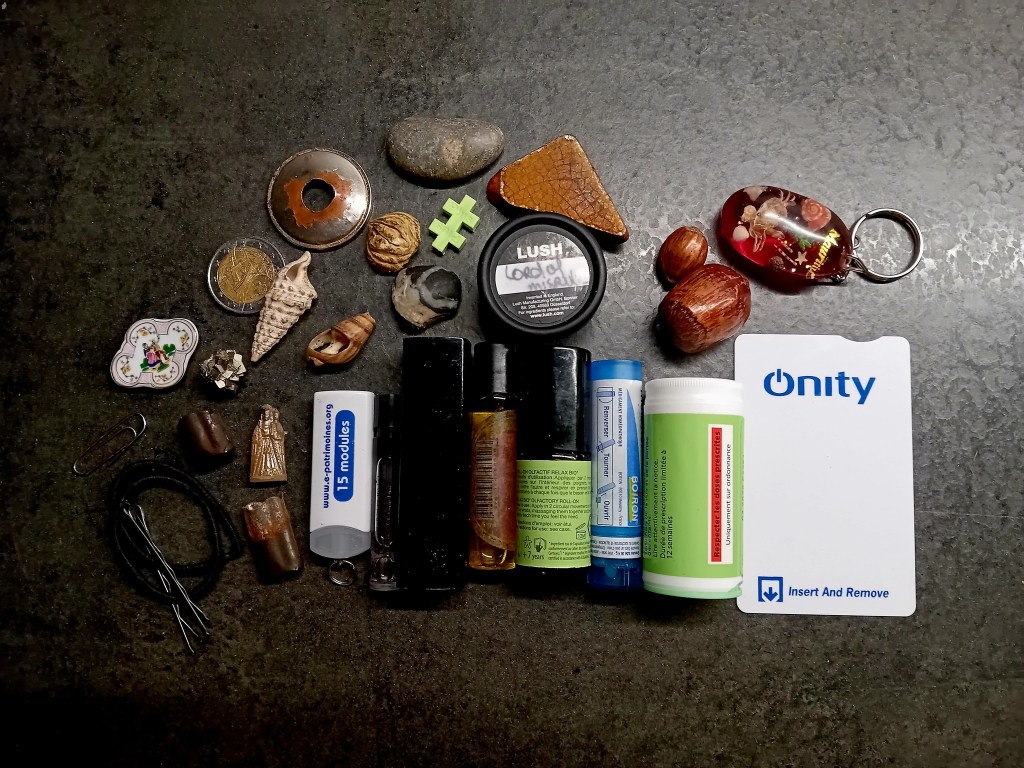
Cover Picture by Pauline Picot. The contents of my purse, which I emptied before giving a talk at the Roanne Detention Center in March 2025. Eventually, they asked me to put my purse in a locker. No matter how well you think you are prepared, you never really are.