What are disability poetics? What does it mean to invoke such a thing? Why should we?
These are questions I’ve been asking myself and my students for most of the year, especially in several reviews I’ve written of works by disabled artists. I always seem to circle around an answer without ever reaching one that sticks. Then again, it’s hard to land on any single gloss when there’s no unified perspective from which disabled poets write in the first place. Of course, this dissimilar similitude—to crib Robert Burton—defines most minority communities, but disability represents something of a limit case. It’s an identity that must contend with—and, in fact, is all the stronger for—its especially large tent, which accommodates everyone from Blind and Deaf individuals to those with nonnormative minds to people who limp or roll about like me.
As mentioned, however, these differences don’t present a new challenge as much as heighten an existing one—of balancing the individual and community—with which other cultural leaders have long reckoned. We might turn, for instance, to exponents of feminist or womanist literature (e.g., Adrienne Rich or Alice Walker); Black Arts (e.g., Amiri Baraka); or verse for the “common life,” as Wordsworth explains in his preface to Lyrical Ballads (1800).
By contrast, no such ars poetica, as prominent or authoritative as these, exists for a disability counterpart. It’s not that theoretical musings are lacking altogether; indeed, there’s Tobin Siebers, on disability aesthetics; Michael Davidson, on a poetics of error; the scholar/writer Travis Chi Wing Lau, on the crip poetics of pain; and fantastic online glosses, from a mixtape by Ashley-Elizabeth Best to the headnote for a “Disability Poetics” collection, by Jennifer Barlett and Sheila Black. But it is true that interest among public-facing critics, or general readers, for anything resembling a crip lit—much less disability poetics—remains curiously low. (It’s a point I’ve previously made for Synapsis. In that piece, however, I was concerned with carefully wrought figures of speech, as they were torqued first one way and then the other. Here, I’m interested, as my title suggests, in more human concerns: those of lived experience.)
So, I keep returning to the question of how we define disability poetics because critical ignorance of our literary culture is not a negligible disinterest: to invoke a legible disability arts movement is to extend cultural authority to our marginalized community, which is too often framed through tragedy alone.
For its part, the present essay does not attempt to account for that disinterest, even if I have my thoughts. Primarily, it’s an experiment in one approach to the question of what a disability poetics might include to start with. It’s an inductive one, beginning with close reading and, in the process, attending carefully to the nuances and granularities of disability experience, creativity, and poiesis—that is, literary making—itself. Or rather, attending to the people and creatures around which these processes swirl. It’s a meditation on how a disabled poet might versify their formation of community, knowledge, and connection with others, in affective bonds distinctly crip. Only then might we finally propose an answer for that critical neglect: these bonds often take the form of close encounters, so near and sheer as almost never to have happened at all—so intimate as to seem merely practical rather than the proper purview of art.
*
To get a sense for what I mean, let’s turn to the book from which I’ve adopted the term close encounters—that is, Close Escapes, a collection of lyric poems by Stephen Kuusisto. Kuusisto is a stalwart of disability literature, whose writing often shines forth the phenomenological kaleidoscope of blindness. I’m most familiar with his memoirs, The Planet of the Blind and Have Dog, Will Travel, but his collection of epistolary verses to Borges, another blind writer, is memorable, too, for its mix of personal poignance and critical verve.
Close Escapes at first seems to pose a formal challenge of higher magnitude. This challenge might be summed up, colloquially, as wispiness: a minimalism of punctuation, syntax, diction, and, length that produces poems like plumes of cigar-smoke. They miraculously, momentarily, flow formally together before dispersing into air. This effect is produced, grammatically, by frequent aposiopesis. But it wasn’t long before I realized that this literary texture of tenuousness did not retreat from Kuusisto’s earlier attention to the realities of disability but intensified it.
This essay focuses on the first of the collection’s lyrics, which sounds broader thematic depths. It begins, “I was alone” (3), evoking someone like Wordsworth at the start of The Prelude, or Dickinson, stereotypically isolated and aloof. And though I was prepared to feel the constraints of poetic set-piece as a result, Kuusisto erects our expectations only to tack in another direction, to particular experience that, as we’ll get to, addresses larger truths. His speaker is traveling, staying in a hotel for the night, “with a radio dog and a glass of water”. (It’s in keeping with the conventions of Close Escapes itself to punctuate outside of the quotes.) The purely practical significance of each item is easy enough to infer, but as the poem continues, broader implications come into focus, nearly in reverse order. It’s the various, unexpected intimacies that each item enables around which Kuusisto’s book—and I’d go so far as to say any poetics of disability—revolve.
To wit: in the context of the next line—“There was a chair a bed the usual hotel furnishings”—that “glass of water” reflects the careful cultivation of crip knowledge: the speaker’s strategy of spatial awareness. For my part, I rarely walk into a room without noting potential trip hazards and the nearest bathroom; Kuusisto, and others with visual impairments, are likely more meticulous still. But this imperative, to scan and secure oneself, never exerts so much pressure that our readerly engagement with the lyric’s speaker curdles into condescending pity. Rather, it generates artistic possibility. It conjures up an observational precision that lends vivacity to a collection where situations shift and narrative occasions remain obscure (leaving readers the ones more disabled, one is tempted to say). What’s more, in weaving a denser texture for crip reality, the poem cleverly invites a typically ableist question: how does a blind person alone in their hotel room know where the water is in the first place? Kuusisto doesn’t specify because, of course, there are many ways—which is exactly the point.
The point being: blindness affords the speaker a closeness with space that paradoxically escapes any sort of sighted stare. No wonder, then, that Kuusisto compels us to follow his speaker’s lead intimately, to trace the competence of a blind man after his connecting flight was canceled, as the hour nears midnight, and as he travels to a dilapidated area of whatever city he’s in, perhaps to give a talk since he’s wearing a “rumpled business suit.” Meanwhile, Kuusisto undermines the cultural stereotype of the helpless, unaware charity case (as this type appears in Wordsworth’s London in The Prelude), and he knows it: “I had to take the dog out I put on her leather harness / Me?” Pitch-perfectly, the parallelism of grammar and syntax magnifies the shock of a rhetorical question that’s shunted to the following line. We’re moved out of the hotel room, then, to a “a parking lot / The only place to take the dog or so I’d been told”, where they stand together in “the nowhere of blindness— / That beautiful nothing with its hope and autonomy and its private song / Shared between man and animal the oldest song on Earth”. Just as the glass of water does more than hydrate, so too, the dog doesn’t simply guide but accompanies, buoying Kuusisto, partly by ensuring his “autonomy.” I mean empowering, volitional, wondrously intimate interdependence—though not necessarily with another human. It’s a moment of caring, meaningful paradox, extended by polysyndeton, that, as the latter line clarifies, also projects Kuusisto far back in time—and that installs disability at the heart of human experience writ large. That is, the speaker is not simply one man with one dog but a poetic common man, partaking in a secularly sacred bond that the appositional grammar of the last line conflates with the work of poetry itself: song.
This song, amid the “nowhere” of blindness—we might say, the originary state of humanity itself—becomes, to use another recurring phrase in the collection, one of its dark joys. The concept speaks to the trials, and unexpected triumphs, of finding delight in, or through, darkness—and, by extension, disability. It’s a discovery that depends on transfiguring the realities of disability into art, and then placing this art at the fountainhead of all others. Audaciously, then, Kuusisto leapfrogs over every previous model of blind poiesis—including the ancient blind bard, which he’s complicated beyond recognition anyway, a la Milton. And he goes so far, even, as to preempt the opening of Genesis itself. In Close Escapes, creation—of verse, at least—begins not with light or Adam and Eve but with a blind person and their companion. From this “nowhere,” all creativity tumbles forth.
Such darkness manifests in a recurring formal construction of the volume: the multiple spaces between words that might otherwise be punctuated with a comma, semicolon, or period. The effect is to mime the halting, but hardly haphazard, gait of a visually, or physically, disabled person by slowing down the reader, forcing us to attune ourselves to the literary surroundings as carefully as Kuusisto’s speaker does to his physical ones. This feature points to a lyrical forebear Kuusisto nearly invokes directly at the start, Dickinson, by cripifying her characteristic em-dash. It’s a transformation that flags another function of the spaces of Close Escapes: they offer us a respite wherein transtemporal crip ancestry can be conjured up and affirmed.
This central aim of the book is first evoked by the radio, a device that not only allows its users to listen to and communicate with voices far away but which staves off the loneliness of being disabled, here and in other poems (“I was too blind for the army / So I stayed home with a radio,” Kuusisto writes elsewhere). Of course, to speak of voices is also to speak of poetry and of books, which have long offered crips, whose bodyminds hive them off from the world, another kind of home. I’m in this company–and Kuusisto is, too.
Indeed, much of the collection is structured around his meditations on the writers most present in his mind; by my count, no fewer than twenty are mentioned (but I’m not good with numbers), until allusion itself becomes the poems’ clearest throughline—a unifying concept for Close Escapes and disability life alike. At the same time, this dense intertextuality reminds us that the literary canon has not only mitigated the loneliness of those who were confined to their homes or institutions but reinforced it, by reinscribing ableist logics that fuel the exclusion of disabled bodyminds in public life even now.
Kuusisto’s response is one of reversal. Not unlike his younger peer, the contemporary poet Robert Macaisa Colgate (as I’ve characterized him), Kuusisto opens familiar literary tropes with the crowbar of material reality, and then inhabits them as his blind, disabled self. We get a sense of this in the first poem, with his romantic bait-and-switch. He is alone, but not really—and certainly not on, say, Westminster Bridge, before everyone else, on September 3, 1802. Nor is there anything supernatural about blindness here—not with the details Kuusisto carefully conveys. Nor is he suffering the misprision of convenient ableist fictions, laying rebukes of these at the feet, even, of such heavy-hitters as Rilke. Referring, perhaps, to “The Blind Man,” he writes, “You saw the sightless men of Paris / Led by crones and children / How you hated them”, having heard their speech only as “low gibberish” and “shivered / At their cataracts”. Yet the poem ends with an invitation, an entreaty: “Here: a blind man’s kerchief / Embossed just for you / With Braille / Touch it …”.
Touch, finally, is the most important resource of blindness for Kuusisto—the thing it most poignantly brings to poetry. We might also call it, as I have: intimacy, which is so rarely twinned with disability at all. (This is beginning to change, however, thanks to the indefatigable work of the late Alice Wong and others.) It’s a special intimacy that crosses otherwise treacherous borders of animacy, species, time period, or life forms, as Kuusisto’s connection with his guide dog makes clear. Their bond becomes a template, and conduit, for other kinds of intimacy throughout the collection when, for example, Kuusisto sings of “the wisdom of trees / And the blind man” who accesses this wisdom by “touch[ing] them.”
The final imperative of Close Escapes, then, is to reconceive of access altogether, not merely as something that must be developed for disabled bodies but something that disability can generate itself—to the intellectual and interpersonal advantage of all. Who knows what we might access if only we embrace the vagaries of disability and, by extension, the fragilities shared among all sorts of bodyminds?
*
But back to where we started: while certainly not an exclusive rubric, close encounters is a helpful one for defining disability poetics since it articulates a spectrum of experiences that constitute the capacious phenomenology of being crip. I’ve argued that many of these experiences have to do with unexpected intimacy: that is, contact with objects or images or means of communication—a radio, for Kuusisto; a cane, for me; perhaps ASL for a Deaf person—that acquire a significance far outsize to their practical effects, that become implements of culture and connection alike.
Many also involve the need to find one’s culture—especially for those of us, like Kuusisto, like me, like so many other crips I know—who grew up, or are surrounded mostly, by ablebodied family members, friends, and peers. Often, we have been taught the tragedy of disabled life from our loved ones or pop culture without also being initiated into its joys.
And many of these experiences revolve, finally, around the contingency of our lives, the sense of barely having made it: barely having entered the building, having made it to the bathroom, having gotten to even the most casual, lowest key of hang-outs. Barely having survived. Barely having escaped nonexistence—and the cultural dearth such a loss would have left to all.“Close escapes” and “close encounters” are perhaps, then, two sides of the same coin; together they reaffirm the miracle, and many dimensions, of crip existence that our art brings vividly to life.
Admittedly, to define disability poetics in this way is, possibly, to say nothing new at all: disabled artists have, for instance, decried the deployment of dead metaphors for years. But the familiarity of these arguments, these poetics, this art within a community of crips is something else, altogether, from the broader acceptance of them out in the wider world. Truths of this kind must therefore be sounded on repeat.
But such repetition serves more than practical ends—more than social awareness or attitudinal change. Indeed, the most important close encounter of all, Kuusisto suggests, is the one between author and reader—in our case, crip and crip, in a dialogue of mutual understanding and assent.
In all my months of rehabilitation after the accident, in all the doctors offices I sat in, all the machines to which I subjected my form, I mourned a future that seemed replete with contact but never actual touch. If only I’d understood a poetics of close encounters then, I might have felt something more than fear. I might have felt hope–that, against all odds, my disability would open up to something like beauty.
Works Cited
Stephen Kuusisto, Close Escapes (Port Townsend: Copper Canyon Press, 2025).
Image Description
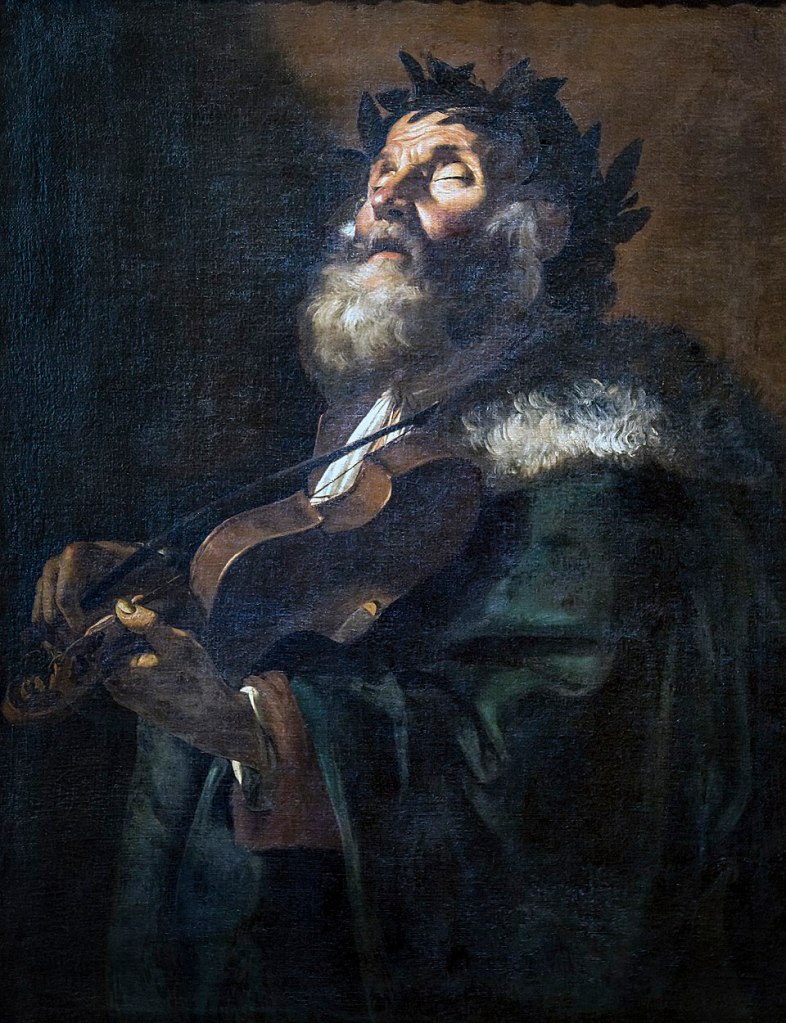
“Homer” by Mattia Preti (1613-1699) – A blind, bearded man, looking upwards, with a lurel wreath on his head, and draped in a heavy, green cloak, is fiddling.
Acknowledgments
My heartfelt appreciation goes to Cody Siegel, my research assistant, for his helpful editorial perspective.