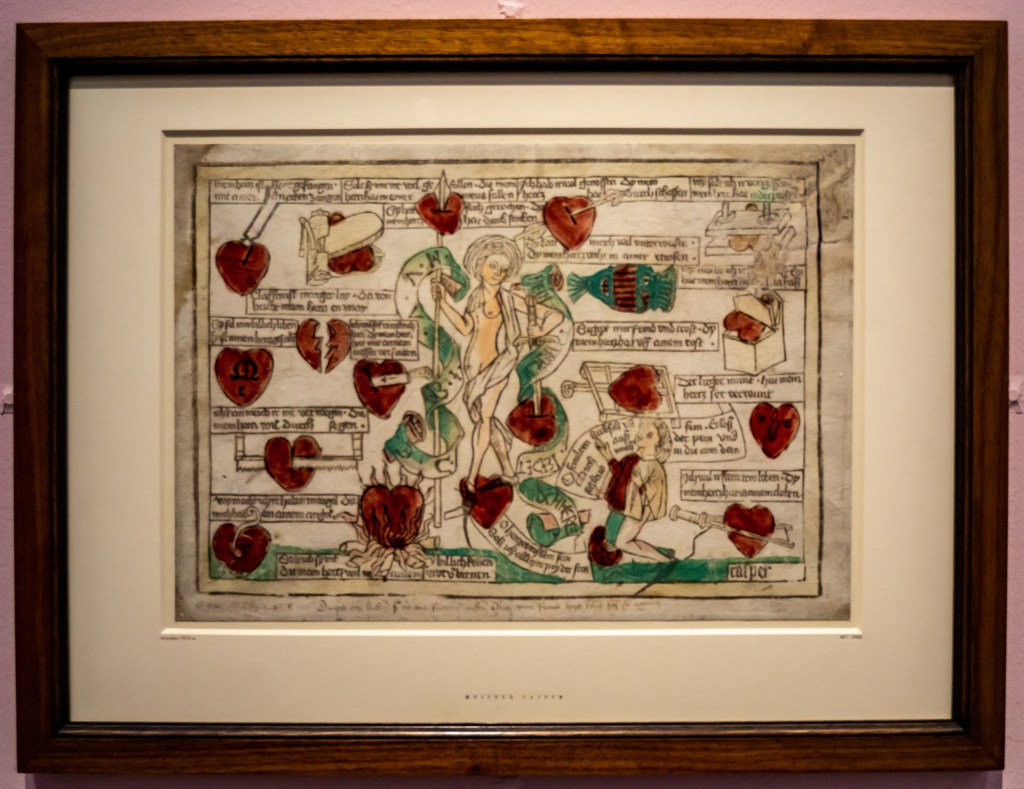
Readers of medieval romance were all too familiar with a common trope of modern romance novels: love is pain. Andreas Capellanus opens his famous twelfth century treatise on romantic love by calling love “a certain inborn suffering,” a malady most commonly afflicting young noble-born men for whom the sight of (and subsequent meditation upon) his beloved’s beauty is a source of pain and illness. Some of these medieval “symptoms” of lovesickness will no doubt resonate with anyone who has ever had a crush: listlessness, a loss of appetite, difficulty sleeping, pining, and an inability to get a person off your mind, even if you want to. The notion that “love hurts” has become not simply a pop culture cliché, but an assumed historical truism. Yet while our somatic complaints about love tend to be global, our cultural and medical understandings of where that pain originates has shifted through the ages.
Well before the codification of something called lovesickness, Ancient Mesopotamians believed the liver to be the seat of the soul, the place from which human emotion and passions derived. Though Ancient Egyptians placed the livers of their mummified dead in jars of those bound for the afterlife, they left the heart in place, believing it to be the place of residence of the soul.
To the Ancient Greek physician Galen, writing at the end of the second century, lovesickness was an affliction of the spirit, what he called “a passion of the soul.” Nevertheless, its impact had very real manifestations upon the body; one suffering from lovesickness would display sleep disturbance, wasting, and pallor, outward signs that would change to flushed cheeks, rapid pulse and breathing in the presence of the beloved. To treat the symptoms of lovesickness, he encourages activity that is both communal and cheerful: public baths, group hunts, and cheerful storytelling (told over a good amount of wine) with companions. Even as he identifies it as an illness of the soul, Galen’s description and treatment of lovesickness suggest a cultural understanding of the strong connection between the spirit and the body.
The eleventh century physician-monk Constantinus Africanus (Constantine the African) called lovesickness eros, (later corrupted to “heroic love”) and referred to it as a “disease touching the brain.” Constantine’s knowledge reflects a multicultural, multifaith understanding of human health, as he translates into Latin his Viaticum, originally a 10th century Arabic text by the physician Abu Ja‛far Ahmad ibn Ibrāhīm ibn abī Khālid al-Jazzār, who himself was a student of the of the Jewish physician Isaac Israeli ben Solomon (Isaac Judaeus to Europeans). In these early medieval texts, lovesickness is the product of imbalanced humors– specifically, an excess of black bile– which can cause frenzy, mania, and something like insanity in the estimative cell of the brain. An ancient understanding of the body that persisted well into the early modern period, humoral theory conceptualized the body as being comprised of four substances derived from the four elements that comprised all matter; these were blood, yellow bile, phlegm, and black bile (corresponding to air, fire, water, and earth, respectively). Black bile, a cool, dry humor, was responsible for melancholy, a condition whose symptoms overlap with modern descriptions of clinical depression, and which, untreated, could have devastating physical consequences. As a cure for lovesickness, Constantine looks to the Ancient Greek physician Rufus of Ephesus, who encourages sexual intercourse, even if it is with someone the patient does not love, as a means of expelling the excess black bile and restoring the body to balance.
Medical advice aimed at rebalancing the humors recognizes a holistic understanding that premodern cultures had about the body. Medical and literary texts of the Middle Ages underscore an understanding of health as being a result of the non-naturals, which included diet, exercise, sleep, air quality, and emotional regulation. Disruption of any of these could lead to humoral imbalance and, in turn, bodily illness. Through the ages, lovesickness is overwhelmingly an affliction of young men of noble birth, in whom the hot tempered nature of youth and an aesthetic appreciation of beauty could create the perfect storm leading to eros. When the accumulated black bile was warmed by the naturally hotter temperament of a young man’s body, the sooty fumes produced were believed to rise up to the brain and engulf its imaginative cell; the result was as a kind of temporary madness or frenzied state. This could lead to dark thoughts, manic moods swings, and even an inclination toward suicide. Thus we see lovesickness described not only as a disease of the mind that could result in negative effects on the body, but also an illness whose physical manifestations could poison the brain and affect the spirit.
By the twelfth century, French physician Gerard of Berry distinguished between aspects of lovesickness that belonged to the soul (depressed thoughts, an inability to concentrate on topics not related to the beloved) and those that belonged to the body (dried out, sunken eyes from excessive tears, disordered pulse rate, and frequently changing moods). While recognizing that the disease “cannot be be perfectly cured without intercourse,” he also acknowledges the “permission of law and faith.” As such, Gerard first suggests bloodletting or other forms of purging to his patient, alongside proper sleep, baths, and pleasant aesthetic distractions (including wine) before resorting to intercourse.
As the late fourteenth century saw an explosion of popularity in vernacular medical texts, non-Latinate readers began to have access to health regimens; so, too did they begin to see lovesickness portrayed in literature written in their own native tongue. Lovesickness was a common trope in French and English chivalric romances. In these poetic accounts written for noble lords and ladies, a lover’s ailment would be legible on his body, marked by deep sighing, swooning, and turning pale in the company of his beloved. One particularly notable example occurs in Chaucer’s Canterbury Tales, when the Knight paints a viscerally detailed portrait of lovesickness as suffered by one of his protagonists, Arcite:
Bereft he was of sleep and meat and drink
That lean he grew and dry as a shaft, I think.
His face was sallow, all pale and ashen-cold
And solitary kept he and alone,
Wailing the whole night long, making his moan
And if he heard a song or instrument,
Then he would weep ungoverned and lament;
So feeble were his spirits, and so low,
And so changed was he, that no man could know
Him by his words or voice, whoever heard
And in this change, for all the world he fared
As if not troubled by malady of love,
But by that humor dark and grim, whereof
Springs melancholy madness in the brain
And fantasy unbridled holds its reign.
And shortly, all was turned quite upside-down
Both habits and the temper all had known
Of him, this woeful lover, Dan Arcite. (Chaucer, 503-521)
Left untreated, the lovesick knight becomes unrecognizable, his body transformed from the inside out. His troubled, depressed mood and wasting body showcase lovesickness, an affliction of the heart spreading to the brain and poisoning the body.
Throughout history, then, the “source” of lovesickness is wont to shift, from the liver to the heart, and even touching the eye. In Ancient Greek and Western Medieval understandings of emotion, the eye proved especially vulnerable since it was believed that illness could enter the body through any open orifice. Those who fell in love at first sight were said to have been struck through the eye by the beauty of their beloved– or, as Chaucer’s Knight says of Arcite,
He cast his eye upon Emiley/ and doing so he blanched, and cried out “Ah!” as though he were stung through the heart. (Chaucer, 219-221).
Simultaneously, lovesickness is just as likely to be treated as an affliction of the soul or the spirit, locating it at times in the brain or more abstractly, in the mind, positioning it, by turns, as a spiritual, psychological, or somatic affliction.
Today, twenty- first century poets, filmmakers, and popular songwriters describe unrequited love mainly as an affliction of the heart, but also one whose effects touch other parts of the body as well. In her lead single for Emerald Fennell’s Wuthering Heights film, singer Charli xcx likens the so-called “Chains of Love” to the feeling of burning, drowning, puncture wounds, lacerations, and suffocation, something that has the potential not merely to shatter the heart but also to wound the flesh and choke the very life from the body.
Though despite our tendency to think of lovesickness more as a metaphor than a literal reality, modern medicine has shown that, in various ways, love has a very real somatic impact on the brain and, in turn, the body. What the poets of old might have described as being struck by Cupid’s arrow, modern psychology calls limerence, a state of obsessive infatuation felt by one person toward one who is little more than a stranger. Though the term resurfaces on social media every now and then as therapy speak for a crush that feels overwhelming, limerence has been recognized as a psychological affliction with the potential to disturb both mental and physical wellbeing. Psychologist Dorothy Tennov coined the term in the 1970s, parsing it from romantic love or sexual attraction by highlighting limerence’s obsessive, painful and often involuntary nature.
Even the healthiest reciprocal crushes have a physical impact on the mind and body. In a 2015 study, MRI scans of college students who reported recently falling in love showed increased brain activity in the caudate nucleus and the ventral tegmental area, zones of the brain associated with “reward detection and expectation and the integration of sensory experiences into social behavior,” and “pleasure, focused attention, and the motivation to pursue and acquire rewards,” respectively. Rather than black bile, the endocrine system produces a cocktail of hormones responsible for affective responses. Instead of the liver housing an individual’s passion, adrenal glands sitting atop the kidneys cause cortisol, the so-called “stress hormone,” to spike. When an individual in love gazes upon or even thinks about the object of their affection, dopamine production in the brain and gut increases. The resulting somatic response is a familiar one: increased heart rate, sweating, loss of appetite, rapid breathing, flushing of the cheeks, and dilation of the pupils. Even “heartbreak” might not be as metaphorical a term as we have previously thought; cardiologists also call Takotsubo cardiomyopathy “broken heart syndrome,” a transient abnormality in the heart’s left atrium’s that can manifest with symptoms that mirror myocardial infarction (MI) or heart attack. Some studies have reported a higher rate of Takotosubo syndrome in those who have been recently widowed.
So even if we cannot answer the questions of where loves comes from or why it hurts, we might take comfort in knowing that we are hardly alone in our suffering– and that while the advice for self-care often offered to the lovesick– a good book, cathartic music, warm bubble baths, and even wine– might not be medicinal per se, they are part of a longer tradition for treatment and recovery from lovesickness from many, many years ago.
Works Cited:
- Chaucer, G. “The Knight’s Tale,” The Canterbury Tales, Ed. Sinan Kökbugur, 1997. Librarius. http://www.librarius.com/canttran/knighttrfs.htm.
- Edwards, S. “Love and the Brain,” On the Brain, Spring 2015. Harvard Medical School. https://hms.harvard.edu/news-events/publications-archive/brain/love-brain
- Seshadri KG. “The neuroendocrinology of love,” Indian Journal of Endocrinology and Metabolism, July/August 2016; 20(4):558-63. https://doi: 10.4103/2230-8210.183479.
-
Wack, MF. Lovesickness in the Middle Ages: The “Viaticum” and Its Commentaries. University of Pennsylvania Press, 1990. http://www.jstor.org/stable/j.ctv4rfv4g.
- Zeki S. “The neurobiology of love,” FEBS Letters, May 2007. https://doi.org/10.1016/j.febslet.2007.03.094
Further Reading:
- Amin HZ, et. al. “Takotsubo Cardiomyopathy: A Brief Review.” Journal of Medicine and Life. Jan-Mar 2020;13(1):3-7. https://doi: 10.25122/jml-2018-0067.
- Capellanus, A. The Art of Courtly Love, trans. John Jay Parray. Columbia University Press, 1941.
- The Cleveland Clinic, “Limerence: The Science of Obsessive Attraction,” Health Essentials. November 2025. https://health.clevelandclinic.org/limerence
- Efferth, T, et. al. “Broken heart, tako-tsubo or stress cardiomyopathy? Metaphors, meanings and their medical impact,” International Journal of Cardiology, Vol 230; 2017. 262- 268. https://doi.org/10.1016/j.ijcard.2016.12.129.
- Kalas, L. “Being lovesick was a real disease in the Middle Ages,” The Conversation, February 2017. https://theconversation.com/being-lovesick-was-a-real-disease-in-the-middle-ages-70919
- Lippi D. “Arrhythmias in the History: Lovesickness.” Cardiac Electrophysiology Clinics. Sept. 2017. 341-344. https://doi: 10.1016/j.ccep.2017.05.008.
- Raypole, C. “15 Ways Love Affects Your Brain and Body,” Healthline, August 2020. https://www.healthline.com/health/relationships/effects-of-love.