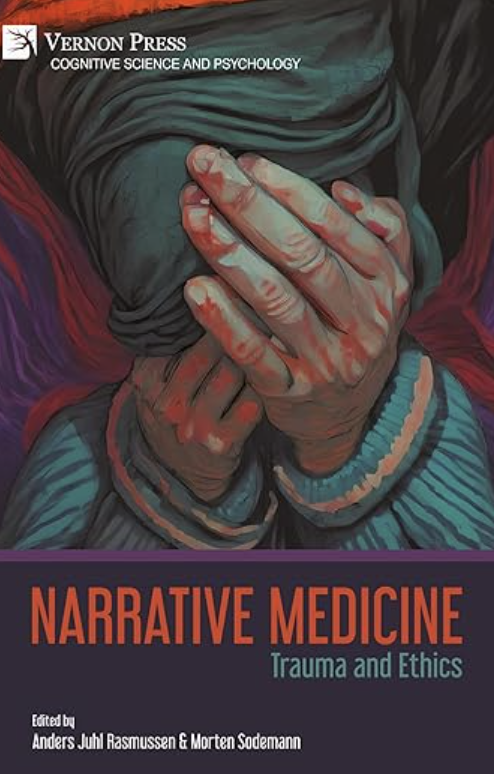
The co-editors of Narrative Medicine: Trauma and Ethics, Anders Juhl Rasmussen and Morten Sodenmann, open their introduction with their goal for this text: to “reposition narrative medicine with trauma studies and ethics in a global context” (xv). The book contains 20 chapters from scholars of medicine/healthcare, narrative medicine, trauma-informed care, ethics, literature/writing, philosophy, anthropology, arts & media, psychology, and disability studies, among other areas of expertise; the book is global and multicultural, with authors hailing from 4 continents and many countries. Though broad in scope, the chapters coalesce around the editors’ stated theme so that the book feel like a cohesive whole. For the reader’s ease, the book is divided into 3 parts: Autoethnographical Research; Narrative Methods and Ethics in Trauma Care; and Studies of Aesthetic Trauma Narratives.
The goal of the first section, Autoethnographical Research, is stated to be “stories [that] are related to lived experiences of trauma, but not necessarily restricted to that experience…. [to] help our readers to realize how pervasive trauma is in our world, and how we can can understand our responsibilities in the fact of trauma” (xxiv). This is the shortest section of the book, made up of just 3 chapters, and is one of the most experience-near parts of the text. It begins with Annmaree Watharow, Sue Joseph, and Georgia Fagan’s discourse on the trauma experiences of people living with disability (PLWD) and the ways in which the spaces set open to hear their stories can be made more inclusive and, thus, more ethical. The following two chapters– one by Sarah Pini and Lillian Wilde about using embodied narratives to understand and communicate about trauma and the illness experience, and the second by Astrid Joutseno about the grief of one’s own terminal illness– both draw upon lived experiences of cancer. Taken together, these three chapters meet the lofty goal of demonstrating the ways in which trauma can both be a wide-reaching part of being human and also how the right conditions and space for storytelling can make a profound impact on those who are experiencing it.
The second part of the book, Narrative Methods and Ethics in Trauma Care, is subdivided into sections on those pieces which are “health care-centered” (Part 2.1) and those which are “patient-centered” (Part 2.2) but connected based on their focus on applied methods of narrative medicine in trauma-informed ways. Part 2.1, as promised, focuses primarily on those who are practitioners in the healthcare system. This includes John Launer’s chapter on clinicians providing supervision for “multi-professional supervision groups attended by practitioners sharing narratives of encounters in their work they have experienced as traumatizing” (41); Colleen McMillan and Aaron Smith’s writing on the accumulation of “small traumas” in the scope of a clinician’s regular caseload– things like “relational ruptures… losses, grief and abandonment” (53)– and the ways in which space must be made for both what we might call lowercase t trauma in addition to capital T trauma; Elizabeth Lanphier’s suggestions for making the class narrative medicine workshop a more trauma-informed space for learners; and Mark Celinscak’s dive into how the British medical professionals who took care of Holocaust survivors immediately after Bergen-Belsen was liberated talked and wrote about those for whom they were caring.
Part 2.2 approaches the patient experience from the provider perspective (as opposed to the patient perspective found in Part 1). Oddgeir Synnes and Hilde Bondevik share reflections on the creative writing workshops they co-led for patients impacted by cancer at an Oslo hospital– “examin[ing] in what way reading and writing in the setting of a cancer hospital can open towards repair, of finding a voice, re-enchantment and affiliation to the world and others” (91); Jacob Y. Stein and Rivka Tuval-Mashiach share ideas on the ways in which the structure and application of qualitative and narrative research can be applied therapeutically in the wake of traumatic experiences through the lenses of hermeneutics and phenomenology; and Emma McKenzie composes a chapter about the ways in which the language and imagery of horror are used to depict both the experience of living with and being treated in a psychiatric hospital for mental illness. Together, these parts offer both critique and ideas for furthering the ethical frameworks that guide narrative medicine and narrative practice as they affect the care of those who have experienced trauma.
The third and final part of this collection, Studies of Aesthetic Trauma Narratives, is the longest section of the book and is subdivided between chapters focusing on the therapeutic and analytical objectives of the authors’ work. Where previous sections largely focused on lived patient and provider experiences, this one spends more time with media portrayals and the ways in which those reflect and inform larger conversations about the narratives of trauma. Part 3.1, the Therapeutic Objective, begins with Ssanyu Birigwa and Molly Lindberg’s analysis of the TV series I May Destroy You which depicts multiple types of trauma; Ricardo Rato Rodrigues’s chapter moves to the written word and the writings of Portuguese author António Lobo Antunes and British novelist Patrick McGrath, both of whom write about trauma from the perspective of psychiatrist-narrators; T.S. Kavitha and Mahesh Sharma compare and contrast notions of healing and cure in well-known cancer-centered books The Emperor of All Maladies and The Fault in Our Stars; and Preeti Puri and Shefali use the graphic novel The Parakeet as the axis of discussion about the combined utility of “verbo-visual narratives [to] facilitate trauma patients to testify their suffering” (165).
Part 3.2, the Analytical Objective, is opened by Mona Baie’s close reading of Two Kinds of Decay to “explore the traumatic experience of illness as well as the (im)possibility of its representation through language (182). This is followed by Brooke Covington’s argument for the use of a critical race theory (CRT) lens when telling and listening to narratives of trauma in medicine and the inclusion of “counterstorytelling” (191); Victoria Sampson on her personal experiences of loss and the narration of that loss through self-reflective journaling, situated within Black feminist decolonial theory; Margaux Danby’s close-watching and reflections on the television show Watchmen and its ability to bring together echoing moments in history; Nora Simonhjell’s analysis of the Norwegian novel Tingenes tilstand and the ways in which it writes of the physical manifestations of trauma; and Hannah Ming Yit Ho’s dive into the book The Witch Doctor’s Daughter and the ways in which traditional healing practices and religious expectations can conflict and coexist. Together, these chapters offer a broad picture of the ways in which narrative, medicine, and trauma are depicted across the globe and across visual and written media.
As a whole, the authors all write with clarity and expertise about their areas of study/focus and, while situated in different types of relationships to the field of narrative medicine—some are direct scholars or professors in the field, while others come at it a bit more tangentially—are clearly dedicated to the improvement and expansion of the field. I suspect that each reader will have different chapters that most speak to them based on their own fields of study and work, but would imagine that most scholars in the field of narrative medicine would find something of resonance throughout the tome, which is a testament to the overall quality and diversity of the work. This diversity made for a varied and interesting read, especially as the editors’ division of the book into thematic categories supported that heterogeneity. It is important to note that despite some discussion in the editors’ introduction about this book being a space for critiquing narrative medicine, the work’s suggestions are more for the future of narrative medicine than an examination of its roots. This was verbalized well in Arthur W. Frank’s afterword where he points out a few important caveats about narrative medicine foundationally, such as the use of the term “patient narratives,” which reinforces that the field is one very much of medicine. As this book’s audience is practitioners and scholars in the field, this isn’t a deficit, but is an important frame.
Overall, this book is a nice contribution to the literature about narrative medicine. It pushes the conversation forward in a direction that is needed; as the vast majority of the global population interacts with their local healthcare system in some way, an attunement to trauma-informed practices and the ethical implications of narrative medicine is ever more necessary.
Disclaimer
Rishi Goyal, Synapsis editor, wrote the foreword for this book; he has not impacted the content of this review or been part of its editing/publishing process. Note also that Molly Lindberg, one of the chapter authors, is a regular Synapsis contributor.
Citation
Anders Juhl Rasmussen and Morten Sodenmann. Narrative Medicine: Trauma and Ethics. Vernon Press, 2024.