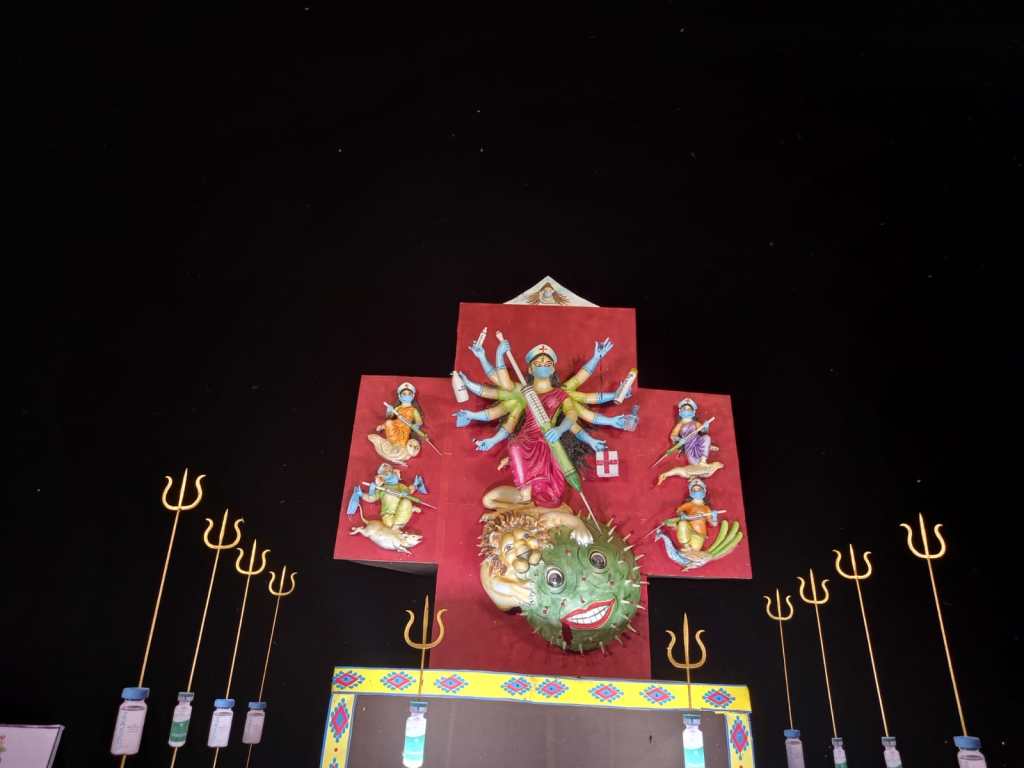
There was a time, not long ago in the Spring of 2021, when “immunity” became the topic du jour: spoken at dining tables, whispered over phone calls, forwarded in remedies and rumours. It slipped, almost unnoticed, from the clinic into the intimate grammar of everyday life. Immunity started to organise how one imagined proximity, obligation and care. Looking back now, from the uneasy distance of five years, what lingers is not only the memory of the crisis but also the language that made it legible. Immunity promised protection but it also drew lines: between bodies that could withdraw and those that could not, between lives that were secured and those that remained exposed.
This essay treats immunity as a concept that has travelled across languages, disciplines and histories and acquired meaning through acts of translation. In the South Asian context, as Projit Bihari Mukharji—a notable historian of anti-colonial science—demonstrates in Nationalising the Body (2009), colonial Bengal witnessed a dense traffic of ideas in which epidemic disease, environment and bodily disposition were articulated through overlapping vocabularies of medicine, morality and force. Within this vernacular medical archive, Mukharji shows that shakti—articulated as jeevanishakti or pratirodh shakti—emerged in colonial Bengal as a vernacularised “vital force” located within the body (137-140). This vernacular articulation of “vital force” mediated susceptibility to and resistance against contagion through a synthesis of Ayurvedic thought and modern medical discourse. This conceptualisation demonstrates that the translation between sacred vitality and biomedical immunity has been historically embedded in South Asian epidemic imaginaries.
This essay is an attempt to explore Udayan Mukherjee’s short story “A Shelter from the Storm” (2021) about the conceptual tensions of establishing and unsettling what counts as immunity. Written during the pandemic, this short story is set in a Bengali upper-class mansion whose giant doors are opened to poor, lower-caste migrant labourers despite social distancing restrictions. If immunity became, during the pandemic, a way of organising life, I ask what it might mean to reimagine it otherwise: not as the defence of the self against the world but as something that emerges, precariously, in the act of remaining open to it.
Immunity, Contagion and the Vernacularisation of Medical Knowledge
Modern immunity, as Roberto Esposito argues, protects life by instituting a boundary between the self and what threatens it. It functions through negation: to live is to defend oneself against intrusion (2013, 11). This logic, while grounded in immunology, produces graded exposure, which shields some bodies while others remain perpetually vulnerable. The COVID-19 pandemic made this starkly visible in India, where the capacity to isolate mapped onto caste and class privilege, while labouring bodies—Muslims, migrants, northeastern populations—were rendered suspect and read as sites of risk (Menon 2023, 142). This perception resonated with longer histories of caste in Indian sociopolitical terrain, where certain bodies, already marked as polluting, are perceived as vectors of contagion (Sukumar and Menon 2023, 140-145). To be immune during the pandemic was, implicitly, to be distant from those whose labour sustained everyday life but whose proximity now appeared dangerous.
Mukerjee’s narrative complicates the terms through which contagion is understood. The story turns our attention to the female domestic workers who extend shelter and food to stranded migrant workers. This act, perceived within the biomedical logic of immunity, appears irrational. They breach the boundary that immunity seeks to maintain. The question, then, is not whether these acts are safe but what they reveal about the limits of a model of immunity that can only imagine protection through separation. What if the very bodies marked as risky are also the ones that sustain life? What if exposure is not merely a failure of immunity but a condition through which other forms of resilience emerge?
Mukharji’s work demonstrates that the history of epidemic thought in South Asia cannot be reduced to the importation of such biomedical frameworks. Colonial Bengal witnessed what we might now call a vernacularisation of medical knowledge: a process through which concepts like contagion, miasma and later germ theory were translated into existing linguistic, cultural and philosophical vocabularies (133). This translation was mediated by Bengali medical practitioners or daktars. Mukharji conceptualises the daktars as a heterogeneous, socially recognised group who practised Western medicine while operating across uneven educational, social and epistemic terrains (7). As he notes, their identity emerged in the shifting space between self-fashioning (through medical texts, journals and claims to expertise) and popular literary representation, producing a vernacular medical subject whose authority was negotiated as much in the marketplace and public imagination as in formal institutional structures (15). These daktars produced hybrid explanatory frameworks in which disease could be understood simultaneously as environmental, moral and physiological.
In nineteenth and early twentieth-century Bengali writings on health and vitality, notions of bodily strength were frequently inflected by shakti, reimagined as both a divine abstraction and a quality that could be cultivated through discipline, diet and moral conduct (144). These translations did not collapse shakti into biology but they rendered it bodily—something that could be inhabited, practised and shared. This has two important implications. First, it destabilises the binary between “scientific” and “religious” knowledge. Shakti, here, exceeds mere theology and becomes a conceptual bridge through which new medical ideas are rendered intelligible. Second, it reframes contagion itself. Rather than a purely negative process of infection, contagion also acquires, as Mukharji calls it, a productive dimension that generates new social relations, identities and forms of response (175).
From Sacred Force to Embodied Practice: Rethinking Shakti
In “A Shelter from the Storm,” shakti is enacted through the bodies of domestic workers who expose themselves to potentially contagious migrant workers to sustain them. The shift in shakti from sacred force to embodied practice marks a movement from transcendence to immanence. Far from being limited to divine iconography, shakti is dispersed across acts of care while also carrying its earlier undertones of divine connotations. As Mukharji shows, colonial medical writings often drew on religious imagery—invoking figures like Kali to describe epidemic forces or equating care with moral and even spiritual duty (166-169). His studies demonstrate that the sacred was never fully separate from the medical but was continually translated, reworked and embedded in new contexts.
“A Shelter from the Storm” extends this trajectory into the present through a carefully staged spatial and sensory scene. The narrative illustrates how the labourers are categorically separated: men in one room, women and children in another. Such partitioning appears, at first glance, to reproduce the logic of biomedical immunity—the management of bodies through controlled exposure. Yet the story unsettles this reading through the way the men’s space is described. The men are allocated in a hall that once housed the altar of the goddess Kali. As the narrative unfolds, the windows are opened and the hall is “brought into light” (Mukherjee, 151) as if something latent is being reactivated. Within Hindu theological traditions, light symbolises a sign of presence—of darshan, the moment of seeing and being seen by the divine, and of prakāśa, a principle associated with illumination, revelation and consciousness itself, as elaborated in Śaiva and Vedantic thought (Clooney 1996, 301; Kramrisch 1981, 80). In this sense, the entry of light into the hall reanimates it as a site of potential sacred encounter. The absent-yet-present altar, the residual sacredness of the space and the influx of light together produce an atmosphere charged with shakti, evoking an immanent and sensorial force that reorganises perception and reorients the bodies gathered within it.
The men’s entry into this space is narrated with an almost ritualistic stillness. One of the servants imagines himself as a “general-lieutenant” directing the migrant labourers to “start moving in a line towards the room” (Mukherjee, 153), transforming the act of sheltering into something strangely ceremonial and disciplinary at once. The men then “walked in quietly and sat down on the floor. Almost on cue” (153). The sentence carries an eerie theatricality. Their bodies appear choreographed, subdued by exhaustion, fear and the authority of the mansion itself. Yet with their entry, the narrator suggests that something else is also returning: the “old spirits” of the household (153), invoked alongside the lingering power of the Goddess. The hall no longer functions merely as a quarantined enclosure. It becomes a charged contact zone where caste-marked bodies, pandemic anxieties and residual sacred energies uneasily converge.
This is where the story resonates deeply with the history traced by Mukharji’s accounts, which demonstrate how shakti exceeded the sacred space and entered vernacular medical discourse, where epidemic phenomena, environmental conditions and bodily predispositions were articulated through overlapping registers of power, morality and vitality. “A Shelter from the Storm”, thus, serves as a contemporary reactivation of this layered conceptual field. Through the representation of the migrant men and women, whose bodies are already coded within pandemic discourse as potential carriers, the story places them in a space historically associated with the embodiment of shakti. Their bodies, previously marked as sites of contagion, are now exposed to a different order of force.
The gendered dimension of this scene is crucial. Unlike conventional gender discourse that aligns the female body as a site of divine embodiment, the men’s bodies become the sites upon which this force is symbolically inscribed. This redistribution complicates any straightforward association of shakti with feminine empowerment. Instead, shakti appears here as a circulating force unevenly distributed across gendered bodies. Nevertheless, the transformation of shakti from the sacred to the profane also compels us to ask what is at stake when shakti enters the modern biomedical domain of immunity.
Care and the Afterlife of Immunity: Conclusion
Modern biomedical immunity initiates a form of radical profanation by stripping away the metaphysical dimensions of vitality and reducing it to measurable resistance, to antibodies and to thresholds of infection. What is lost in this process is precisely the sense of force as relational and environmental. By placing male bodies within a space once occupied by the altar of Kali and by suffusing it with light that evokes shakti, “A Shelter from the Storm” stages a moment in which the residual presence of the sacred unsettles the profaned concept of immunity. The men are not simply protected or contained but they are re-situated within a field of force that exceeds biomedical intelligibility.
What, then, does it mean to rethink immunity through this layered history of translation? In “A Shelter from the Storm”, the female workers’ action of ushering the migrant labourers into the mansion challenges the idea that safety lies in separation. They reveal that life is sustained through interdependence, even when such interdependence is risky and unevenly distributed. Their action echoes Leonard Boff’s notion of care, which he describes as man’s fundamental ethos and “an indispensable compassion for all human beings” (2008, xi). This “ethos” fosters synergy, reconnection and mutual benevolence, going beyond merely protecting one another or seeking validation through self-assumed importance (20). This does not mean abandoning the insights of biomedicine. Vaccines, public health measures, and epidemiological knowledge remain crucial. But Mukherjee’s narrative and the vernacular histories traced by Mukharji invite us to question the limits of a model that prioritises defence over relation.
To frame this in terms of contemporary medical humanities, the story contributes to an emerging field of vernacular medical humanities, which resists the universalisation of biomedical categories and insists on their cultural and historical specificity. By placing immunity in dialogue with shakti, I foreground an inherent fault line in immunity. Immunity, as a modern concept, seeks to stabilise the boundary of the body. Shakti, as it travels through colonial and contemporary contexts, destabilises that boundary, foregrounding the body’s entanglement with its environment and with others.
Five years after the pandemic, this tension remains unresolved. The inequalities that shaped exposure persist. Revisiting Mukherjee’s “A Shelter from the Storm” provides a way of thinking otherwise—through care, through relation and through the fragile persistence of life in conditions that exceed the logic of immunity.
References
Boff, Leonardo. Essential Care: An Ethics of Human Nature. Translated by Alexandre Guilherme, Baylor University Press, 2008.
Clooney, Francis X. Seeing through Texts: Doing Theology among the Srivaisnavas of South India. Albany, New York, State University of New York Press, 1996.
Esposito, Roberto. Terms of the Political: Community, Immunity, Biopolitics. 2008. Translated by Rhiannon Noel Welch, Fordham University Press, 2013.
Kramrisch, Stella. The Presence of Śiva. Princeton, New Jersey, Princeton University Press, 1981.
Mukharji, Projit Bihari. Nationalising the Body: The Medical Market, Print and Daktari Medicine. Anthem Press, 2009.
Mukherjee, Udayan, editor. “Shelter from the Storm.” Essential Items and Other Tales from a Land in Lockdown. New Delhi, Bloomsbury, 2020, pp. 111-135.
Sukumar, N., and Shailaja Menon. “The Unwanted Citizen: Dalit Precarity and the Pandemic in India.” Coronasphere Narratives on COVID-19 From India and Its Neighbours, edited by Chandan Kumar Sharma and Reshmi Banerjee, Routledge, 2023, pp. 134-146.
Header image: An image of a themed Durga puja in the Indian state of West Bengal in 2021. It recasts Durga’s battle against evil as a struggle against the coronavirus, mobilising Shakti as a symbol of immunity, protection and collective resilience. Author’s own photograph.