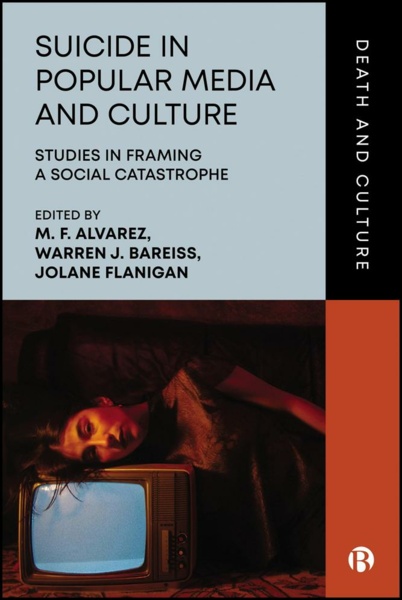
Suicide in Popular Media and Culture: Studies in Framing a Social Catastrophe responds to a particular mode of cultural interpretation that frames readings of death beyond the physical and more as an enactment of societal norms. The anthology aligns with the concerns of the Death and Culture series by centering its theme on suicidology and how this plays out in media in multifaceted ways. The authors’ attempt to locate suicide within its historical context as it has been explored in philosophy, psychology, metaphysics, literary studies, and biomedical models. The intent is to unsettle the dominant physiological disciplinary practice that monopolizes the understanding of suicidology. The book proposes a more decentered approach, drawing attention to “polysemic representations of suicide” to highlight the interdisciplinarity inherent in the discourse (Alvarez, Bareiss, and Flanigan 3). The decentralized understanding of suicidology, developed across the collection, unpacks how traditional and new media each function as vectors that manufacture understanding of suicide.
The chapters in the collection draw on literary studies, film studies, documentary, news media coverage, and social media, but this range is not simply an exercise in disciplinary breadth; it is a deliberate framework that positions the central argument attained through an interdisciplinary lens. Each medium offers ways of defining the act of interpretation of suicide through formal and generic conventions, which shed light on the audiences’ act of consumption. The chapters do not simply engage in case study; they reveal interpretive machinery interested in shifting the focus from the individual act of suicide to a psycho-social object of analysis. It therefore makes sense how the collection moves from moral interpretation in literary context, exemplified by William Shakespeare’s canonical text (chapter 1), to lived experience beyond fictional enactment, as in the cases of Anthony Bourdain (chapter 6), farmers in the United States (chapter 7), and non-binary, gender diverse, and transgender youth (chapter 8). The shift in trajectory, from the canonical to the contemporary marginalized lived experience, allows the collection to ask a consistent question across radically different registers: what does it mean to encounter narratives of suicide as already framed, whether by genre, news cycle, public health discourse, cultural expectation, and then have that framing, having done its social work, collapse back onto the individual? The chapters, responding to sensationalization of suicide, function less as discrete case studies and more as a cumulative demonstration of how framing itself operates as a form of power over how suicide is known, a power that repeatedly relocates a social catastrophe within the isolated figure of the one who dies.
Janet Clare and Brennan Thomas approach suicide as a fictionalized and aesthetic event that engages audience interest at levels beyond the individual. Clare frames the socio-political consequences of suicide through Ophelia’s death in Shakespeare’s Hamlet, using it to contextualize the prevailing attitude towards suicide in early modern society. Clare’s analysis reflects on the dramatic appeal of the act and how an early modern audience would have perceived it (21). Here, the audience functions as an interpreting spectator, reading the staged death for what it reveals about its historical moment. Thomas shifts the audience into a more active role. Examining critical treatments of the film Dead Poets Society, Thomas considers how audiences and critics resist the romanticization of suicide, a resistance bound up with the apparent privilege the characters embody (25). For Clare and Thomas, the audience moves from interpreter to moral respondent. Alessandra Seggi signals a further expansion of the audience response, recasting detachment as immersion in lived space and place through the analysis of heterotopias (49). The aesthetic object is no longer something the audience regards from a distance but a space they are drawn into. Adam Lauver completes this trajectory by extracting the audience from the observer’s role altogether: framing HBO’s The Leftovers as a lived anteriority of suicidology, Lauver stages a collision between autoethnography and the fictional (70), collapsing the boundary between witnessing a fictional suicide and inhabiting the experience it represents. Taken together, these chapters chart a steady erosion of the observer’s distance, until the audience no longer interprets suicide from without but is drawn into the frame it once merely surveyed, an implication that sets the stakes for the collection’s turn toward lived and advocated experience.
Chapters 5, 6, and 7 turn the focus of suicidology toward narrative itself, treating storytelling as a double-edged force: it can restore agency and give voice to vulnerability, but it can equally distance, silence, and efface the individual it claims to represent. Elizabeth Spradley and R. Tyler Spradley examine the creation of virtual communities such as The Mighty as an exemplary case of how narrative can counter the grand narrative of suicide (100), building spaces in which vulnerability is articulated on the individual’s own terms. Bareiss turns to the other edge. Analyzing media coverage of Anthony Bourdain’s suicide through quantitative data sets, Bareiss shows how discussion moved beyond Bourdain the individual (125), revealing the distance that opens between the narrative of suicide and the person at its center, and reflecting on a form of silencing enacted through what they term the “social grieving process” (129). Flanigan extends this effacement further. Unpacking the role of media in shaping public opinion around farmer suicide, Flanigan demonstrates how the cultural ideation of the farmer renders the farmer invisible (134); the grand narrative, in this reading, strips the farmer of agency, reducing them to a socio-economic symbol tethered to the land as a fixed appendage. Together, these chapters reveal that the same narrative capacity that can restore an individual’s voice can just as readily restrict it, so that even storytelling meant to counter the grand narrative risks reproducing the hypervisibility the collection sets out to expose.
The final two chapters step away from the analysis of existing content and instead propose ways to build awareness through pedagogical practice and knowledge creation. Carla Sofka reflects on the influence of young adult genre writing and its capacity to foster “grief literacy” (178). Sofka attends to the reader and their vulnerability as they enter the world of suicidology, particularly when they encounter narratives tailored to their needs (180). M. F. Alvarez extends the discussion to pedagogical practice in the undergraduate classroom (200), centering a teaching philosophy in which students exercise autonomy under an instructor who teaches “‘with’ them and not ‘at’ them” (201). This student-centered model mirrors the complexity of framing suicidology as a thematic concern: both the narrative structure and the way an audience receives knowledge should be free from the sensationalism or romanticism so often dictated by popular media. Alvarez invokes the “wicked problem” attached to suicide by turning the lens away from the individual, using teaching practice to ground students in the multidimensionality of death (203). In turning from observation to instruction, these final chapters reposition the reader and student not as spectators of suicide but as participants capable of holding its complexity. The shift in focus functions as an implicit argument that awareness is built not by consuming better narratives, but by learning to interrogate the frames through which suicide is known.
Overall, the collection offers an impressive range of media representations of suicide and of ways to respond to the framing of the individual as the sole locus and origin of the act. The breadth of the chapters speaks to the difficulty of holding such an interdisciplinary idea within a single, concise collection, and here lies its central challenge: grounding the reader’s attention across the shifting landscape of so multifaceted a discussion. While the guiding concern of displacing the individual as the only source of suicidology holds the volume together, the relationships among its styles and research methodologies often make the collection read as a set of parallel interpretations rather than complementary ones. The inclusion of pedagogical strategies works well to propose ways in which an understanding of suicide might be reframed, yet the shift toward pedagogy feels abrupt. What remains missing, beyond that pedagogical turn, is a sustained account of how media engagement with suicide might be addressed at the level of the media as an institution.
Works Cited
Alvarez, M.F., et al. Suicide in Popular Media and Culture: Studies in Framing a Social Catastrophe. Bristol University Press, 2026.