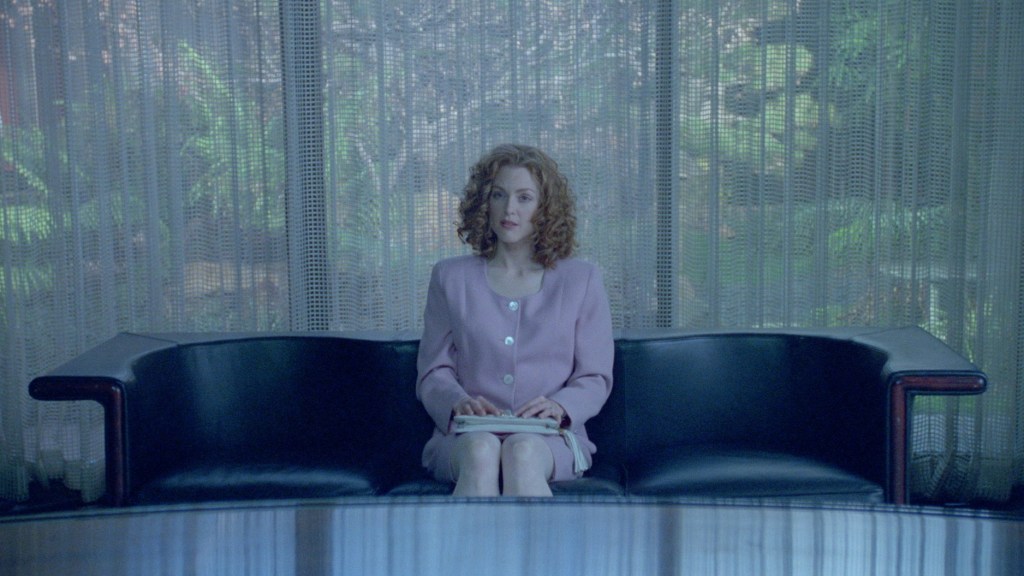
A third of the way into Todd Haynes’s 1995 film Safe, we follow its protagonist, Carol White (Julianne Moore), into a health movement gathering. In the lecture hall, a television screen displays the following question in block capitals: “ENVIRONMENTAL ILLNESS: ARE YOU ALLERGIC TO THE TWENTIETH CENTURY?” Over footage of white smoke billowing from industrial exhaust ducts, a male narrator intones with somber authority, “This is a disease you catch, from your environment.” The film then cuts abruptly to crawling traffic on a California freeway, the shot situated within Carol’s car as she drives home. The world described on TV becomes literalized in the world she must travel through.
For Carol, the gathering offers a plausible, if temporary, explanation of her symptoms: nosebleed, nausea, headache, general fatigue, etc. Her affliction could be environmental in origin, consistent with what is commonly known as multiple chemical sensitivity (MCS). It names the possibility that ordinary surroundings have become physiologically hostile. But if the environment is making her sick, where can she go to get well?
Safe explores this question through Carol’s journey from an affluent suburban home to a desert retreat devoted to environmental illness. Along the way, the pursuit of cure and safety becomes indistinguishable from the contraction of a life. What makes an environment habitable, and hospitable, for particular bodies? When do protection and enclosure sustain conditions for living, and when do these measures become a demand to withdraw from the world, or even another form of illness? French philosopher of science Georges Canguilhem’s account of health as a relationship between organism and milieu helps us approach these questions, without reducing Carol’s suffering to a definitive diagnosis. The film allows us to query what kind of community can recognize and validate vulnerability, and what happens when the tenet of community is built on fantasy of complete immunity.
Safe tells the story of Carol, an upper-middle-class housewife in the San Fernando Valley. Her escalating symptoms rupture her unremarkable routine: persistent fatigue after dancercise class, a nosebleed after hair perm, a coughing fit from inhaling engine exhaust, an acute aphasia at a baby shower, and delirium during dinner with her husband’s clients. Activities that should anchor her situatedness in domestic and social life instead rise up as hindrances against her.
The film’s enigma, its diegetic ambivalence towards diagnostic or curative resolution, is amplified by the proliferation of conjectures. Critics read it as an allegory for the AIDS crisis; the film’s 1987 setting places us squarely within the milieu of homophobic paranoia. Some consider Carol’s allergy an index of artificial substances that saturate our world with industrial toxicity. Others identify a psychosomatic cause: that she is suffocated by gendered expectations of homemaking. Still others find the existential conditions of Covid-19 the latest manifestation of Haynes’s prescience. Without settling on any particular diagnosis, I am interested in how these insights help us ask a different set of questions, shifting focus from etiology to a life lived under duress. The investigation of cause—be it psychic or somatic, social or ecological, individual or systemic—invites us to speculate on what we take to be the conditions and limits of living within different explanatory frameworks. When familiar places turn unpredictable, daily encounters impossible to endure, the question is how to recognize and accommodate the altered relationship Carol has with her surroundings.
For Canguilhem, the living organism is a dynamic center of evaluation within its milieu. Life is neither a “monotonous deduction” of the environment nor simply a reaction to external imposition. The living constitutes itself through contingent interactions with the material, historical, and social circumstances of its milieu, negotiating its “leaks, holes, escapes and unexpected resistances” (Normal 198). Life is “original,” not in the logical sense of temporal antecedant or invention, but in the vital sense that what counts as tolerable, favorable, or threatening depends on the particular life at stake—its sense, sensibility, and desire. For this reason, Canguilhem notes, “irregularity and anomaly are conceived not as accidents affecting an individual but as its very existence” (Knowledge 125).
This philosophy of life redefines the normal and the pathological in relation to individual life rather than population statistics. Viewed as a vital—not ontological—idea, health involves not just the absence of pathology or disease but an organism’s “latitude,” “a capacity to tolerate variations in norms . . . to overcome organic crises and to establish a new physiological order” (Canguilhem, Knowledge 132).
The film puts into sharper relief this distinction between the medical paradigm’s attempt to define norms and the lived reality of a sufferer. In the eyes of institutional medicine, Carol is a pathological anomaly. Her symptoms, although cinematically spectacular, are “just not showing up on the test,” her physician laments. Despite experiencing a shrunken normative latitude that limits what she can do, Carol remains statistically unintelligible to the prevailing clinical standards, failing even at being sick the “right” way.
The phenomenon of MCS, as Michelle Murphy writes, “made and marked a domain of supposed impossibility,” wherein sufferers were “abjected from biomedicine as a condition outside of ‘disease’—that is, as an invalid bodily state” (152). The film stages this predicament through the accumulating skepticism from Carol’s doctors and husband. We are conscripted to feel the impotence of the institutions—medical and patriarchal-familial—that have tasked themselves with verifying and conferring “truth.” Such an impasse drives Carol to the edge of abjection, which, as Murphy writes, designates not just corporeal abnormality but the impossible realm of a paradoxically “nonmaterial form of suffering” (153).

But abjection is not an automatic antithesis to community. MCS networks expose Carol to new knowledge and alternative communities. She finds validation in support groups and educational meetings, while investing in new practices of material subtraction. She eliminates potential synthetic irritants and moves into a sterile space within her home. Eventually she leaves for Wrenwood Center, a New Age “communal health settlement” in the New Mexico desert to search for an inhabitable place. There is nothing inherently contradictory in the logic of seeking protection and limiting exposure, in order to rebuild immunity and participate in the world. But the film prompts us to ask further: what happens when continued illness appears as evidence of inadequate protection? How far are we willing to go in search of complete safety?
Wrenwood presses on the defensive logic already present in Carol’s suburban life. Both promise to offer security by calibrating and managing surroundings in which undesirable interface might be eliminated. The serene appearance of the gated neighborhood, where affluent white families are shielded from racialized urban violence, obscures the labor of domestic workers of color that sustains it. Insulation from differences depends on selective curation of social and material relations.
But something has already crept inside. Carol falls asleep while TV reports on environmental degradation. At dinner, her stepson Rory delivers a school report on racialized gang violence in LA. Neglecting the report’s substance, Carol reacts to Rory’s descriptive language as an aesthetic provocation: “Why does it have to be so gory?” Rory grumbles: “Gory? That’s how it really is. God.” Carol’s objection concerns the form in which violence enters into the protected home and becomes perceptible to the psyche. Here the film’s generic form echoes its diegetic logic of exposure and safety. Rory’s gory description invokes the cinematic language of noir that “contaminates” the film’s stylistic guise as a melodrama. In an analysis of the melodramatic citation in Haynes’s films, Mary Ann Doane notes that Carol embodies “at once the conflicted woman of melodrama and the infected, aberrant, diseased other, evidence of the inevitable failure of the contemporary obsession with the self.” She signals not just the site of social contradiction, but the impossibility of being with oneself, of accommodating the shifting terms of one’s existential conditions. In a Canguilhemian gesture, Doane continues, “Pathology is only possible . . . when viewed by those who cling to their status as normal” (17).
Wrenwood offers a vision of protection at its extreme. Its therapeutic philosophy, as Haynes notes, places the responsibility of well-being squarely on the individual (Roth). Symptoms become a matter of will, and healing comes from fixing the attitude. Self-love promises to repair what medicine cannot. Wrenwood initially provides Carol with recognition and acceptance that have been denied elsewhere, quickly supplying her with a shared language of inner transformation that psychologizes crisis, while directing the work of healing inward. Carol acquires this excessive vocabulary of self-love, which merely appears to compensate for her narrowing physical and social milieu. Her body continues to deteriorate despite repeated declarations of self-love. Eventually she moves into a bare, igloo-like building by herself; even the air she breathes is supplied by her portable oxygen tank.
In the final scene, Carol removes her oxygen mask and recites “I love you. I really love you. I love you” into her pallid reflection in the mirror. Writing during the Covid pandemic, Emily Apter argues that this version of self-love “doubles as a death of the social,” “an apotheosis of the bourgeois private and endpoint of social distancing.” Whether the utterance brings comfort remains unresolved. But the smallness of the life it now permits leaves us with the horrifying image of isolation shared between Carol and her reflection. If Canguilhem’s account of life helps us understand disease as a reminder of life’s precarity, the film also tasks us with imagining care and community that acknowledge the need for protection without foreclosing the possibilities for encounter, change, and shared life.
Works Cited
Apter, Emily. “Live Free or Die? Psychopolitical Infrastructures of Denialism.” e-flux Architecture, June 2022, www.e-flux.com/architecture/sick-architecture/471538/live-free-or-die-psychopolitical-infrastructures-of-denialism. e-flux.com
Canguilhem, Georges. Knowledge of Life. Translated by Stefanos Geroulanos and Daniela Ginsburg, edited by Paola Marrati and Todd Meyers, Fordham UP, 2008.
———. The Normal and the Pathological. Translated by Carolyn R. Fawcett in collaboration with Robert S. Cohen, Zone Books, 1989.
Doane, Mary Ann. “Pathos and Pathology: The Cinema of Todd Haynes.” Camera Obscura: Feminism, Culture, and Media Studies, vol. 19, no. 3 (57), 2004, pp. 1–21.
Murphy, Michelle. Sick Building Syndrome and the Problem of Uncertainty: Environmental Politics, Technoscience, and Women Workers. Duke UP, 2006.
Roth, David. “Todd Haynes’s Masterpiece Safe Is Now a Tale of Two Plagues.” The New Yorker, 28 Mar. 2020, www.newyorker.com/culture/culture-desk/todd-hayness-masterpiece-safe-is-now-a-tale-of-two-plagues.
Safe. Directed by Todd Haynes, Sony Pictures Classics, 1995.
Cover Image
Film still from Todd Haynes, Safe (1995).