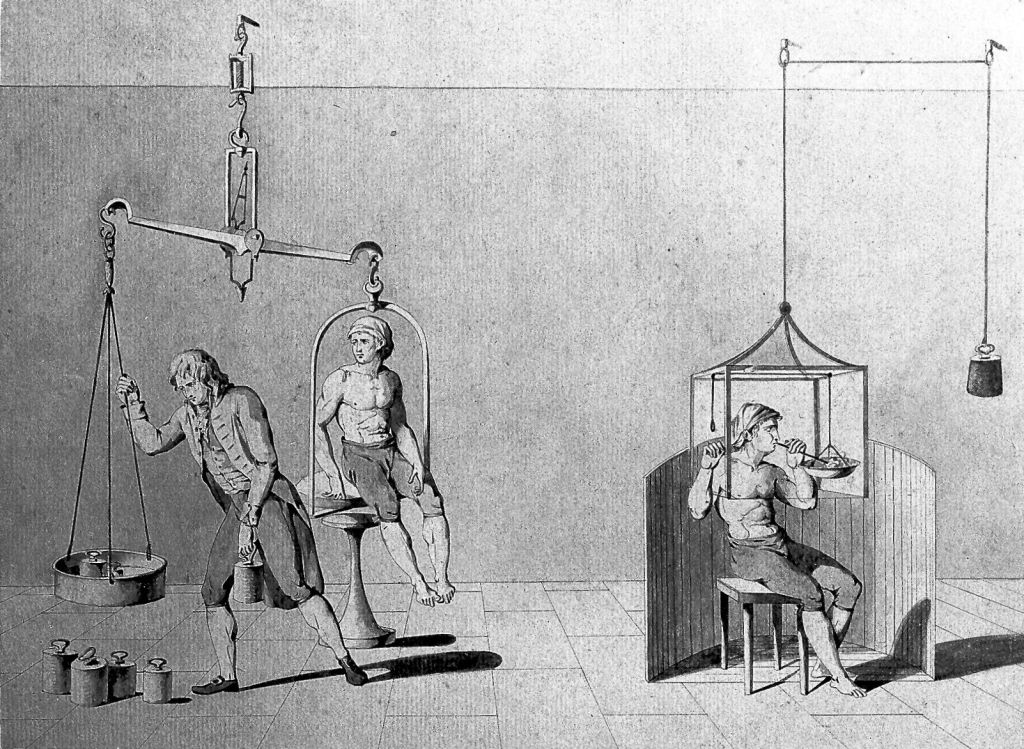
Experiments in respiratory ventilation have evolved over centuries, progressing from crude and sometimes deadly devices to complex machines now integrated into intensive hospital care over the world. It was not until c.1900 that respirators became reproducible, commercial machines. Positive-pressure ventilation, pushing air into the lungs (by manual means or magnets or motors) , would not establish itself as a reliable mode of breathing assistance until later into the twentieth century. The methods and approaches for controlling respiration with a ventilator multiplied again when researchers began to experiment with ventilation processes that collaborate with physiological respiratory controls. Up to around 1960, a ventilated patient and their ventilator were bound to the same respiratory program; a ventilator was a device designed to deliver breath according to a pre-determined value (time, volume, pressure). These are now called “mandatory breaths.” As the mechanics developed, ventilators progressed from “controllers” to “assistors” (Branson 16), with the ability to accommodate a patient’s own breathing effort. This is called “spontaneous breath.” With the shift to mechanical assistance over control, ventilation took on a different set of terms—ones now linked more closely to the person being ventilated and their breathing experience. Since ventilators became capable of assistive ventilation modes, where patients are able to trigger the ventilator and take spontaneous breaths while on ventilator support, patient-ventilator synchrony continues to be a point of discussion for physicians. There are risks to both mandatory (mechanically-controlled) and spontaneous (patient-controlled) breaths on a ventilator, and these risks must be negotiated ongoingly to restore breath’s possibility.
The difficulty of reconciling control modes and methods around a patient’s spontaneous effort is illustrated in the following published conference exchange about patient-ventilator interactions, where Robert Kacmarek and Magdy Younes, both physicians with established expertise in mechanical respiration, consider that sometimes, a patient’s breathing will contradict a clinical instinct.
[Robert] Kacmarek: But […] how do we know we’re right and the patient’s wrong? Maybe we should let the patient breathe 40–50 times a minute. That’s what the patient’s brain is telling them to do, and I don’t think we have really good evidence to say our taking over and sedating and paralyzing that patient is better than letting the patient assume a ventilatory pattern with appropriate assistance and good synchrony that their neurocontrol says is the best for them.
[Magdy] Younes: I fully agree with Bob. […]
I have weaned many patients who were deemed unweanable because every time you drop the pressure support the ventilator rate goes up from 20 to 40. They say the patient is unweanable. Then you put them on a synchronous mode and they are very comfortable and you can wean them.
We just have to accept the fact that in some cases the respiratory rate is 40 or more and it’s not going to hurt them, because this is what they want and are comfortable with… (qtd in Branson 23)
Kacmarek and Younes highlight that the physiological standards typically used to set ventilator controls must be understood as guidelines should a patient’s physiology indicate that they can breathe comfortably at a different standard (in this case, for respiratory rate). The ratio of mandatory breaths and spontaneous breaths therefore requires a routine analysis of risk relative to the patient’s time spent on a ventilator, the status of their respiratory system, and, critically, their experience breathing with it. The science, then, is not steadfast—how it feels to breathe, and individual dynamics between the brain and the lungs and the rest of the body, matters for mechanical supports for breath. The safety of control mechanisms for breath improves with a more complex understanding of the variance across breathers and their lived physiology. There are benefits and detriments to letting go of control of a patient’s breath, but one thing is for certain: when the aim is for a patient to wean from a ventilator, they must be allowed to try to breathe.
This is, essentially, an aesthetic argument, one that suggests that what we know about respiration is not enough to facilitate safe ventilation; what we know must always be contextualized with lived experience, that point at which breathing exceeds its science. I am not a physician; I write from the perspective of a humanities mutt, having trained in the arts, history of science, and critical race and gender theory. While I am certain ventilation techniques and modes have continued to advance and expand since the discussion quoted above, and correspondingly, attitudes about interactions between patients and ventilators have advanced and expanded in concert, I see an understanding of breath contained in Kacmarek’s and Younes’ insights that presents a vital meeting point for medicine and the humanities. This is an understanding that values how breath (and ventilation) is lived, equal to or above how its living has been standardized by those who own the rights to distribute and use these machines. It authorizes a way of practicing ventilation that destabilizes respiratory authority without dismissing knowledge and expertise. Who gets to decide what a good breath feels like? And who is enabled to claim and act within their own model for good breathing? These are questions that demand answers across disciplines, particularly as breathing emergencies grow exponentially alongside the devastating and unevenly felt effects of our changing climate.
Making patient feedback mechanically permissible prompts a shift in thinking about the desired outcomes in ventilation, to make a place for experience-based data. What might be possible if those designing, building, and practicing with ventilators elevated patient experience to an aesthetic register—not only accounting for physiological variance from a respiratory norm (as in the example above), but for physiology’s expression as a body that lives as and through its difference? I am trying to trace the boundary between “how it feels to breathe with a ventilator” and “how it feels to breathe with a ventilator, in a particular body, in a particular hospital and health care system, in a particular political climate, in the 2020s” Is there a world where the medically determined domain of respiration can come into greater alignment with that much more nuanced process, breath, in all its social and political significance? This is not a question any one person can hope to answer, but I like to imagine what could be possible if the answer was yes.
Works Cited
Branson, Richard. “Patient-Ventilator Interaction: The Last 40 Years.” Respiratory Care vol. 56, no. 1, 2011, pp. 15-24.
Image Credit
A man being weighed on a set of scales, and a man with his head in a glass container; showing Lavoisier’s experiments with respiration. Drawing attributed to M.A.P. Lavoisier, ca. 1790. Wellcome Collection. Source: Wellcome Collection.